Simple neural network diagram tool
Make professional neural network diagrams using free symbols and templates in EdrawMax, an intutive diagramming tool friendly to beginners.

Why Use EdrawMax Neural Network Diagram Maker?
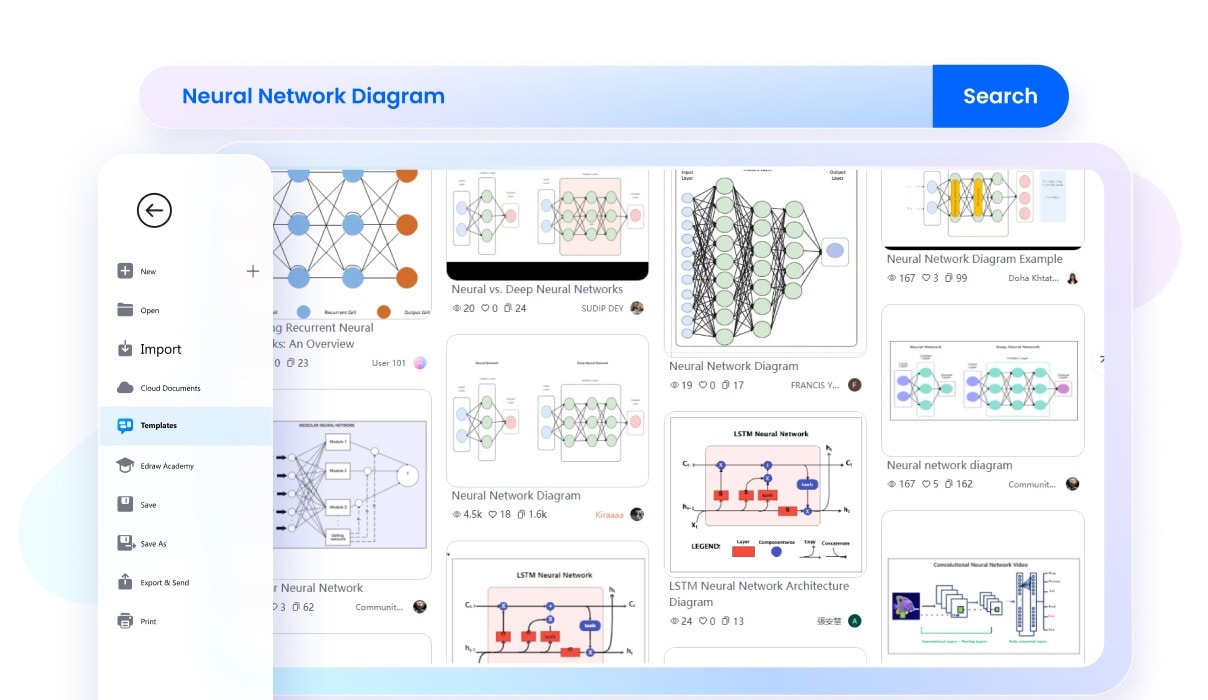
Don’t know where to start? Take a look through our built-in library of templates, providing unique ideas for all types of diagrams and designs. Start quickly by picking a template and making the required customizations, saving you time and effort!
EdrawMax is incredibly accessible thanks to its support for all major platforms, including Windows, MacOS, and Linux. If that’s not enough, it also has a web version. So, you can use it anywhere, anytime without any hassle!

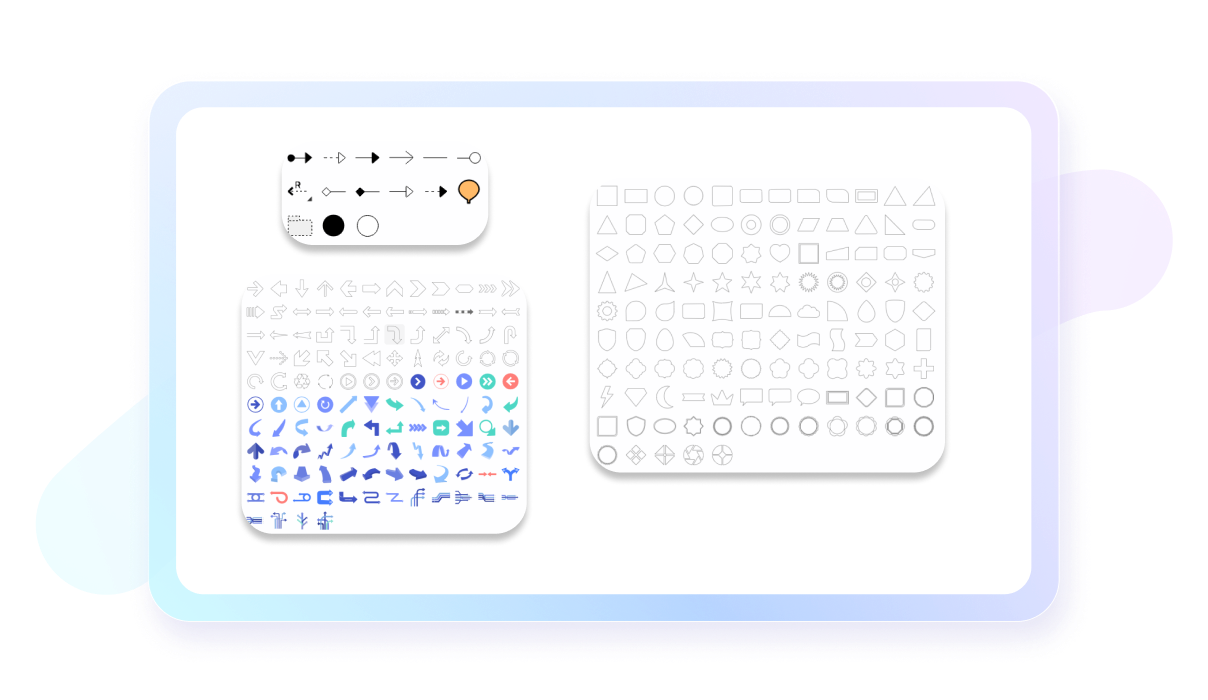
Make your diagrams more engaging and detailed by utilizing our vast collection comprising over 26,000 symbols. Explore and pick the ones that fit perfectly in your diagrams. Simply drag and drop them into your drawings to make your designs stand out from the crowd.
Are you ready to save your diagram on your device? Try out 10+ different format options in EdrawMax, ranging from Word, PPT, JPG, and Visio, to PNG, PDF, and SVG. Select any format you want, export the file, and share it with the world!

How to Make a Neural Network Diagram in 3 Simple Steps


What our users say

More Neural Network Tools
Discover more AI-powered diagram makers to boost your productivity.
FAQs About EdrawMax Neural Network Diagram Tools
-
What is a neural network diagram?A neural network diagram is a visual representation of an artificial intelligence model's structure. It typically uses circles to represent individual neurons and lines to show the connections between them. These diagrams help researchers and developers visualize how data flows through the system from the input stage to the final output.
-
What do the input, hidden, and output layers represent?In a diagram, the input layer receives raw data, while the output layer provides the final prediction. The hidden layers sit in between, performing complex mathematical transformations. Visualizing these layers helps you understand the depth of the model and how it processes information through various stages of abstraction and learning.
-
What is the significance of the arrows between nodes?The arrows, or edges, represent the flow of information and the mathematical weights assigned to each connection. In a diagram, these lines indicate how data from one neuron influences another. They illustrate the strength of relationships within the network, which the model adjusts during training to improve its overall accuracy.
-
What do the circles in a neural network diagram represent?In these diagrams, the circles or nodes represent individual neurons, which are the basic processing units of the network. Each node receives inputs, performs a mathematical calculation—usually involving weights and an activation function—and then passes the resulting signal to the next layer in the sequence to facilitate the learning process.
-
Can a diagram show different types of neural networks?Yes, diagrams can represent various architectures like Convolutional Neural Networks or Recurrent Neural Networks. While basic diagrams use simple circles and lines, specialized diagrams might include symbols for pooling layers, filters, or feedback loops. These variations help distinguish the specific mathematical approach used to solve different types of problems.
Stop drawing. Start describing.
AI diagramming isn't just text-to-diagram.
AI now understands any input, fetches live data, adapts through dialogue, and works everywhere.
 (AI & Web)
Free neural network diagram templates from EdrawMax