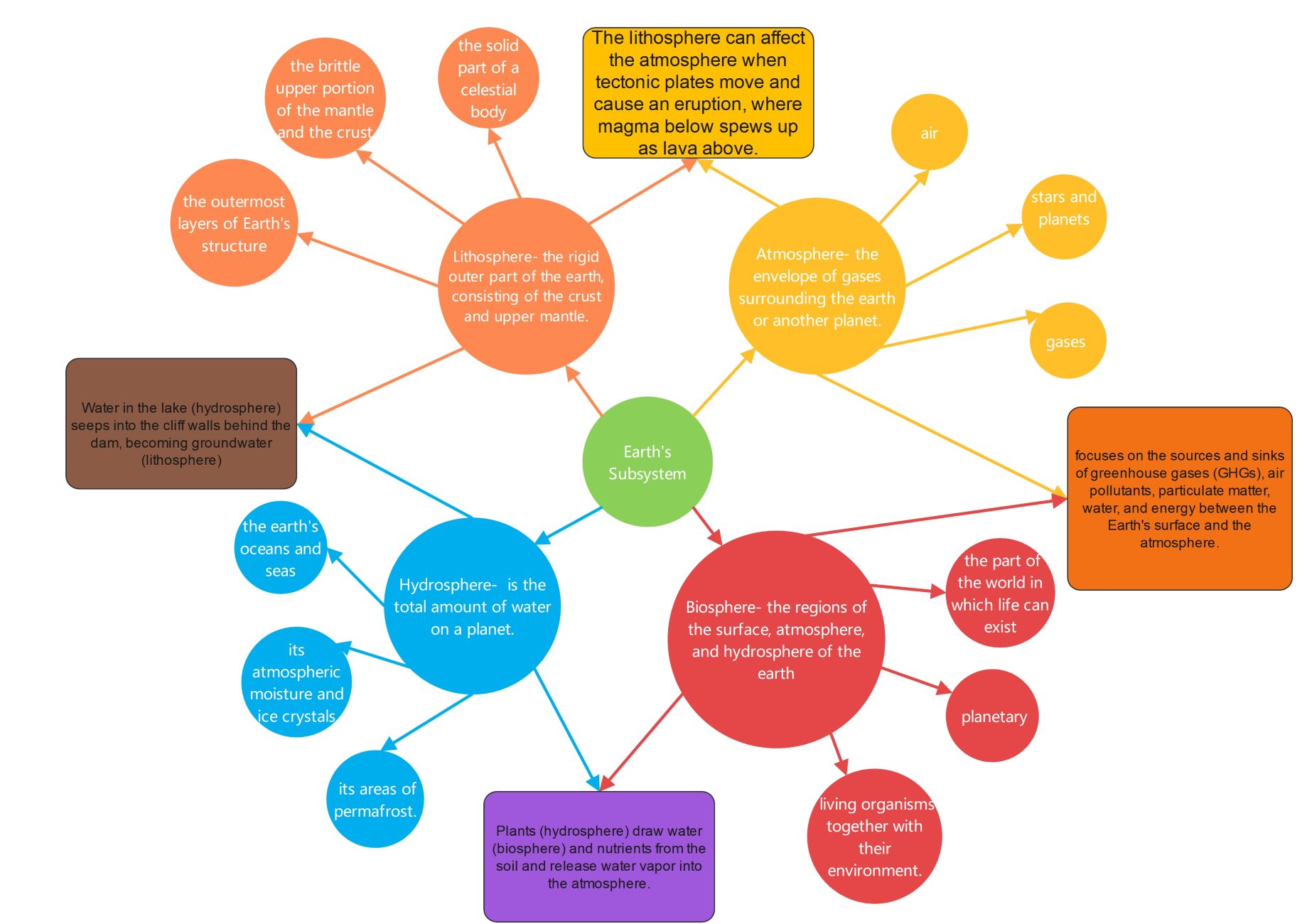
About this Earth Subsystem Concept Map template
This template provides a clear visual breakdown of Earth's four primary spheres. Use it to understand how land, air, water, and life interact within a unified global system. It is perfect for geography students, teachers, or environmental science researchers.
Lithosphere
The lithosphere represents the rigid outer shell of our planet, including the crust and upper mantle. It provides the solid foundation for all terrestrial life and contains essential minerals and landforms shaped by tectonic forces.
- Brittle upper portion of mantle and crust
- The solid part of a celestial body
- Outermost layers of Earth's structure
- Tectonic plate movement affecting atmosphere
Atmosphere
The atmosphere is the protective envelope of gases surrounding Earth. It regulates the climate, provides oxygen for breathing, and shields the surface from solar radiation. This layer is essential for sustaining life across the entire globe.
- The air surrounding the planet
- Stars and planets visibility
- Gaseous composition and layers
- Interaction with the greenhouse effect
Hydrosphere
The hydrosphere encompasses all the water on Earth in various forms like liquid, ice, and vapor. It moves through a continuous cycle, influencing weather patterns and providing the hydration necessary for all living organisms to survive.
- Earth's oceans and seas
- Atmospheric moisture and ice crystals
- Areas of permafrost
- Groundwater interaction with lithosphere
Biosphere
The biosphere includes all regions of the Earth where life exists, spanning the surface, atmosphere, and water. It focuses on how organisms interact with their environment and how nutrients and energy flow through the planetary system.
- Regions where life can exist
- Living organisms and their environment
- Sources and sinks of greenhouse gases
- Plant interaction with hydrosphere and atmosphere
FAQs about this Template
-
How do Earth's subsystems interact with each other?
Earth’s subsystems do not exist in isolation; they constantly exchange matter and energy. For example, the lithosphere provides soil for the biosphere, while the hydrosphere provides necessary water. The atmosphere regulates temperatures for all living things. When these systems interact, they create a balanced environment. Understanding these connections is vital for studying environmental science and how natural cycles impact our planet's health.
-
Why is the lithosphere important to the other spheres?
The lithosphere serves as the physical foundation for the other spheres. It provides the solid ground for the biosphere and acts as a reservoir for nutrients. Volcanic activity within the lithosphere releases gases into the atmosphere, which influences climate. Additionally, landforms like mountains affect weather patterns and water distribution in the hydrosphere. Without a stable lithosphere, the other subsystems could not function properly.
-
What role does the biosphere play in the Earth system?
The biosphere is the biological component of the Earth system. It includes all living organisms that interact with the air, water, and land. Plants in the biosphere absorb carbon dioxide from the atmosphere and release oxygen through photosynthesis. They also draw water from the hydrosphere and nutrients from the lithosphere. This interaction maintains the chemical balance of the planet and supports life-sustaining cycles.

 (AI & Web)