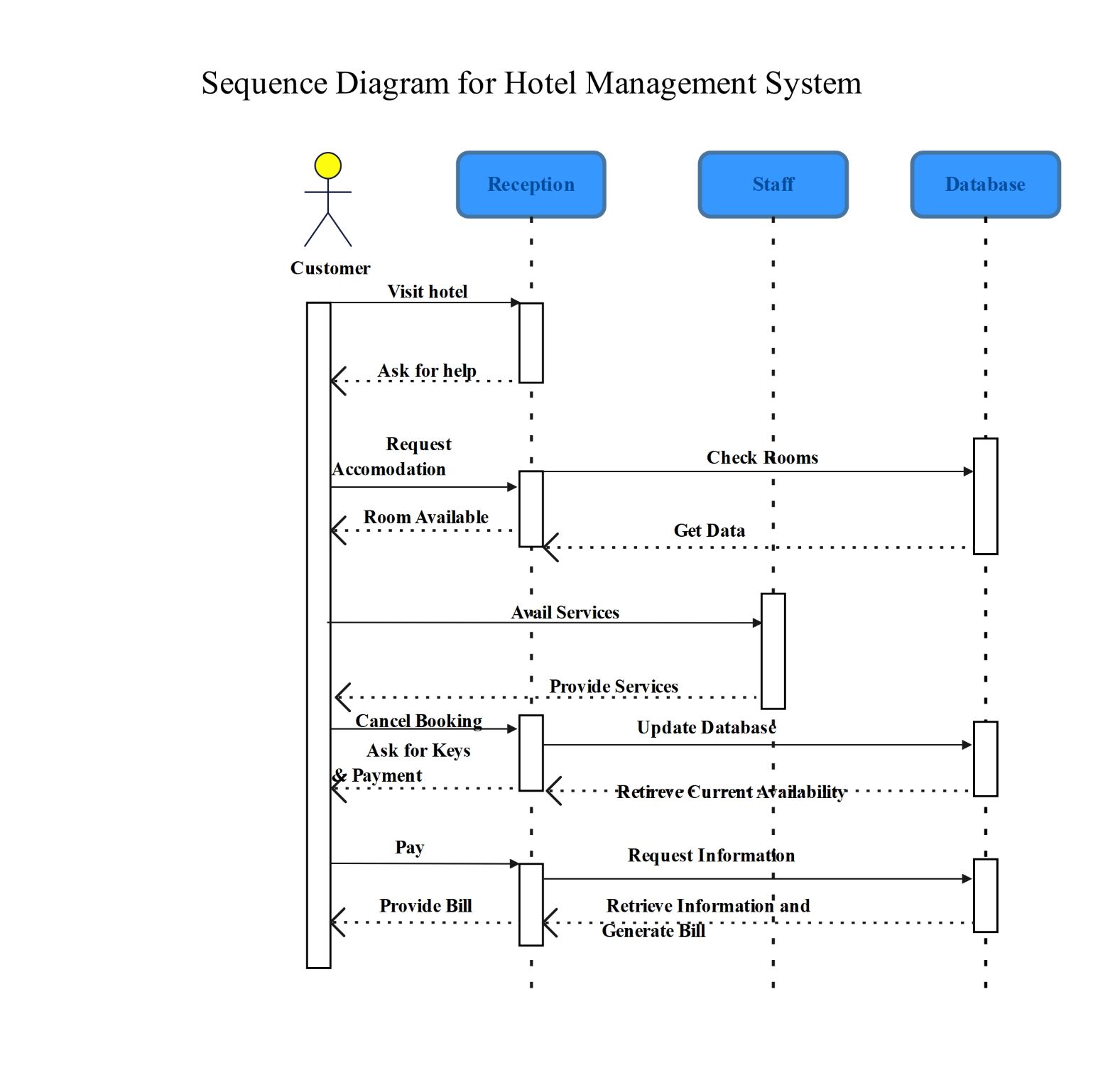
About this UML Sequence Diagram for Hotel Management System template
This professional template illustrates the step-by-step process of hotel operations. It tracks how a customer interacts with reception, staff, and back-end systems to ensure a smooth stay from arrival to the final billing stage.
Customer Interactions
The customer acts as the primary user initiating the workflow within the system. They engage with reception for booking and staff for services. This section outlines the initial requests and the eventual payment process for the stay.
- Visit hotel and ask for help
- Request accommodation availability
- Avail various hotel services
- Cancel booking if necessary
- Complete payment and receive final bill
Reception and Database Logic
The reception acts as the central hub connecting guests to the internal database. This node handles data retrieval for room availability and updates the system records. It ensures that information is accurate and bills are generated correctly.
- Check room availability in the database
- Update records upon booking or cancellation
- Retrieve current availability status
- Request information for bill generation
- Generate and provide bill to the guest
Staff and Service Delivery
Staff members handle the physical services requested by the customer during their stay. This interaction is direct and ensures that guest needs are met promptly. It represents the operational side of the management system beyond data processing.
- Receive requests for specific services
- Provide services directly to the customer
- Communicate service completion status
FAQs about this Template
-
Why use a sequence diagram for hotel management?
A sequence diagram provides a clear visual timeline of how guests interact with hotel resources. It helps system designers identify potential bottlenecks in the booking or check-out process. By mapping these events, hotels can optimize staff roles and ensure the database remains updated. This clarity reduces errors during high-traffic periods and improves the overall efficiency of the management system.
-
What roles are essential in this UML diagram?
The essential roles include the Customer, Reception, Staff, and the Database. The Customer initiates the process, while Reception handles the business logic and communication. Staff members are responsible for service delivery, and the Database stores critical information like room availability and billing data. Each role is crucial for maintaining a seamless workflow and ensuring that guest requests are fulfilled correctly.
-
How does the database interaction work here?
In this system, the database is queried by the Reception to verify room availability and retrieve guest information. Whenever a booking is made or canceled, the Reception sends an update request to the database. Finally, when the guest checks out, the database provides the necessary details to generate an accurate bill, ensuring that all financial records are precise and up-to-date.



 (AI & Web)