About this Network Diagram for Network Redundancy template
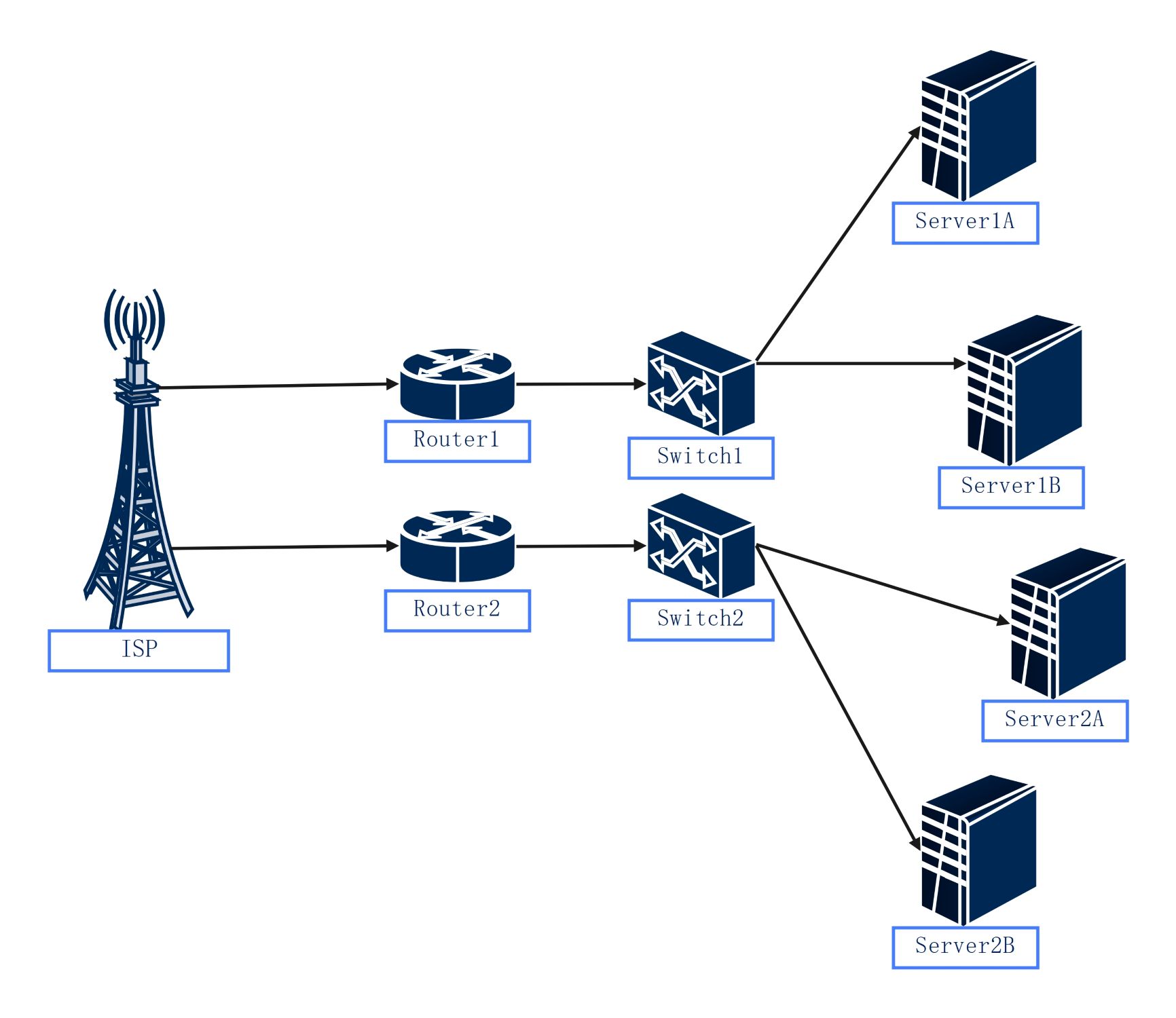
This template showcases a robust redundancy model designed for high availability. It uses parallel hardware paths to ensure that internet connectivity and server access remain uninterrupted. Network engineers can use this layout to plan failover strategies and improve system reliability for any professional IT environment.
Internet Service Provider
The Internet Service Provider represents the external connection to the global web. In this redundant layout, the ISP feeds into two separate hardware paths. This ensures that a single router failure does not disconnect the internal network.
- External Connectivity Source
- Dual Data Feed Architecture
- Primary Gateway Point
Redundant Routers
Router 1 and Router 2 operate in parallel to manage data traffic. If one router experiences a hardware fault, the other takes over instantly. This dual-router setup is the foundation of a high-availability network architecture.
- Parallel Path Management
- Hardware Failover Capability
- Traffic Load Balancing
Network Switches
Switches distribute data from the routers to individual server units. Having Switch 1 and Switch 2 creates secondary paths for internal communication. This setup protects the network from localized hardware failures at the distribution layer.
- Data Distribution Layer
- Switch Redundancy
- Secondary Communication Path
Server Infrastructure
The servers are grouped to ensure that applications remain accessible at all times. Server 1A and 1B provide redundancy for their group, while 2A and 2B do the same. This keeps your data safe and available.
- Server Grouping for 1A and 1B
- Server Grouping for 2A and 2B
- Application High Availability
- Data Storage Redundancy
FAQs about this Template
-
What is the primary benefit of network redundancy for businesses?
The main benefit is business continuity during a hardware failure. Redundancy allows your network to switch to a backup path automatically without interrupting service. This prevents lost revenue and protects your brand reputation. By avoiding downtime, you ensure that employees stay productive and customers can always access your digital services. It acts as an essential insurance policy for modern IT.
-
How do redundant routers improve overall system reliability?
Redundant routers eliminate the single point of failure problem in a network. In a standard setup, if the only router breaks, everyone loses internet access. With dual routers, protocols like VRRP allow a standby device to take over the traffic immediately. This transition is usually so fast that users do not notice any lag. It ensures stable connectivity for all critical business operations.
-
Is it expensive to set up the network redundancy shown here?
Implementing redundancy requires buying extra hardware, which increases initial costs. However, the cost of a single hour of downtime often exceeds the price of a second router or switch. For small to medium businesses, this investment pays for itself by preventing financial losses during outages. It provides a more stable environment for scaling your operations and handling higher traffic loads safely.


 (AI & Web)