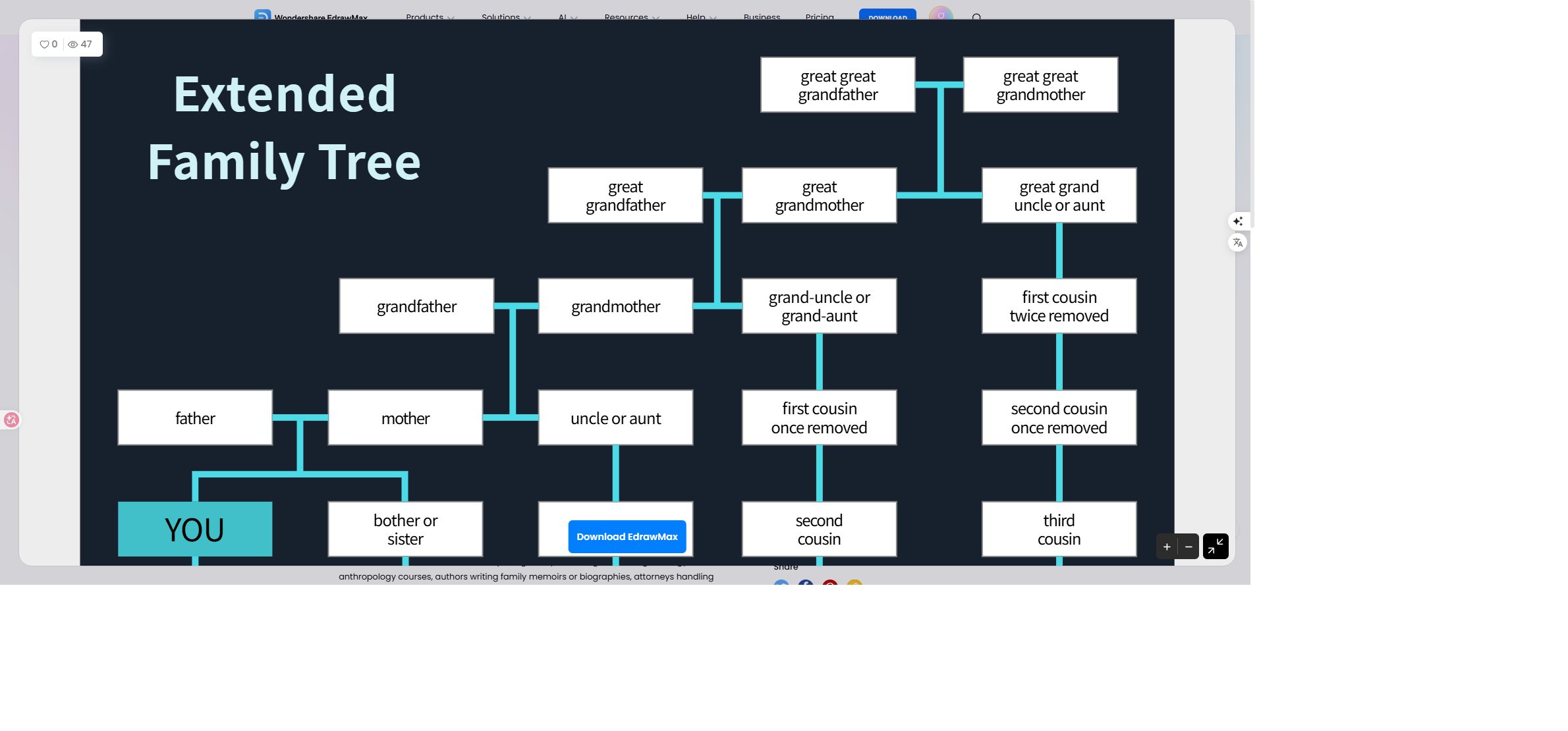
About The Extended Family Tree Multi-Generational Genogram
Map complex kinship connections across generations with this extended family tree genogram designed for genealogy, research, and relationship documentation.
Visible Structure
The diagram is built from labeled elements such as cousin relationships, generation layers, and kinship terminology. Those labels are the clearest guide to what the image is actually showing and why this specific template differs from another diagram in the same broad category.
How the Elements Work Together
The value of the template comes from the way those visible elements are arranged in relation to one another. That visual relationship helps readers interpret complex kinship connections across multiple generations more quickly than a flat list or isolated caption would.
Practical Use
Once the labels and structure are read together, the template can support genealogy research, ancestry documentation, and family relationship mapping. It is especially useful for genealogists, family historians, and students who need an editable starting point rather than a blank canvas.
FAQs about this Template
-
What does this extended family tree multi generational genogram help explain?
This extended family tree multi generational genogram helps explain the topic through visible labeled elements and their arrangement in the diagram. Instead of depending on one short title, the image gives readers a clearer way to understand complex kinship connections across multiple generations.
-
Why do visible labels matter on a diagram like this?
Visible labels turn shapes into meaning. They show what the parts represent and make the structure easier to interpret, especially when the topic would otherwise be too abstract, too technical, or too broad to explain clearly through layout alone.
-
How should someone read a diagram when the topic is unfamiliar?
A good approach is to start with the largest or most central labels and then move outward to supporting elements such as cousin relationships, generation layers, and kinship terminology. That reading order helps the viewer understand the structure first, which makes smaller details easier to interpret later in the context of the whole image.
-
When is a labeled template more useful than a plain illustration?
A labeled template is more useful when the reader needs to understand not only what the topic is, but also how its parts are organized or related. For this family genogram, labels create a bridge between visual structure and explanation, which makes the image more practical for genealogy research, ancestry documentation, and family relationship mapping.
-
What should be checked before reusing or publishing this template?
Before reusing the template, the editor should confirm that the labels, structure, and topic framing still match the intended use. That check matters because even a visually clear template can become misleading if the visible elements are left outdated or are interpreted in the wrong context.

 (AI & Web)