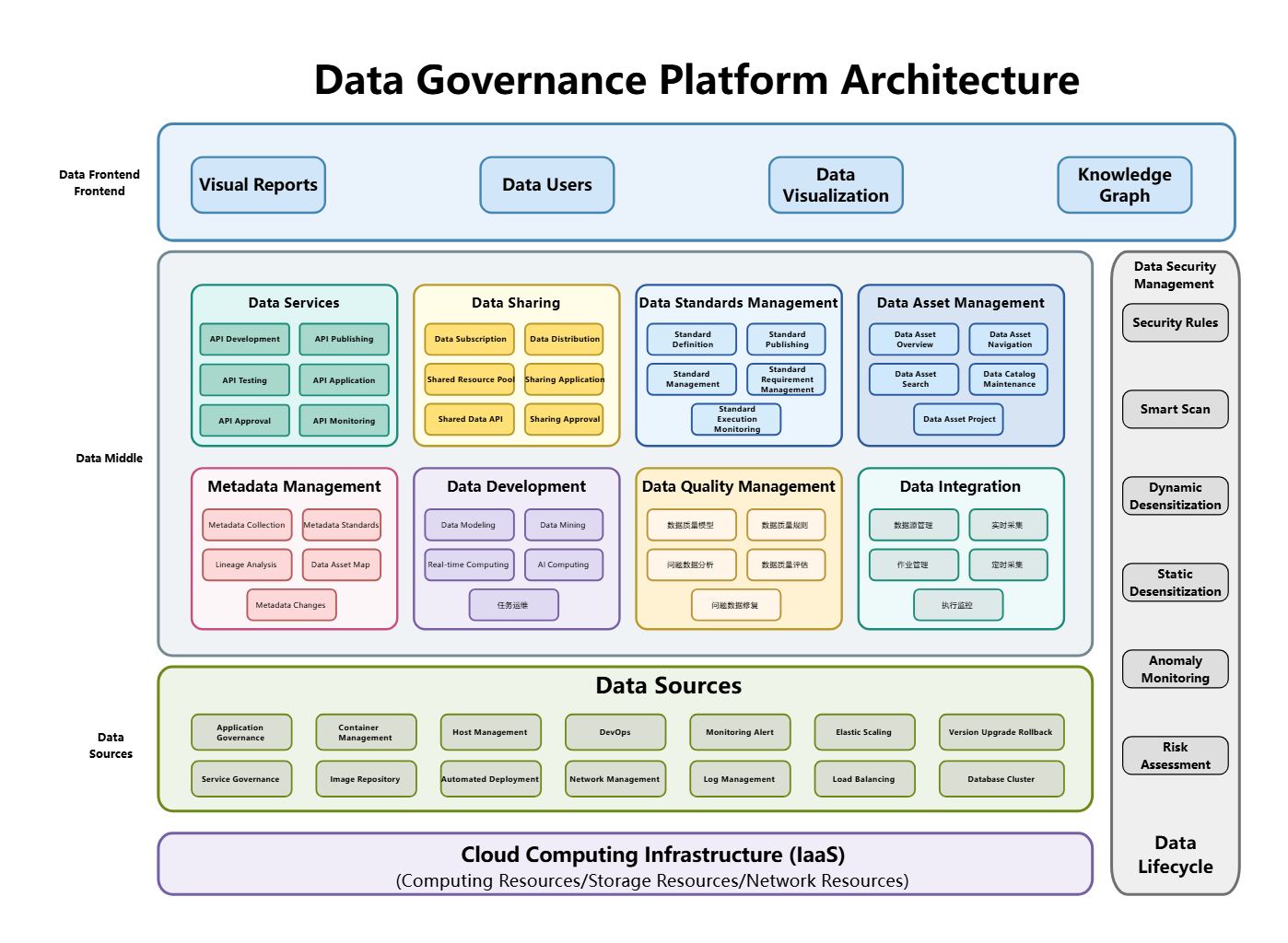
About this Data Management And Security Architecture
This diagram shows data management and security architecture in a clearer structure, so the main layers or modules are easier to explain.
Frontend and Consumption
The Frontend and Consumption section marks one visible part of the architecture. In this diagram, it includes Visual Reports, Data Users, Data Visualization, Knowledge Graph, so the section reads as a specific functional block rather than a generic label.
- Visual Reports
- Data Users
- Data Visualization
- Knowledge Graph
Service and Governance Functions
The Service and Governance Functions section marks one visible part of the architecture. In this diagram, it includes Data Services, Data Sharing, Data Standards Management, Data Asset Management, so the section reads as a specific functional block rather than a generic label.
- Data Services
- Data Sharing
- Data Standards Management
- Data Asset Management
- API Development
- API Publishing
- Data Subscription
- Data Distribution
Data Middle Platform
The Data Middle Platform section marks one visible part of the architecture. In this diagram, it includes Metadata Management, Data Development, Data Quality Management, Data Integration, so the section reads as a specific functional block rather than a generic label.
- Metadata Management
- Data Development
- Data Quality Management
- Data Integration
- Lineage Analysis
- Data Modeling
- Real-time Computing
- AI Computing
- Data Sources
Security and Risk Controls
The Security and Risk Controls section marks one visible part of the architecture. In this diagram, it includes Data Security Management, Security Rules, Smart Scan, Dynamic Desensitization, so the section reads as a specific functional block rather than a generic label.
- Data Security Management
- Security Rules
- Smart Scan
- Dynamic Desensitization
- Static Desensitization
- Anomaly Monitoring
- Risk Assessment
- Data Lifecycle
Platform and Infrastructure Support
The Platform and Infrastructure Support section marks one visible part of the architecture. In this diagram, it includes Application Governance, Service Governance, Container Management, Automated Deployment, so the section reads as a specific functional block rather than a generic label.
- Application Governance
- Service Governance
- Container Management
- Automated Deployment
- Monitoring Alert
- Load Balancing
- Database Cluster
- Cloud Computing Infrastructure (IaaS)
FAQs about this Template
-
How do teams visualize Data Management And Security Architecture AI architecture?
Teams usually visualize Data Management And Security Architecture AI architecture with a diagram that separates input flow, model processing, orchestration, and supporting data or control layers. This makes it easier to review how requests move through sections such as Frontend and Consumption, Service and Governance Functions, and Data Middle Platform, and where inference, retrieval, feedback, external integrations, or support logic fit in the workflow.
-
Can AI generate Data Management And Security Architecture architecture diagrams automatically?
Yes, AI can generate a first draft of a Data Management And Security Architecture architecture diagram, but it still needs human review. AI is useful for proposing flow structure and major groupings, while engineers should validate the real model pipeline, data dependencies, security boundaries, tool integrations, and support assumptions before using the diagram in delivery or technical review.
-
What is the difference between AI architecture and application architecture?
AI architecture focuses more directly on model flow, inference logic, retrieval, orchestration, and feedback loops, while application architecture describes broader software structure. AI diagrams are more useful when teams need to explain how prompts, data, models, outputs, support services, and control layers connect inside an intelligent system or agent workflow.
-
What should a Data Management And Security Architecture AI architecture diagram include?
A strong Data Management And Security Architecture AI architecture diagram should include the main inputs, model or agent layer, data or retrieval sources, and the core output path. It should also show where orchestration, monitoring, external tools, feedback loops, or support controls connect, so readers can understand the real processing flow instead of seeing only isolated technical blocks.
-
Which diagram type is best for documenting AI workflows?
An architecture diagram is usually the best place to start because it shows the main workflow, dependencies, and support layers in one view. Teams often add sequence, agent flow, or data pipeline diagrams later when they need to explain prompt handling, retrieval order, model interaction, operations detail, or escalation paths more precisely.

 (AI & Web)