




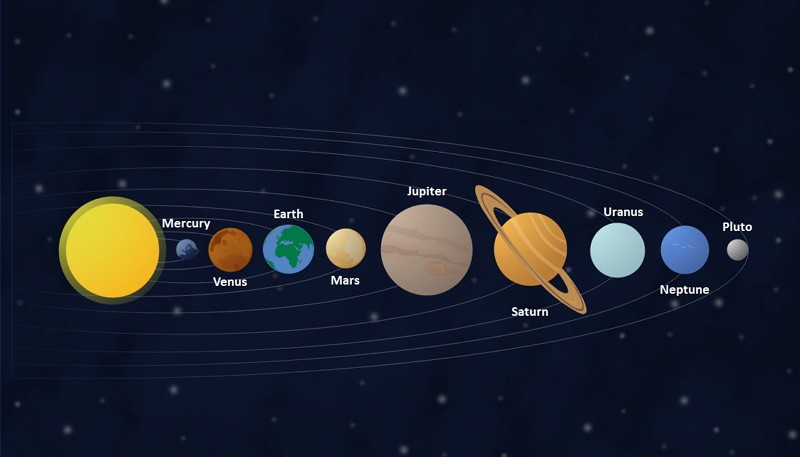
Our solar system consists of the Sun and the objects gravitationally bound to it. According to NASA Solar System Exploration, it has eight planets and five officially recognized dwarf planets, along with moons, asteroids, comets, and other small bodies. The planets, in order from the Sun, are Mercury, Venus, Earth, Mars, Jupiter, Saturn, Uranus, and Neptune.
Planet order from the Sun: Mercury → Venus → Earth → Mars → Jupiter → Saturn → Uranus → Neptune. For a labeled solar system diagram, this order is the first thing to verify before adding orbits, the asteroid belt, dwarf planets, or other objects.
A solar system diagram is useful for showing order and broad structure, but most classroom diagrams are not drawn to scale. The real differences in planet size and orbital distance are too large to fit conveniently on a single page.
In this article
1. What Is in the Solar System?
The Sun is the star at the center of our planetary system and accounts for about 99.8% of the solar system's mass. Most of the remaining mass is concentrated in the planets, especially Jupiter and Saturn. The solar system formed about 4.6 billion years ago from a cloud of gas and dust.
The system is often discussed in broad regions. The four inner planets—Mercury, Venus, Earth, and Mars—are rocky terrestrial planets. Farther out are Jupiter and Saturn, the gas giants, followed by Uranus and Neptune, the ice giants. Beyond Neptune lies the Kuiper Belt, a region containing icy bodies including Pluto and other dwarf planets.
At a glance: The solar system has eight planets in this order from the Sun: Mercury, Venus, Earth, Mars, Jupiter, Saturn, Uranus, and Neptune. The first four are terrestrial planets; Jupiter and Saturn are gas giants; Uranus and Neptune are ice giants. NASA also recognizes five dwarf planets, and Ceres lies in the main asteroid belt between Mars and Jupiter.
2. What Are the Eight Planets in Order?
| Order | Planet | Type | Quick fact |
|---|---|---|---|
| 1 | Mercury | Terrestrial | Smallest planet and closest to the Sun |
| 2 | Venus | Terrestrial | Hottest planetary surface because of its dense greenhouse atmosphere |
| 3 | Earth | Terrestrial | Only world currently known to support life |
| 4 | Mars | Terrestrial | Iron minerals give much of its surface a reddish appearance |
| 5 | Jupiter | Gas giant | Largest planet in the solar system |
| 6 | Saturn | Gas giant | Known for its extensive ring system |
| 7 | Uranus | Ice giant | Rotates with an extreme axial tilt |
| 8 | Neptune | Ice giant | Farthest major planet from the Sun |
Moon discoveries and confirmations continue, so total moon counts can change over time. For a classroom diagram, focus on the eight planets and major regions unless you are using a dated source for current moon totals.
3. What Other Objects Are in the Solar System?
Dwarf Planets
NASA lists five officially recognized dwarf planets: Ceres, Pluto, Haumea, Makemake, and Eris. Ceres is the largest object in the asteroid belt between Mars and Jupiter and the only dwarf planet in the inner solar system. Pluto, Haumea, and Makemake are associated with the Kuiper Belt region, while Eris is a distant dwarf planet in the scattered disk.
Asteroids
Asteroids are rocky or metallic small bodies. Many orbit in the main asteroid belt between Mars and Jupiter, although asteroids also exist elsewhere. Ceres was historically called an asteroid but has been formally classified as a dwarf planet since 2006.
Comets
Comets are icy bodies that can develop a glowing coma and tails when they approach the Sun. Short-period comets are associated largely with the Kuiper Belt and related regions, while the distant Oort Cloud is thought to be a source of many long-period comets.
4. How Do You Read and Draw a Solar System Diagram?
A useful solar system diagram should make three things immediately clear: the order of the planets, the broad division between inner and outer planets, and whether the illustration is not to scale. For classroom use, correct order and clear labels are usually more useful than trying to show true planet sizes and orbital distances on the same page.
- Read from the Sun outward: Mercury, Venus, Earth, Mars, Jupiter, Saturn, Uranus, Neptune.
- Use categories: the first four are terrestrial planets; Jupiter and Saturn are gas giants; Uranus and Neptune are ice giants.
- Check the scale note: many educational diagrams compress distances or enlarge planets so all eight can be seen clearly.
- Draw and label the Sun. Place it at one side or center depending on your layout.
- Add the four inner planets. Mercury, Venus, Earth, and Mars should appear in that order.
- Add the four outer planets. Continue with Jupiter, Saturn, Uranus, and Neptune.
- Show broad visual features. Jupiter should be the largest planet; Saturn should show its prominent rings; Earth can include blue oceans; Mars can use a reddish tone.
- Add orbit lines carefully. Orbit paths are ellipses, and the planets are not equally spaced in reality.
- Label the scale assumption. Note “not to scale” unless sizes and distances were calculated proportionally.
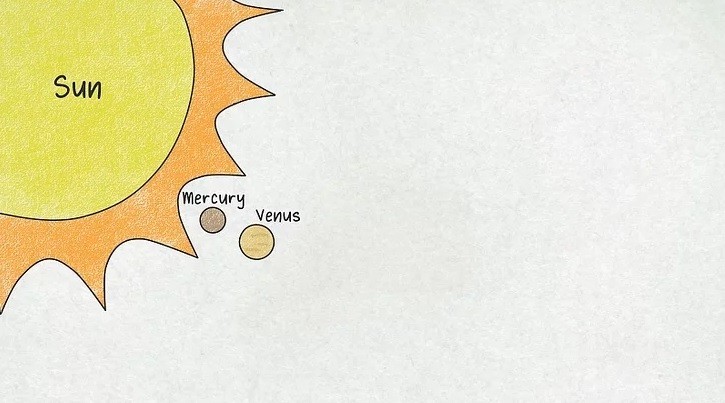
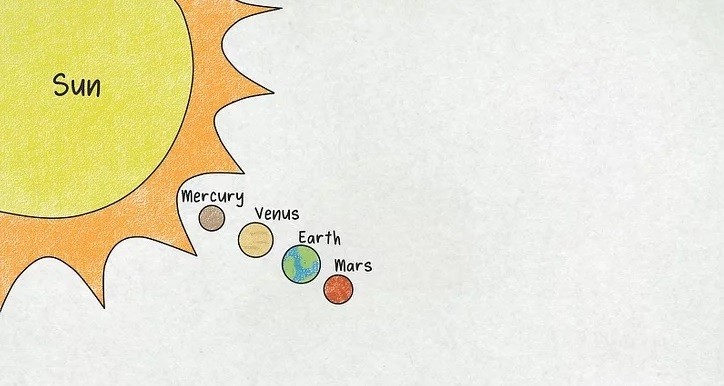
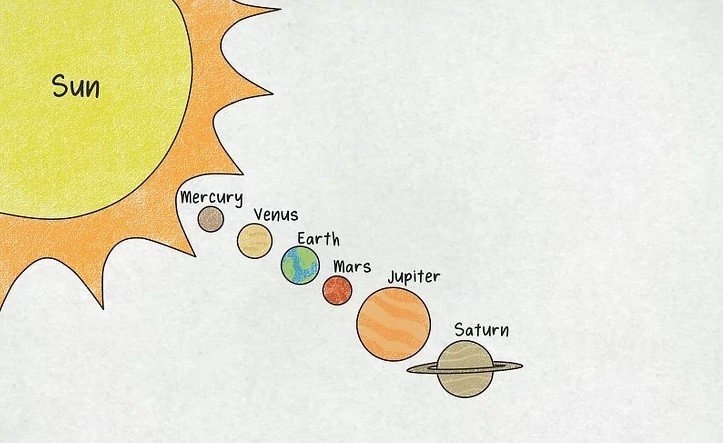
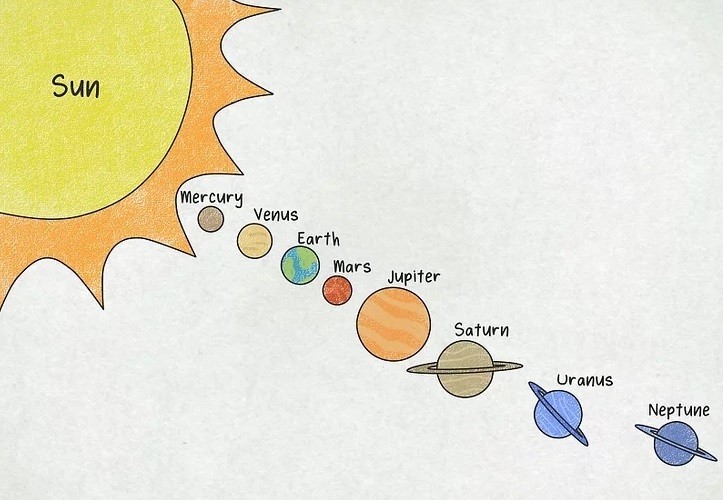
Choose the diagram type for the task: use a labeled diagram for reference and teaching, a blank or partially labeled diagram for quizzes and worksheets, and a scale-focused model only when relative size or distance is the learning objective. A single classroom illustration usually cannot show both planet size and orbital distance to true scale at the same time.
How to Create a Solar System Diagram in EdrawMax
Open a science or astronomy template, arrange the celestial objects, label the planets in the correct order, and edit colors, text, connectors, and callouts. A diagramming tool is useful when you need a clean presentation rather than a hand-drawn sketch.
 Get 500 free AI tokens
5. Solar System Facts for Students.
- The solar system has eight planets.
- The Sun is a star and contains about 99.8% of the solar system's mass.
- Mercury is the smallest planet; Jupiter is the largest.
- Venus, not Mercury, has the hottest planetary surface.
- Ceres is the largest object in the asteroid belt and is classified as a dwarf planet.
- Pluto has been classified as a dwarf planet since the International Astronomical Union's 2006 definition of a planet.
- The solar system is located in the Milky Way galaxy.
6. FAQs About the Solar System Diagram.
How many planets are in the solar system?
There are eight: Mercury, Venus, Earth, Mars, Jupiter, Saturn, Uranus, and Neptune.
Is Pluto a planet?
Pluto is officially classified as a dwarf planet. The 2006 IAU definition reduced the count of major planets from nine to eight.
What is the largest object in the asteroid belt?
Ceres is the largest object in the asteroid belt and is officially classified as a dwarf planet.
Are solar system diagrams drawn to scale?
Most educational diagrams are not. Accurate relative sizes and distances are difficult to show together on a typical screen or sheet of paper, so diagrams often prioritize order and recognition.
References: NASA Solar System Facts and NASA: About the Planets.
AI Diagram Generator
Enter your prompt. Upload files if needed. Generate diagrams, charts, or slides instantly.




 (AI & Web)