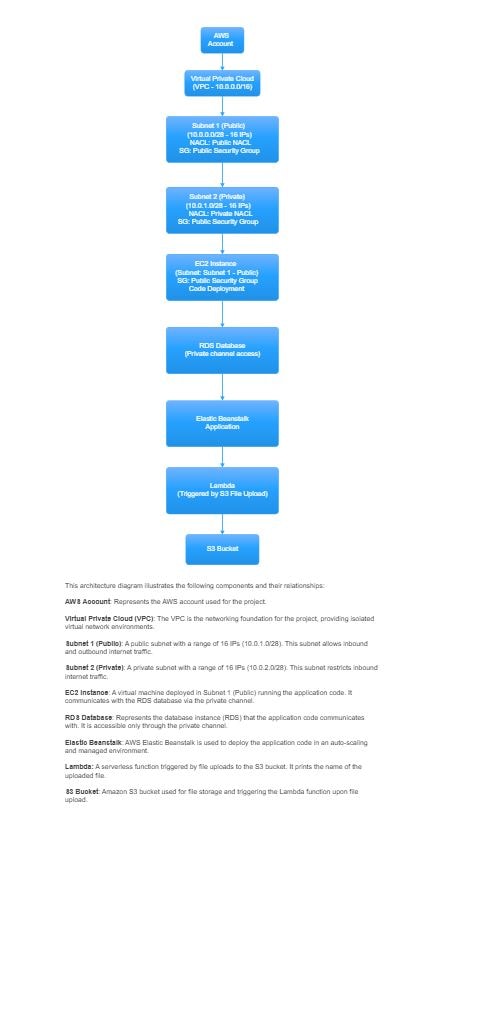
About this Cloud Infrastructure Architecture Diagram
This diagram shows cloud infrastructure architecture diagram in a clearer structure, so the main layers or modules are easier to explain.
AWS Account and Network Boundary
The AWS Account and Network Boundary section marks one visible part of the architecture. In this diagram, it includes AWS Account, Virtual Private Cloud (VPC - 10.0.0.0/16), so the section reads as a specific functional block rather than a generic label.
- AWS Account
- Virtual Private Cloud (VPC - 10.0.0.0/16)
Application and Database Services
The Application and Database Services section marks one visible part of the architecture. In this diagram, it includes Elastic Beanstalk Application, RDS Database (Private channel access), so the section reads as a specific functional block rather than a generic label.
- Elastic Beanstalk Application
- RDS Database (Private channel access)
Storage and Event Processing
The Storage and Event Processing section marks one visible part of the architecture. In this diagram, it includes S3 Bucket, Lambda (Triggered by S3 File Upload), so the section reads as a specific functional block rather than a generic label.
- S3 Bucket
- Lambda (Triggered by S3 File Upload)
FAQs about this Template
-
How do teams document AWS architecture clearly?
Teams usually document AWS architecture with a layered diagram that separates compute, storage, networking, and access services. This approach makes it easier to review service dependencies, traffic paths, scaling logic, and operating boundaries across sections such as AWS Account and Network Boundary, Application and Database Services, and Storage and Event Processing, especially when multiple AWS services work together in one deployment.
-
Can AI generate AWS architecture diagrams automatically?
Yes, AI can generate a first draft of an AWS architecture diagram, but it still needs human validation. AI is helpful for suggesting service groupings and flow paths, while architects should verify the exact AWS components, security boundaries, failover logic, naming, and support assumptions before using the diagram for delivery, review, or internal documentation.
-
What is the difference between AWS architecture and cloud architecture?
The difference is specificity. AWS architecture focuses on how AWS services such as compute, storage, networking, and security are arranged, while cloud architecture is a broader concept that can also include Azure, Google Cloud, or hybrid environments. AWS diagrams are usually more service-specific and more useful for implementation planning, technical review, and environment design.
-
What should an AWS architecture diagram include?
A strong AWS architecture diagram should include the main services, network boundaries, user entry points, and the core data or request flow. It should also show how application services, databases, load balancing, storage, permissions, and monitoring connect, so engineers can understand deployment logic without filling in missing system relationships themselves.
-
Which diagram type is best for AWS system documentation?
A high-level architecture diagram is usually the best starting point for AWS system documentation because it shows service relationships and infrastructure boundaries in one view. Teams often add sequence, network, or deployment diagrams later when they need to explain traffic flow, environment setup, troubleshooting paths, operational responsibilities, or failover logic in more detail.

 (AI & Web)