About this Cloud Native Microservices Architecture Overview
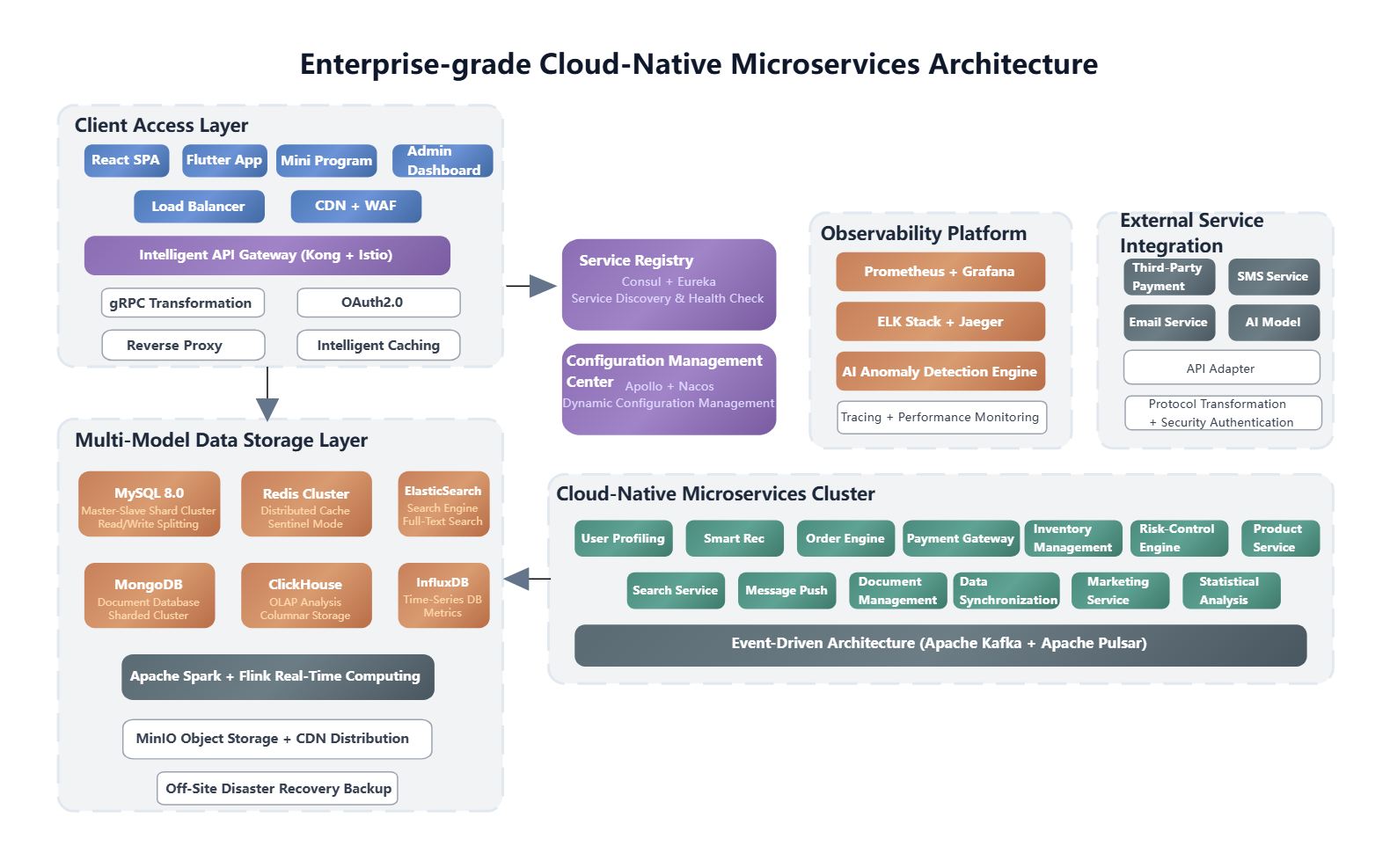
This diagram shows cloud native microservices architecture overview in a clearer structure, so the main layers or modules are easier to explain.
Client Access Layer
The Client Access Layer section groups the components that belong to this part of the architecture. In this diagram, it includes React SPA, Flutter App, Mini Program, Load Balancer, which makes the boundary of the layer easier to explain when presenting how the system is organized.
- Client Access Layer
- React SPA
- Flutter App
- Mini Program
- Load Balancer
- CDN + WAF
- OAuth2.0
- gRPC Transformation
Governance and Operations
The Governance and Operations section marks one visible part of the architecture. In this diagram, it includes Service Registry, Service Discovery & Health Check, Configuration Management Center, Consul + Eureka, so the section reads as a specific functional block rather than a generic label.
- Service Registry
- Service Discovery & Health Check
- Configuration Management Center
- Consul + Eureka
- Apollo + Nacos
- Observability Platform
- Prometheus + Grafana
- ELK Stack + Jaeger
Microservices Cluster
The Microservices Cluster section marks one visible part of the architecture. In this diagram, it includes Cloud-Native Microservices Cluster, Inventory Management, Risk-Control Engine, Product Service, so the section reads as a specific functional block rather than a generic label.
- Cloud-Native Microservices Cluster
- Inventory Management
- Risk-Control Engine
- Product Service
- User Profiling
- Smart Rec
- Payment Gateway
- Marketing Service
- Statistical Analysis
Data and Event Backbone
The Data and Event Backbone section marks one visible part of the architecture. In this diagram, it includes Multi-Model Data Storage Layer, MySQL 8.0, Redis Cluster, ClickHouse, so the section reads as a specific functional block rather than a generic label.
- Multi-Model Data Storage Layer
- MySQL 8.0
- Redis Cluster
- ClickHouse
- MongoDB
- ElasticSearch
- Apache Kafka + Apache Pulsar
- Apache Spark + Flink Real-Time Computing
External Integrations
The External Integrations section marks one visible part of the architecture. In this diagram, it includes External Service Integration, Third-Party Payment, Email Service, SMS Service, so the section reads as a specific functional block rather than a generic label.
- External Service Integration
- Third-Party Payment
- Email Service
- SMS Service
- API Adapter
- Protocol Transformation + Security Authentication
- AI Model
FAQs about this Template
-
Which diagram type is best for documenting microservices?
A high-level microservices architecture diagram is usually the best starting point because it shows service boundaries, gateways, data stores, and supporting infrastructure in one view. It helps teams explain how independent services relate to each other before they add lower-level sequence, event flow, deployment, observability, or support diagrams for implementation detail.
-
How do teams visualize microservices architecture clearly?
Teams usually visualize microservices architecture by separating client entry points, service layers, data stores, and messaging or infrastructure support. This makes it easier to review ownership, service boundaries, and dependencies across sections such as Client Access Layer, Governance and Operations, and Microservices Cluster, especially when many small services need to cooperate without becoming one tightly coupled system.
-
What is the difference between microservices architecture and monolithic architecture?
Microservices architecture breaks a system into smaller independent services, while monolithic architecture keeps most application logic inside one larger codebase or deployment unit. Microservices diagrams are more useful when teams need to explain service boundaries, API relationships, data separation, scaling decisions, operational ownership, and failure isolation across a distributed application environment.
-
What should a microservices architecture diagram include?
A strong microservices architecture diagram should include service boundaries, API gateways or entry points, data stores, and the main request or event flow. It should also show where authentication, messaging, monitoring, deployment infrastructure, or support tooling fit, so readers can understand how the distributed system is coordinated and where operational responsibilities sit.
-
Can AI generate microservices architecture diagrams automatically?
Yes, AI can generate a draft microservices architecture diagram, but the result still needs engineering review. AI is useful for proposing service groupings and flow structure, while architects should confirm real domains, APIs, data ownership, failure boundaries, infrastructure dependencies, and support assumptions before the diagram is used in delivery planning or design review.

 (AI & Web)