About the famous women in history
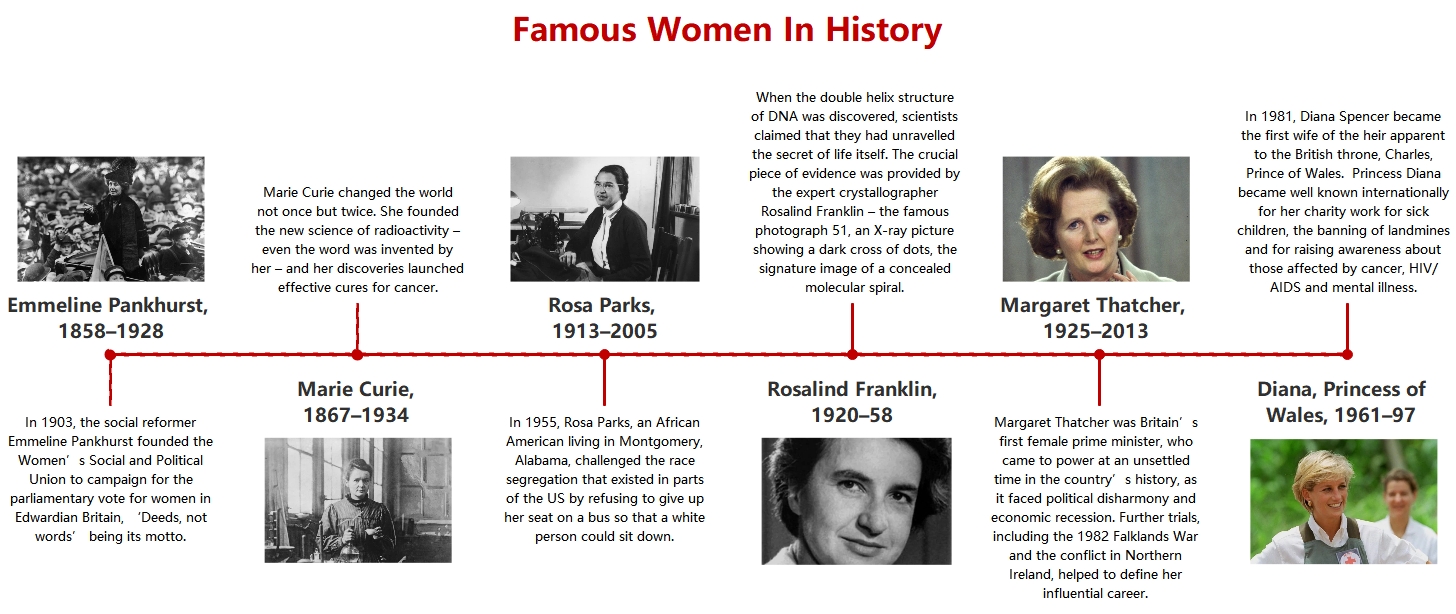
This timeline template highlights six influential women who changed the world. It provides a structured layout for educational presentations or historical research. Use it to showcase significant milestones in science, leadership, and human rights advocacy.
Emmeline Pankhurst
Emmeline Pankhurst was a leading figure in the British suffragette movement. She founded a dedicated union to fight for women’s right to vote. Her bold actions and leadership sparked a major social revolution in Britain.
- Founded the Women’s Social and Political Union in 1903
- Famous for the "Deeds, not words" motto
- Campaigned for parliamentary votes in Edwardian Britain
Marie Curie
Marie Curie was a pioneering scientist who revolutionized medical treatments. She discovered radioactivity and developed vital foundations for cancer research. Her groundbreaking work changed the scientific landscape and earned her two prestigious Nobel Prizes during her career.
- Invented the term radioactivity
- Launched effective cures for cancer through her research
- Founded the new science of radioactivity
Rosa Parks
Rosa Parks was a civil rights activist who challenged racial segregation in America. Her refusal to give up her bus seat became a symbol of resistance. This act ignited the Montgomery bus boycott and fueled the civil rights movement.
- Challenged race segregation in Montgomery, Alabama in 1955
- Refused to give up her seat to a white passenger
- Became a key symbol of the American civil rights struggle
Rosalind Franklin
Rosalind Franklin was an expert crystallographer who provided essential data for DNA research. Her X-ray imagery was the crucial piece of evidence needed to understand life’s structure. She remains a vital figure in the history of molecular biology.
- Produced Photograph 51, the famous X-ray picture of DNA
- Discovered the double helix signature in molecular spirals
- Contributed fundamental insights into the structure of life
Margaret Thatcher
Margaret Thatcher was Britain’s first female prime minister. She led the country during a period of economic transition and international conflict. Her influential career defined British politics in the late 20th century through strong and decisive leadership.
- Served as the first female Prime Minister of Britain
- Led the country through the 1982 Falklands War
- Managed political disharmony and economic recession
Diana, Princess of Wales
Princess Diana was known for her immense compassion and global humanitarian efforts. She used her platform to raise awareness for neglected causes. Her charity work left a lasting impact on how society views health issues and social inequality.
- Supported charities for sick children and landmine victims
- Raised awareness for cancer, HIV/AIDS, and mental illness
- Married the heir to the British throne in 1981
FAQs about this Template
-
Why is a timeline useful for studying historical figures?
A timeline provides a visual context that helps learners understand the chronological order of events. By mapping out the lives of influential women, students can see how individual achievements overlapped or influenced later movements. This structured approach makes complex history easier to digest. It highlights the progression of social changes and scientific breakthroughs over several different decades.
-
Who were the most influential women in scientific history?
Marie Curie and Rosalind Franklin are two of the most significant figures in science. Curie’s work on radioactivity opened new doors for medical treatments, specifically in oncology. Meanwhile, Franklin’s mastery of X-ray crystallography was essential for identifying the double helix structure of DNA. Both women faced significant gender barriers but persevered to make discoveries that still save lives today.
-
How did women like Rosa Parks impact civil rights?
Women played a pivotal role in the civil rights movement by challenging unjust laws through peaceful protest. Rosa Parks’ decision to remain seated on a bus was not just a personal act; it was a strategic move that mobilized thousands. Her courage provided the momentum needed for legislative change. This shows how individual actions can lead to massive shifts in national policy.


 (AI & Web)