About this women's rights history template
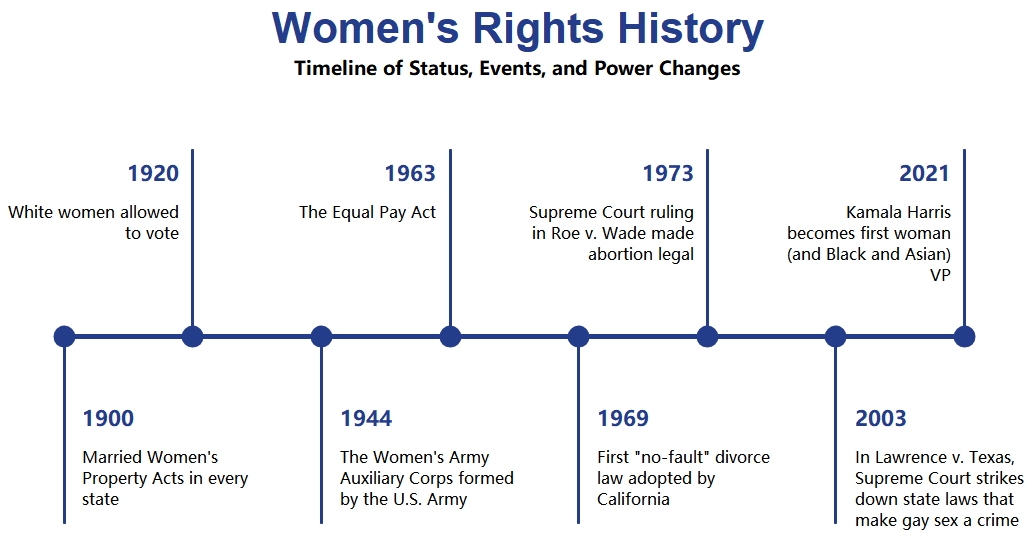
This template provides a clear visual timeline of major milestones in the fight for gender equality. It covers property rights, voting, labor laws, and political breakthroughs. It is designed to help students and researchers understand the long journey of the women's rights movement through a simple chronological layout.
Legal and Political Foundations
The early 1900s marked a major shift in women's legal status across the country. States began allowing married women to own property. Soon after, the suffrage movement won the right to vote, giving women a political voice.
- 1900: Married Women's Property Acts passed in every state.
- 1920: White women granted the right to vote in the U.S.
Military and Economic Progress
Mid-century events expanded women's roles in the military and the general workforce. The creation of a dedicated army corps recognized women's service. Later, the Equal Pay Act focused on fair wages, establishing that women deserve equal economic treatment.
- 1944: The Women's Army Auxiliary Corps was formed by the U.S. Army.
- 1963: The Equal Pay Act was signed into law to end wage gaps.
Social and Reproductive Autonomy
The late 20th century brought major changes to family and healthcare laws. No-fault divorce gave women more freedom in marriage. Simultaneously, the Supreme Court ruled on reproductive rights, allowing women more control over their personal lives and health decisions.
- 1969: California adopted the first "no-fault" divorce law in the country.
- 1973: Roe v. Wade made abortion legal across the United States.
Expanding Civil Rights and Political Power
In the modern era, women have reached the highest levels of political power and leadership. Legal rulings also expanded civil rights for diverse groups. These events highlight a future of inclusive leadership and broad legal protections for everyone.
- 2003: Lawrence v. Texas struck down state laws that criminalized gay sex.
- 2021: Kamala Harris became the first female, Black, and Asian Vice President.
FAQs about this Template
-
What was the impact of the 19th Amendment?
The 19th Amendment was a massive victory for the suffrage movement. It gave white women the right to participate in elections. This changed the political landscape by bringing millions of new voters into the process. While it did not immediately include all women of color, it set the stage for future civil rights battles and encouraged more women to run for office.
-
How did the Equal Pay Act change the workplace?
The Equal Pay Act of 1963 was the first federal law to address wage gaps. It made it illegal to pay men and women different amounts for the same job. This act forced companies to re-evaluate their pay scales. Although a gap still exists today, this law provided the legal tools for women to fight for fair compensation and economic independence.
-
Why is Kamala Harris's election significant for women's rights?
Kamala Harris becoming Vice President in 2021 was a historic first. She broke a ceiling that had existed for over 200 years. Her role represents the success of long-term efforts to get women into high-level leadership. It shows young girls of all backgrounds that they can achieve the highest offices in the land, inspiring a more diverse future for global politics.

 (AI & Web)