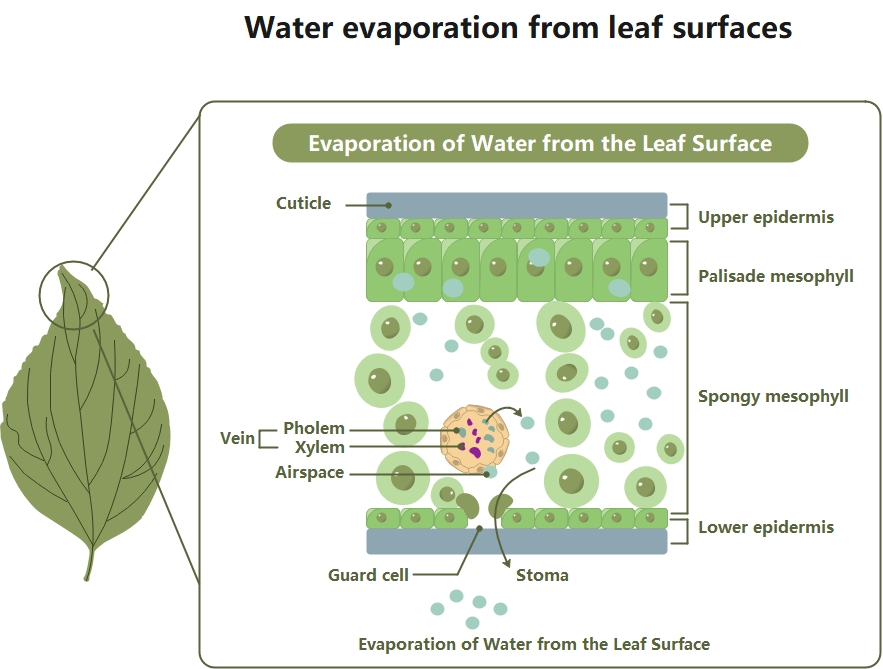
About this leaf transpiration diagram
This leaf transpiration template provides a detailed cross-section view of a leaf. It identifies the biological layers and pathways water takes during evaporation. Educators and students can use this visual tool to master complex botanical processes effectively.
Upper Leaf Structure
The top layers of the leaf provide protection and maximize sunlight absorption. These parts ensure the plant remains waterproof while allowing light to reach the internal cells. They act as the primary shield against the environment.
- Cuticle
- Upper epidermis
Mesophyll Layers
The middle sections of the leaf are responsible for photosynthesis and gas storage. These layers contain cells where energy is produced and spaces where water vapor moves before leaving the plant through the lower surface.
- Palisade mesophyll
- Spongy mesophyll
- Airspace
Leaf Vein and Transport
The vascular system acts like a highway for the plant. It carries water from the roots and distributes nutrients created in the leaves. This network is essential for maintaining the overall health and growth of the plant.
- Vein
- Phloem
- Xylem
Gas Exchange and Stomata
The bottom of the leaf controls how water leaves and how carbon dioxide enters. Specific cells open and close to regulate this movement. This balance is crucial for preventing the plant from drying out completely.
- Lower epidermis
- Guard cell
- Stoma
FAQs about this Template
-
Why is transpiration important for plants?
Transpiration is vital because it creates a suction force that pulls water and minerals up from the roots. This process helps distribute essential nutrients to every part of the plant. Additionally, evaporation from the leaves acts like a cooling system. It prevents the plant from overheating in direct sunlight, ensuring it survives in various temperatures and environmental conditions.
-
What factors affect the rate of transpiration?
Several environmental factors influence how fast water evaporates from leaves. High temperatures and low humidity usually increase the rate because dry air pulls moisture out faster. Wind also speeds up the process by removing water vapor from the leaf surface. However, plants can close their stomata during extreme heat or drought to conserve water and prevent wilting or damage.
-
How do stomata control water loss?
Stomata are small openings on the leaf surface regulated by two specialized guard cells. When these cells absorb water, they swell and open the pore, allowing gas exchange. When the plant is low on water, the guard cells shrink and close the opening. This natural mechanism helps the plant balance its need for carbon dioxide with the necessity of saving water.

 (AI & Web)