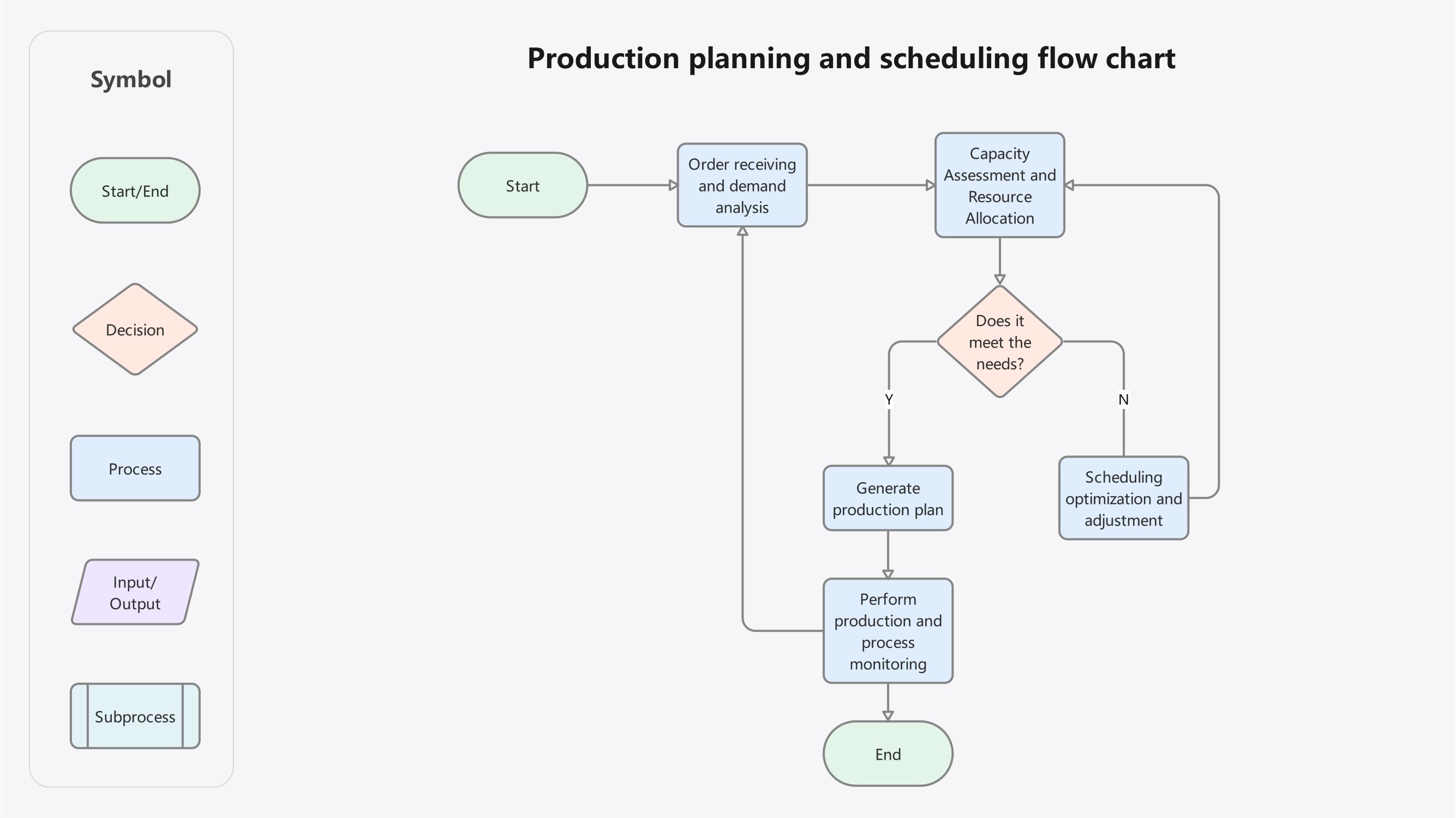
About this Production Planning and Scheduling Flowchart template
This template provides a clear visual guide for managing manufacturing workflows. It helps project managers and floor supervisors track every step from initial demand analysis to real-time process monitoring for maximum efficiency.
Order and Demand Analysis
The first step focuses on gathering customer requirements and evaluating market demand. This ensures the production team understands exactly what needs to be built before allocating expensive resources or equipment to the project.
- Receive customer orders
- Analyze current demand
- Identify product specifications
- Set initial deadlines
Resource Allocation and Capacity Assessment
This phase determines if the facility has the tools and staff required. Managers check machine availability and labor hours to decide if the current schedule can realistically handle the new production volume.
- Assess machine capacity
- Allocate labor resources
- Evaluate material availability
- Verify production constraints
Production Execution and Monitoring
Once the plan is approved, the actual manufacturing begins. Continuous monitoring is essential to ensure quality standards are met and that the timeline remains on track throughout the entire production lifecycle.
- Generate formal production plan
- Start manufacturing processes
- Monitor real-time progress
- Ensure quality control
FAQs about this Template
-
Why is a production planning flowchart important?
A production planning flowchart is essential because it provides a visual roadmap of the entire manufacturing process. It helps teams identify potential bottlenecks early and ensures that resources are allocated efficiently. By using a clear diagram, communication between different departments improves, leading to fewer errors, reduced downtime, and more consistent delivery times for customers.
-
How does scheduling optimization improve manufacturing?
Scheduling optimization improves manufacturing by maximizing the use of available resources while minimizing idle time. It allows managers to adjust workflows based on real-time data or unexpected changes in demand. This flexibility ensures that the most urgent tasks are prioritized and that machinery and labor are used at their peak efficiency, significantly lowering operational costs.
-
What happens if the capacity does not meet the needs?
If the current capacity cannot meet the demand, the scheduling optimization and adjustment phase begins. Managers must find ways to increase output, such as adding shifts, outsourcing specific tasks, or upgrading equipment. They then loop back to re-evaluate capacity until a viable plan is formed, ensuring that no unrealistic commitments are made to the clients.

 (AI & Web)