About this 5-Year Startup Funding Guide template
This timeline template helps entrepreneurs visualize their financial journey. It tracks the path from the initial idea through multiple funding rounds to reaching a major revenue milestone. Use it to plan your startup's long-term capital strategy.
Foundation and Seed Phase
The first year focuses on laying the groundwork for the business. This stage involves transforming a concept into a functional product while securing early-stage support to validate the market demand and core value proposition.
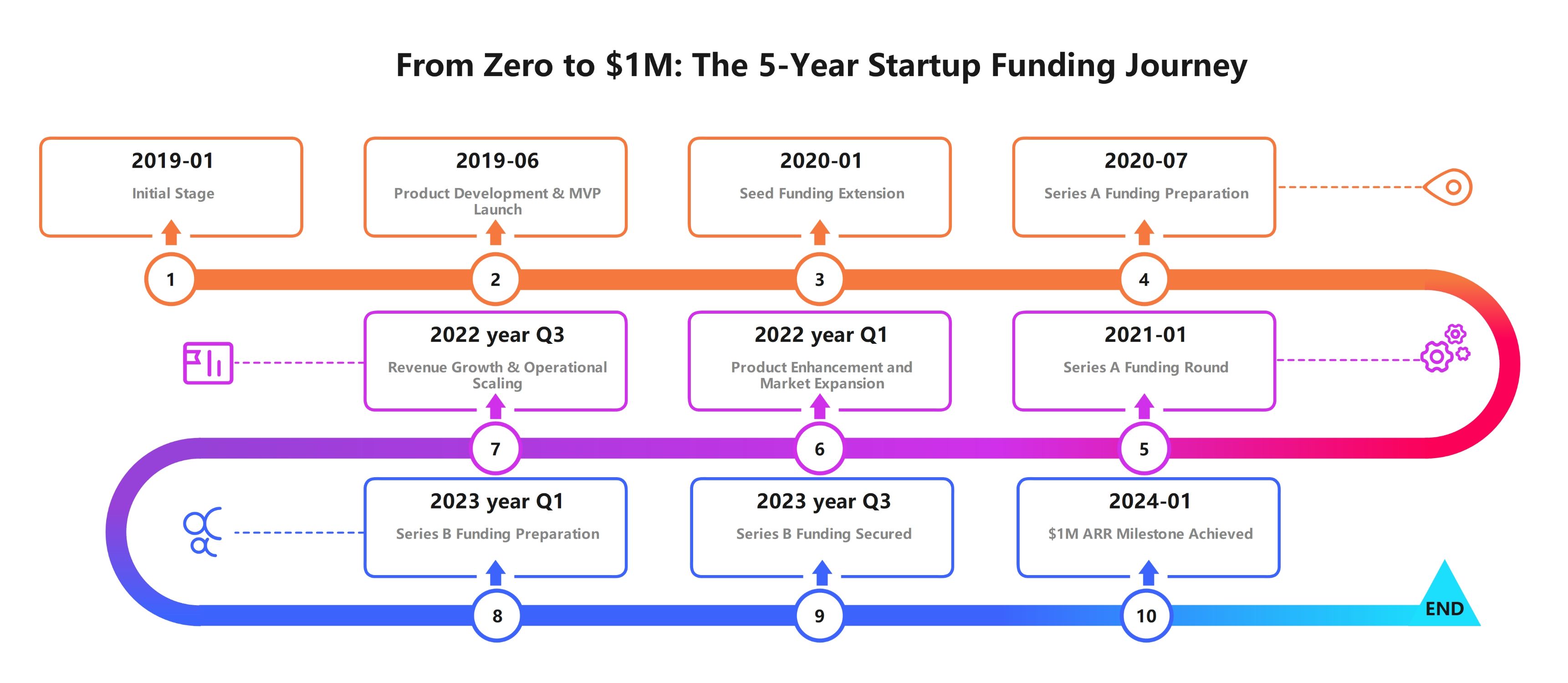
- 2019-01: Initial Stage
- 2019-06: Product Development & MVP Launch
- 2020-01: Seed Funding Extension
Series A Funding Phase
Transitioning from a product to a scalable business requires significant capital. This phase highlights the preparation and execution of Series A funding, which is critical for expanding the team and refining the product offerings.
- 2020-07: Series A Funding Preparation
- 2021-01: Series A Funding Round
Growth and Expansion Phase
After securing Series A capital, the focus shifts toward market dominance. Startups must enhance their features and scale operations to drive revenue growth. This period is essential for building a sustainable and profitable business model.
- 2022 year Q1: Product Enhancement and Market Expansion
- 2022 year Q3: Revenue Growth & Operational Scaling
Series B and $1M Milestone
The final stage of this five-year plan focuses on reaching the $1 million ARR milestone. Securing Series B funding provides the necessary fuel to optimize operations and solidify the startup's position in the competitive landscape.
- 2023 year Q1: Series B Funding Preparation
- 2023 year Q3: Series B Funding Secured
- 2024-01: $1M ARR Milestone Achieved
FAQs about this Template
-
What is the difference between Seed and Series A funding?
Seed funding is usually the first official equity funding stage to help a startup grow from an idea to a product. Series A funding occurs once the company has a track record, such as an established user base or consistent revenue. While Seed rounds often come from angel investors, Series A rounds typically involve venture capital firms looking for long-term growth potential.
-
Why is the $1M ARR milestone significant for startups?
Achieving $1 million in Annual Recurring Revenue (ARR) is a major psychological and financial milestone. It proves that the business model is scalable and that there is a significant market for the product. Reaching this goal often makes it much easier to attract top-tier venture capital for Series B or C rounds, as the risk for investors is lower.
-
How should founders prepare for a Series B funding round?
To prepare for Series B, founders must demonstrate substantial progress since Series A. This includes showing clear revenue growth, a solid customer base, and a repeatable sales process. Investors will scrutinize the company's operational efficiency and unit economics. Preparing detailed financial forecasts and a clear plan for using the new capital to scale the business even further is essential.

 (AI & Web)