




The office of the U.S. president is perhaps the most powerful position in the world, with a history that stretches back to 1789. Every president has faced their own set of challenges, from wars and economic crises to movements that reshaped society. By looking at their stories, we get a clearer picture of how the United States has grown and changed over time.
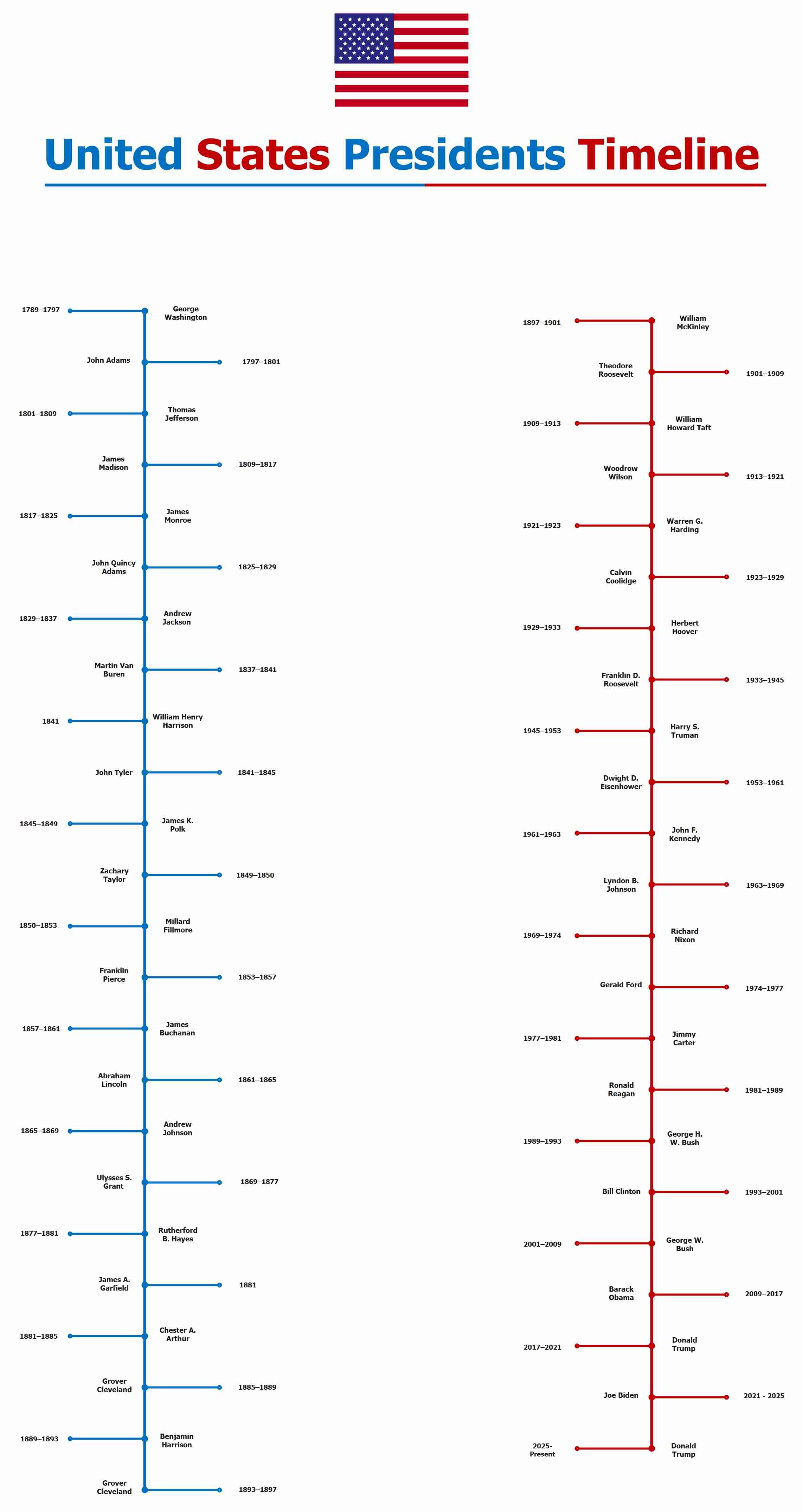
Here’s a complete U.S. presidents timeline that lists every president in chronological order. We’ve gathered all 46 names and their terms in one place, so you can easily follow the nation’s leadership from George Washington to the present day. It’s a simple, insightful way to explore American history of presidents
Presidents of the United States Timeline


George Washington (1789-1797)
George Washington was a Founding Father and the first president of the United States, serving from 1789 to 1797. George Washington is known for fighting in both the French and Indian War and also for leading the Continental Army in the Revolutionary War, where the US gained its independence from Great Britain.
John Adams (1797-1801)
John Adams was the second president of the United States. Being the first Vice President, John Adams successfully defended British soldiers involved in the Boston Massacre and appointed John Marshall to the Supreme Court. He faced criticism and challenges during his presidency because of the Alien and Sedition Acts, which he signed.
Thomas Jefferson (1801-1809)
Thomas Jefferson is known for the Louisiana Purchase, which doubled the size of the United States. He played a big part in the 1776 Revolution and took the lead on the Declaration of Independence. His tenure wasn't without controversy, as he faced criticism for the Embargo Act of 1807. This Act harmed American merchants by stopping all trade with Europe during the Napoleonic Wars.
James Madison (1809-1817)
James Madison is often called the father of the Constitution. He is known for his pivotal role in drafting and promoting the US Constitution. Madison's tenure also saw the establishment of the Second Bank of the United States and the beginning of the “Era of Good Feelings”.
James Monroe (1817-1825)
James Monroe served as president during a period known as the “Era of Good Feelings”. Monroe is best known for the Monroe Doctrine, a pivotal policy declared in 1823 that warned European nations against colonizing or interfering with the Americas.
John Quincy Adams (1825-1829)
Adams believed the government should invest in roads and canals to improve the country. He supported civil rights and education reform. His presidency faced controversy over the "corrupt bargain" with Henry Clay, but later, as a congressman, he strongly opposed slavery.
Andrew Jackson (1829-1837)
Andrew Jackson saw himself as the voice of the common people. Known for his toughness, he survived an assassination attempt. He removed Native Americans through the Indian Removal Act, defeated the British in 1815, opposed a strong federal government, and shut down the national bank.
Martin Van Buren (1837-1841)
Martin Van Buren was the first U.S.-born president and helped create the Democratic Party. His presidency faced the Panic of 1837, a severe economic crisis. His strict money policies failed to fix it, and he opposed adding Texas to avoid slavery conflicts.
William Henry Harrison (1841)
William Henry Harrison had the shortest tenure of any American president. He served just 31 days in 1841 before dying of pneumonia. He is generally known for his wins against the Indians as well as his military exploits at the Battle of Tupacino.
John Tyler (1841-1845)
John Tyler was the first vice president to become president due to the death of his predecessor. Tyler's presidency is most notable for his annexation of Texas in 1845, which contributed to the buildup toward the Mexican-American War. After vetoing a new national bank, his party expelled him.
James K. Polk (1845-1849)
James K. Polk is known for his strong leadership during the Mexican-American War, which expanded the US to the West, gaining parts of New Mexico, Utah, Nevada, Arizona, California, Texas, and Western Colorado. He also settled the Oregon boundary dispute with Britain.
Zachary Taylor (1849-1850)
Zachary Taylor was a career military officer before becoming president. His brief tenure was dominated by the issues left unaddressed by Pulk surrounding the territories acquired during the Mexican-American War. Though a slave owner, he wanted to preserve the Union by admitting California as a free state and delaying slavery decisions elsewhere.
Millard Fillmore (1850-1853)
Fillmore is often remembered for signing the Compromise of 1850, which annoyed both Southerners and Northerners. It included the Fugitive Slave Act, which required the return of escaped slaves to their owners even in free states. This act was highly controversial, and Fillmore didn't get the 1852 presidential nomination.
Franklin Pierce (1853-1857)
Franklin Pierce was in favor of the Kansas-Nebraska Act, which allowed the settlers to vote on slavery, and repealed the Missouri Compromise. It resulted in bloody conflicts known as Bleeding Kansas. He further divided people to the extent of the Civil War. He also acquired land to construct a southern railroad, but lost the party's backing.
James Buchanan (1857-1861)
James Buchanan is often ranked as one of the least effective presidents due to his inability to prevent the Southern States from seceding from the USA. His tenure saw the Dred Scott Decision, which ruled that Congress could not ban slavery in the territories, further polarizing the nation.
Abraham Lincoln (1861-1865)
Abraham Lincoln was the first Republican president who led the nation through the Civil War. He preserved the Union and ended slavery through the Emancipation Proclamation and the 13th Amendment. His leadership changed America, but he was tragically assassinated in 1865.
Andrew Johnson (1865-1869)
After the Civil War, Andrew Johnson and Congress disagreed on how to bring the South back together. He was acquitted, but impeachment resulted from his repeated vetoes and dismissals of officials. Alaska was purchased by the United States during his administration.
Ulysses S. Grant (1869-1877)
During Reconstruction, Ulysses S. Grant fought to defend the rights of African Americans and backed the 15th Amendment, which gave them the right to vote. He upheld civil rights laws and battled the Ku Klux Klan. Through the Treaty of Washington, he was able to make peace with Britain in spite of corruption scandals.
Rutherford B. Hayes (1877-1881)
Rutherford B. Hayes became president after a close election. He ended the Reconstruction period, helped unite the country after the Civil War, and worked for fair government jobs. He also supported education for African Americans and honest leadership.
James A. Garfield (1881)
James Garfield's tenure was tragically short, ending after just 200 days when he was assassinated. Despite his brief time in office, Garfield made an impact with his strong advocacy for civil service reform and education rights for African-Americans.
Chester A. Arthur (1881-1885)
Many were surprised when Chester A. Arthur, who was considered a political insider, backed government reform. By signing the Pendleton Civil Service Act, he established merit-based hiring practices for federal positions rather than political considerations. In addition, he worked on tariff reforms and modernised the U.S. Navy.
Grover Cleveland (1885-1889, 1893-1897)
The only president to hold office for two non-consecutive terms was Grover Cleveland. He vetoed numerous bills, opposed corruption and high tariffs, and favoured the gold standard. He sent troops during the Pullman Strike, which infuriated labour organisations, but he strongly upheld presidential authority.
Benjamin Harrison (1889-1893)
The Sherman Antitrust Act, which outlawed monopolies and promoted fair competition, is credited to Benjamin Harrison. During his presidency, six states became members of the Union. To aid farmers, he increased tariffs and increased the money supply, but these actions ultimately had a negative impact on the economy.
William McKinley (1897-1901)
William McKinley played a key role in leading the United States to victory in the Spanish-American War. This victory marked the emergence of the US as a world power. It forced other countries in the Pacific to respect US trade rights in China. He was assassinated in 1901
Theodore Roosevelt (1901-1909)
Theodore Roosevelt was a dynamic president known for his Progressive reforms and conservation efforts. His Square Deal promoted fairness for workers, businesses, and consumers. He built the Panama Canal, regulated food and drugs, and won the Nobel Peace Prize for his role in mediating the end of the Russo-Japanese War.
William Howard Taft (1909-1913)
William Howard Taft continued some of Roosevelt's Progressive reforms, strengthened the Interstate Commerce Commission, and improved the Postal Service. He supported the 16th Amendment for income tax and fought monopolies. However, his tariff policies and cautious reforms split his party, costing him reelection.
Woodrow Wilson (1913-1921)
In addition to introducing significant Progressive reforms like the Federal Reserve and Clayton Antitrust Acts, Woodrow Wilson led the United States through World War I. Although the United States did not join, he established the League of Nations and the 14 Points for peace. He lowered tariffs as well.
Warren G. Harding (1921-1923)
Warren Harding promised a "return to normalcy" after World War I. His presidency saw economic growth but was marred by scandals like Teapot Dome, involving oil bribes. He reduced government costs, introduced a budgeting system, and vetoed a bill helping World War I veterans.
Calvin Coolidge (1923-1929)
Calvin Coolidge, known for his honesty and quiet style, believed in limited government and free-market policies. He led during the 1920s economic boom, cut taxes and debt, and restored trust after scandals. However, his hands-off approach encouraged risky investments that later hurt the economy.
Herbert Hoover (1929-1933)
Herbert Hoover was president when the Great Depression began. His presidency became defined by the economic collapse that started in 1929 after the stock market crash. Many Americans blamed him for the crisis, leading to the creation of shantytowns known as "Hoovervilles."
Franklin D. Roosevelt (1933-1945)
Franklin D. Roosevelt, commonly known as FDR, took office during the Great Depression. He started the New Deal, a series of programs, public works projects, financial reforms, and regulations. He was elected to four terms, more than any other president. Roosevelt died in office in 1945.
Harry S. Truman (1945-1953)
Truman became president after FDR's death near the end of World War II. He made the historic decision to use atomic bombs on Hiroshima and Nagasaki. He started the Truman Doctrine and the Marshall Plan. During his time, he also desegregated the military, recognized Israel, and led the U.S. into the Korean War.
Dwight D. Eisenhower (1953-1961)
Dwight D. Eisenhower was a World War II hero. He focused on peace and stability during the Cold War. He created the Interstate Highway System, expanded Social Security, and improved science education. It was he who ended the Korean War and enforced school desegregation in Little Rock, Arkansas, in 1957.
John F. Kennedy (1961-1963)
John F. Kennedy, also known as JFK, inspired Americans with his message of hope and service. He is remembered for the phrase "Ask not what your country can do for you, ask what you can do for your country." His presidency saw major events such as the Bay of Pigs invasion, the Cuban Missile Crisis, and the beginning of the space race. He was assassinated in Dallas, Texas, in 1963.
Lyndon B. Johnson (1963-1969)
Lyndon B. Johnson, or LBJ, became president after Kennedy's assassination. He is known for his ambitious domestic program called the Great Society, which aimed to eliminate poverty and racial injustice. Under his administration, Congress passed important legislation such as the Civil Rights Act of 1964 and the Voting Rights Act of 1965.
George H. W. Bush (1989-1993)
George H. W. Bush, popularly known as Bush Sr., was renowned for his leadership skills and foreign policy expertise. He presided over the peaceful dissolution of the Soviet Union and the end of the Cold War. During the 1991 Gulf War, Bush oversaw a successful international coalition. His popularity suffered domestically as a result of economic difficulties during his presidency.
Bill Clinton (1993-2001)
Bill Clinton sought to reform welfare, balance the budget, and expand the economy. Long-term economic growth and increased trade with Canada and Mexico were made possible by NAFTA. Despite his accomplishments, the Monica Lewinsky scandal dogged his presidency. The Senate cleared him, and he ended his term with high approval ratings.
George W. Bush (2001-2009)
George W. Bush is George H. W. Bush's son. He served during one of the most critical periods in contemporary history. During the 9/11 attacks, George W. Bush was the president of the United States. He sent troops to Afghanistan and Iraq to begin the War on Terror. At home, he cut taxes, improved education with No Child Left Behind, and created the Department of Homeland Security.
Barack Obama(2009-2017)
Being the first African-American president of the United States, Barack Obama created history. He prioritised stabilising the economy when he took office during the Great Recession. His major legislative accomplishment was the Affordable Care Act (ACA), popularly referred to as "Obamacare," which gave millions of Americans access to more health insurance.
Donald Trump (2017-2021, 2025-Present)
TV personality and businessman Donald Trump ran on the platform of "Make America Great Again." He appointed three justices to the Supreme Court, lowered taxes, and loosened regulations. Leaving international agreements was one of his "America First" policies.
Trump returned to office in 2025. With his comeback, he is emphasizing strict immigration policies, energy independence, and "America First" economics.
Joe Biden (2021-2025)
Biden led the nation through the COVID-19 recovery. He focused on vaccine rollout and economic stimulus. Biden also rejoined global agreements like the Paris Climate Accord and passed major laws such as the Infrastructure and Inflation Reduction Acts. During his tenure, he faced many issues such as inflation, immigration issues, and the Afghanistan withdrawal.
How to Make a Similar Timeline?
 Get 500 free AI tokens
Step1 Start with a Blank Canvas
- Open Wondershare EdrawMax on your computer.
- Sign in or create an account.
- Click New > Blank Drawing to open a fresh canvas.

Step2 Add a Timeline Title
- Type or insert a title like “U.S. Presidents Timeline.”
- Click Insert > Picture > Local Pictures to add a title image, or use a text box instead.
- You can also add a flag or icon to make it stand out.

Step3 Insert the Timeline Layout
- Click Insert on the top menu.
- Select Timeline, then choose Vertical Timeline.
- Click OK to add it to your canvas.

Step4 Add Presidents’ Details
- Click Text from the left panel.
- Enter the year and name for each president.
- Keep entries short and easy to read.

Step5 Save and Share
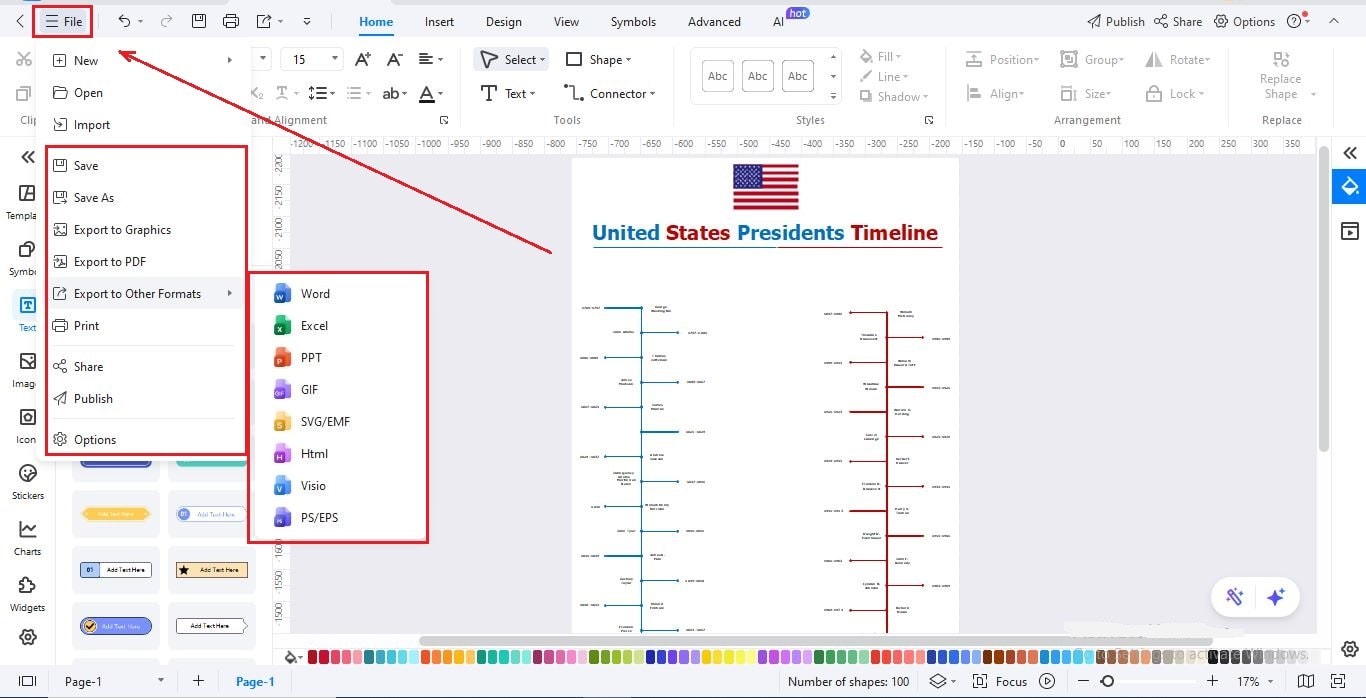
- Click File > Save to keep it editable.
- For sharing, go to File > Export and choose PNG, PDF, SVG, or HTML.
- Click Publish to share it with the EdrawMax community.
Closure
So now you know the journey of all U.S. presidents and how their leadership built the nation we see today. Each one faced challenges that defined their time in history. If you want to design your own US president's timeline, use EdrawMax; it’s the easiest way to turn history into visuals.
AI Diagram Generator
Enter your prompt. Upload files if needed. Generate diagrams, charts, or slides instantly.





 (AI & Web)