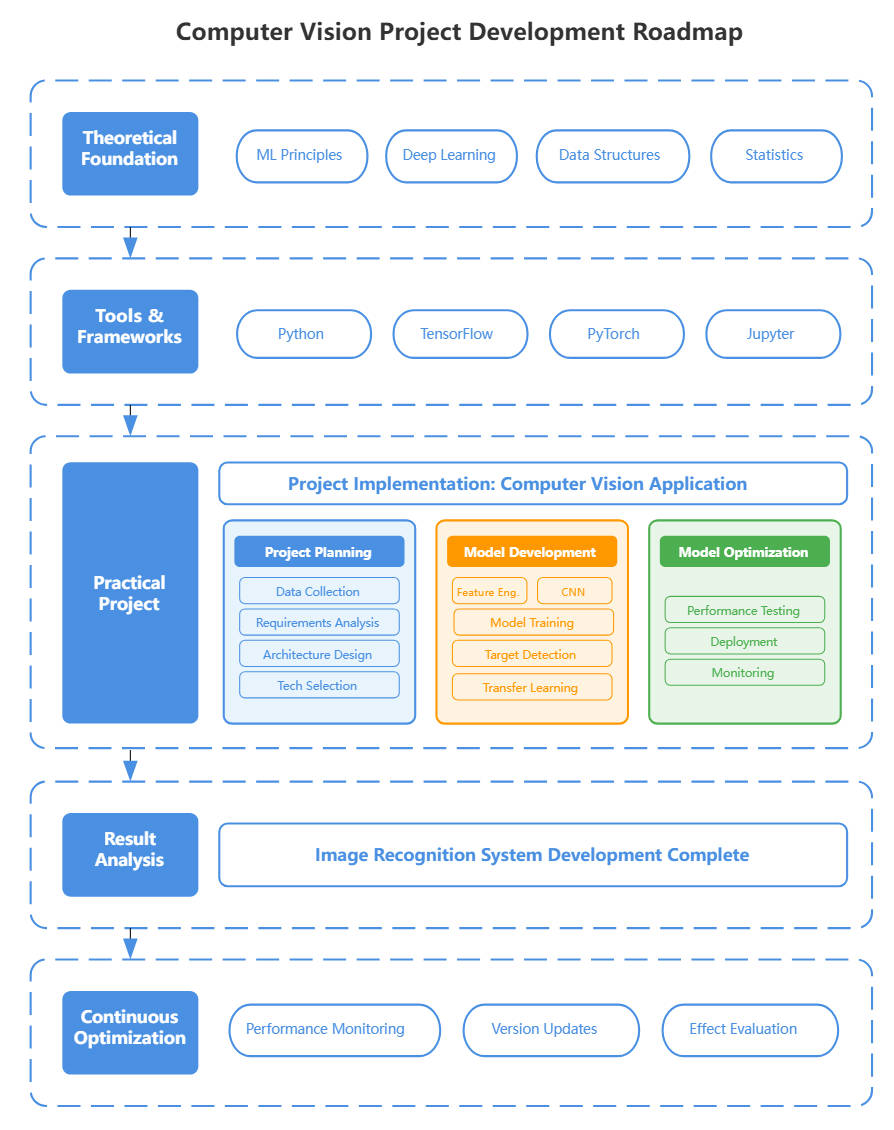
About this Computer Vision Project roadmap template
This roadmap provides a clear visual guide for developing computer vision systems. It outlines the essential steps from theoretical learning to continuous optimization. Teams can use it to track progress and ensure all technical requirements are met during development.
Theoretical Foundation
Success in computer vision requires a strong grasp of core mathematical and programming concepts. This phase ensures developers understand the logic behind neural networks. It sets the stage for building more advanced machine learning models later.
- ML Principles
- Deep Learning
- Data Structures
- Statistics
Tools & Frameworks
Choosing the right technology stack is vital for efficient AI development. This section highlights the industry-standard programming languages and libraries used for image processing. Mastering these tools allows for faster prototyping and easier scaling of your vision projects.
- Python
- TensorFlow
- PyTorch
- Jupyter
Project Planning
Effective planning is the first step in the implementation phase. It involves defining goals and gathering the necessary data for your specific application. A solid plan helps avoid technical debt and ensures the architecture supports your long-term vision.
- Data Collection
- Requirements Analysis
- Architecture Design
- Tech Selection
Model Development
This stage focuses on building and training the actual computer vision model. It includes extracting features and using specific architectures like CNNs to process visual data. Developers use transfer learning techniques to speed up the training process significantly.
- Feature Engineering
- Convolutional Neural Networks (CNN)
- Model Training
- Target Detection
- Transfer Learning
Model Optimization
Optimization ensures that the model performs well in real-world scenarios. This involves testing the speed and accuracy before the final deployment. Continuous monitoring after launch is necessary to maintain high performance and catch any emerging technical issues.
- Performance Testing
- Deployment
- Monitoring
Continuous Optimization
AI models require regular updates to stay relevant and accurate over time. This final stage involves evaluating effects and updating versions based on new data. It ensures the computer vision system remains effective as user needs and environments change.
- Performance Monitoring
- Version Updates
- Effect Evaluation

 (AI & Web)