




Cleopatra VII Philopator stands as one of the most fascinating figures in ancient history. Her life, marked by intelligence, beauty, and political brilliance, reshaped Egypt’s destiny and influenced the course of Rome. To truly understand her impact, it’s essential to view her life chronologically — year by year.
This Cleopatra timeline explores her journey from birth to her tragic death, showcasing her reign, alliances, and lasting influence on world history.
In this article, you will learn about:
- The major events of Cleopatra’s life from birth to death.
- How her political strategies shaped Egypt’s final era.
- How EdrawMax can help you design historical timelines effortlessly.
In the end, you will be able to know more about Cleopatra’s life events and her achievements under her rule. Let’s get into it!
Cleopatra Timeline
Cleopatra was born in Alexandria, Egypt, to Ptolemy XII Auletes and Cleopatra V Tryphaena. She belonged to the Greek Macedonian Ptolemaic dynasty that had ruled Egypt since Alexander the Great’s conquest. Here is the complete Cleopatra timeline focusing on all the key years and events in her life.
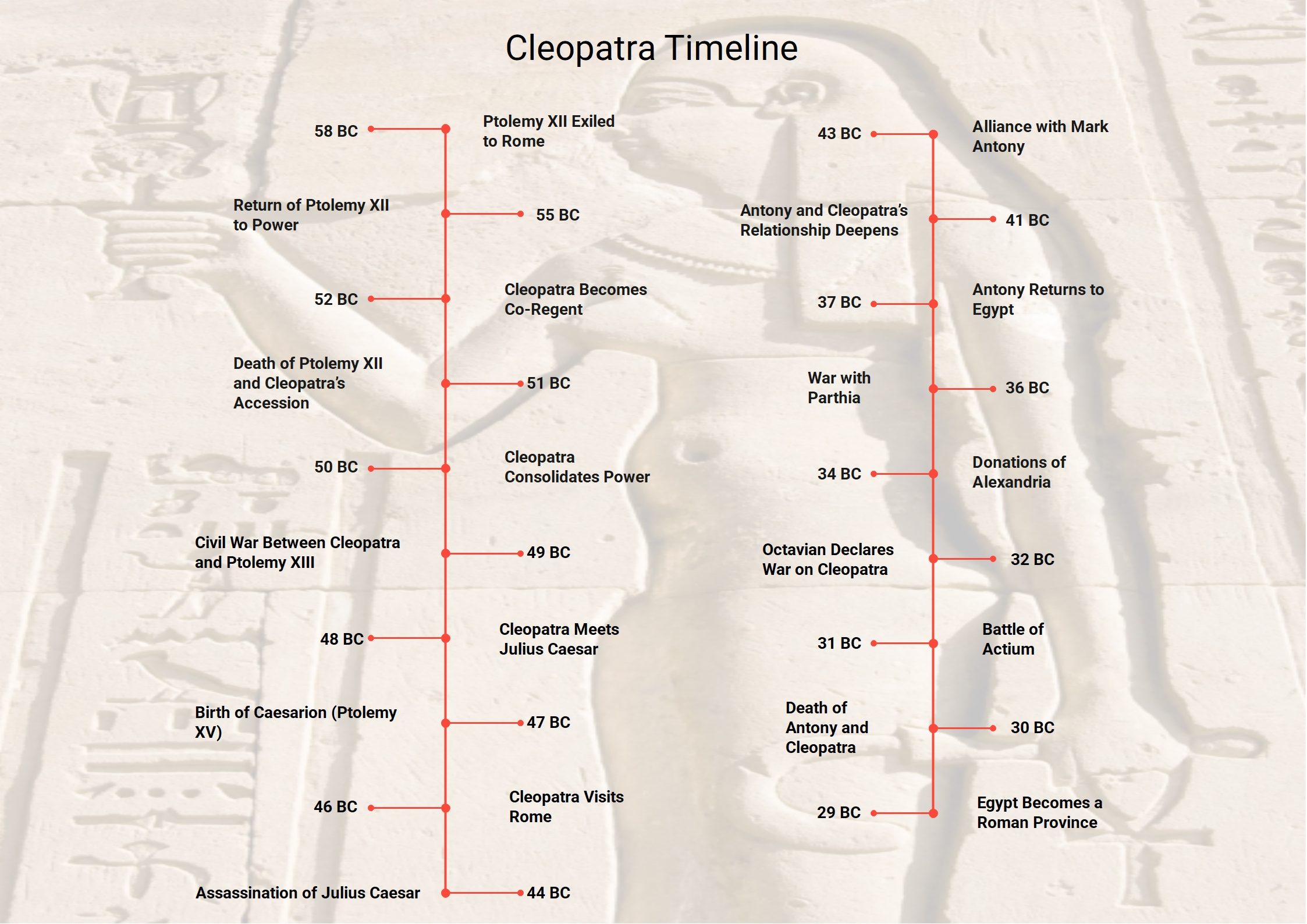


58 BC – Ptolemy XII Exiled to Rome
Cleopatra’s father, Ptolemy XII, was exiled after losing the throne. Cleopatra, still a child, witnessed her sister Berenice IV ascend to power. This period introduced her to Egypt’s internal political turmoil.
55 BC – Return of Ptolemy XII to Power
With Roman military assistance, Ptolemy XII reclaimed his throne. Berenice IV was executed, and Cleopatra observed firsthand the power Rome wielded over Egyptian politics.
52 BC – Cleopatra Becomes Co-Regent
Cleopatra began serving as co-ruler with her father, showing early political aptitude. She learned administration, economics, and diplomacy while preparing for leadership.
51 BC – Death of Ptolemy XII and Cleopatra’s Accession
At 18, Cleopatra became queen alongside her younger brother, Ptolemy XIII. The two were supposed to co-rule, but political advisers favored Ptolemy, leading to tension between the siblings.
50 BC – Cleopatra Consolidates Power
Defying tradition, Cleopatra began ruling independently. She removed her brother’s name from official documents and coins, asserting full control of the Egyptian throne.
49 BC – Civil War Between Cleopatra and Ptolemy XIII
A power struggle erupted between Cleopatra and her brother. Cleopatra fled to Syria, where she raised an army to reclaim her throne.
48 BC – Cleopatra Meets Julius Caesar
Cleopatra returned to Egypt and sought Julius Caesar’s support. She famously had herself smuggled into the royal palace in a carpet to meet him. Caesar helped her regain power, defeating Ptolemy XIII at the Battle of the Nile.
47 BC – Birth of Caesarion (Ptolemy XV)
Cleopatra gave birth to Ptolemy XV, nicknamed Caesarion, whom she claimed was Julius Caesar’s son. This alliance strengthened her position in Egypt and connected her directly to Rome’s power.
46 BC – Cleopatra Visits Rome
Cleopatra visited Rome as Caesar’s guest. Her arrival caused a sensation — she was honored as a queen but also viewed with suspicion by Roman senators. Her presence symbolized Egypt’s growing influence in Roman politics.
44 BC – Assassination of Julius Caesar
The assassination of Caesar deeply affected Cleopatra. With her protector gone, she returned to Egypt with Caesarion. This event marked the beginning of a new phase in her political strategy.
43 BC – Alliance with Mark Antony
As Rome plunged into civil war, Cleopatra aligned herself with Mark Antony, Caesar’s former ally. Their meeting in Tarsus became legendary — Cleopatra arrived on a golden barge, captivating Antony with her charm and intelligence.
41 BC – Antony and Cleopatra’s Relationship Deepens
Cleopatra and Antony formed both a political and romantic alliance. She bore him twins, Alexander Helios and Cleopatra Selene, strengthening their dynastic connection.
37 BC – Antony Returns to Egypt
Antony returned to Alexandria, where he and Cleopatra solidified their partnership. They ruled as co-regents and envisioned an empire that united East and West under their heirs.
36 BC – War with Parthia
Antony launched a campaign against Parthia, partly funded by Cleopatra. Although unsuccessful, the alliance showcased Cleopatra’s role as a strategic financier and political partner.
34 BC – Donations of Alexandria
In a grand ceremony, Antony and Cleopatra distributed eastern territories to their children, declaring Caesarion as “King of Kings.” This provoked outrage in Rome, where Octavian (future Augustus) viewed it as a direct challenge.
32 BC – Octavian Declares War on Cleopatra
Octavian used Antony’s relationship with Cleopatra as political propaganda, accusing her of manipulating him. The Roman Senate officially declared war on Cleopatra, not Antony, to frame it as a foreign conflict.
31 BC – Battle of Actium
The decisive naval battle took place off the coast of Greece. Octavian's forces defeated Cleopatra and Antony's combined fleet. Their retreat to Egypt marked the beginning of the dynasty's end.
30 BC – Death of Antony and Cleopatra
After Octavian’s forces invaded Egypt, Antony committed suicide, believing Cleopatra dead. Soon after, Cleopatra took her own life, reportedly by the bite of an asp (Egyptian cobra). Her death ended over 300 years of Ptolemaic rule.
29 BC – Egypt Becomes a Roman Province
Following Cleopatra’s death, Egypt came under Roman control. Octavian, later Emperor Augustus, executed Caesarion and declared Egypt Rome’s property. Alexandria became a Roman capital in the east.
Legacy (Posthumous)
Cleopatra’s story lived on in literature, art, and film, symbolizing intelligence, passion, and political mastery. Her life bridged two great civilizations — Egyptian and Roman — leaving behind one of history’s most captivating legacies.
How to Create Cleopatra’s Timeline Using EdrawMax
Visualizing Cleopatra’s life timeline can bring ancient history to life, and EdrawMax makes this process remarkably simple. Developed by Wondershare, EdrawMax is a professional diagramming and visualization tool that supports over 210 diagram types, including timelines, Gantt charts, and historical visualizations.
With EdrawMax, you can turn Cleopatra’s life events into a vivid, interactive timeline showing her rise to power, key alliances, and historical milestones. The software provides hundreds of timeline templates and design elements, allowing you to customize each stage of Cleopatra’s journey.
Key Features of EdrawMax:
- Customizable Timeline Templates: Choose from various layouts to display historical events chronologically.
- AI Diagram Assistant: Instantly generate a structured timeline from a text prompt or outline.
- Collaboration and Cloud Access: Share, comment, and co-edit timelines with others in real time.
- Cross-Platform Support: Compatible with Windows, macOS, Linux, and web versions.
- High-Quality Export Options: Export timelines as images, PDFs, or presentations for educational or research purposes.
Whether for academic use, content creation, or personal interest, EdrawMax transforms Cleopatra’s timeline into an engaging, visually rich historical presentation that’s both educational and inspiring.
Step-by-step guide to create Cleopatra Timeline
Here is the step-by-step guide to creating a Cleopatra timeline. Let's get started!
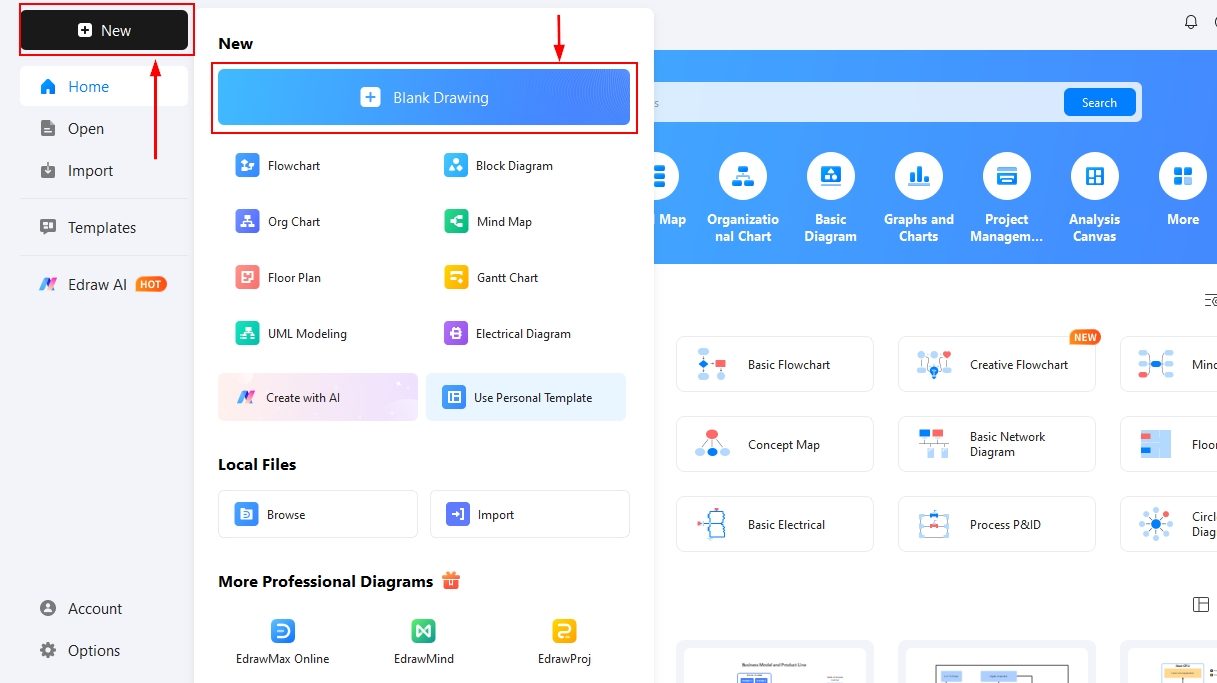
Step1 Open the Empty Canvas
- Launch EdrawMax, click New, and choose Blank Drawing (or select a Timeline template from the Template Library to save time).
- Rename the File to something like "Cleopatra Timeline" and set the canvas orientation (landscape recommended).
 Get 500 free AI tokens
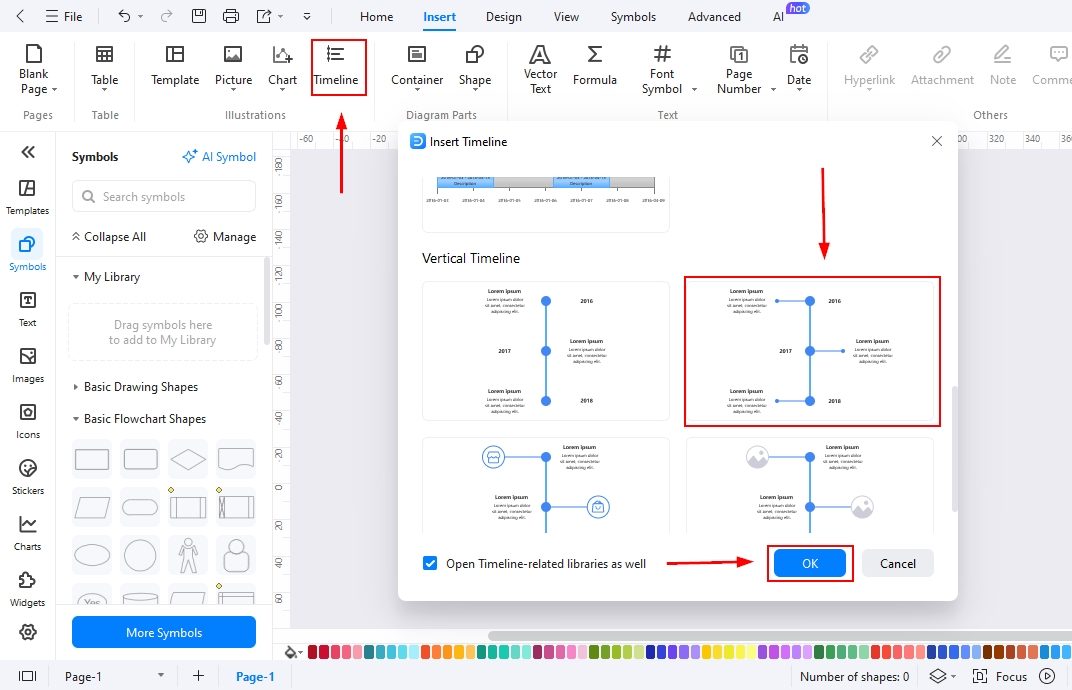
Step2 Add Timeline Structure
- From the Symbols & Shapes library, drag a Timeline or Horizontal/Vertical Line onto the canvas; set the scale (e.g., 69 BC → 30 BC) in the Properties panel.
- Add evenly spaced milestone nodes along the timeline for major dates (birth, ascension, alliances, battles, death, etc.).
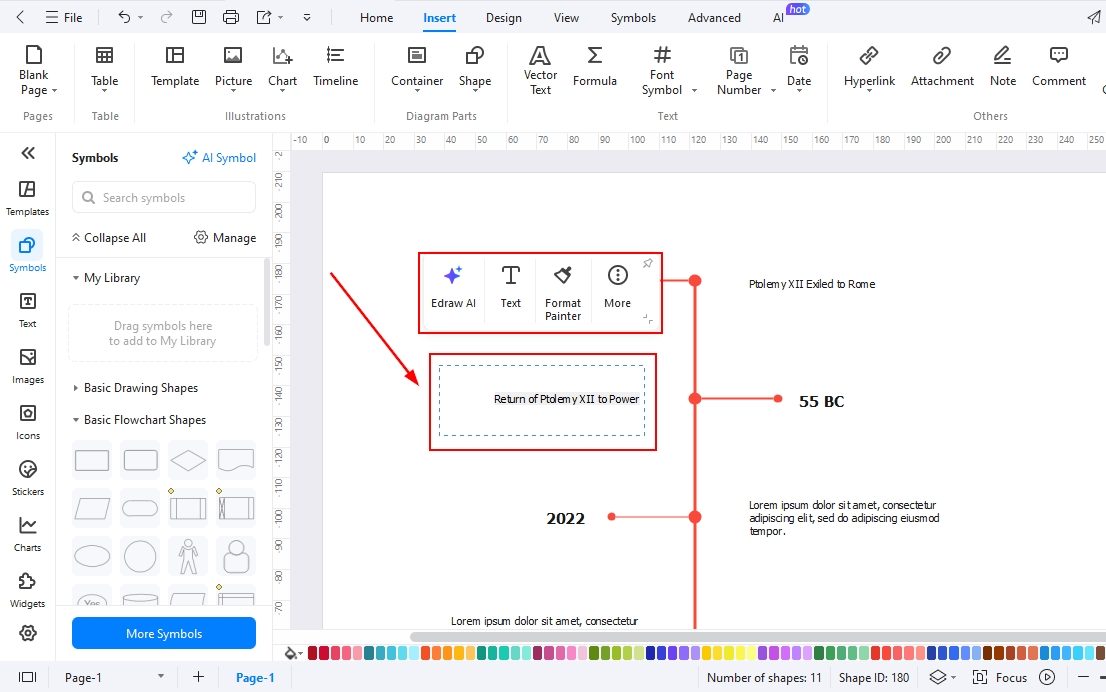
Step3 Add Event Containers/Text Boxes
- Add text boxes or shapes for each event; include concise labels (date + event title) and a short description (1–2 lines) inside or linked as a note.
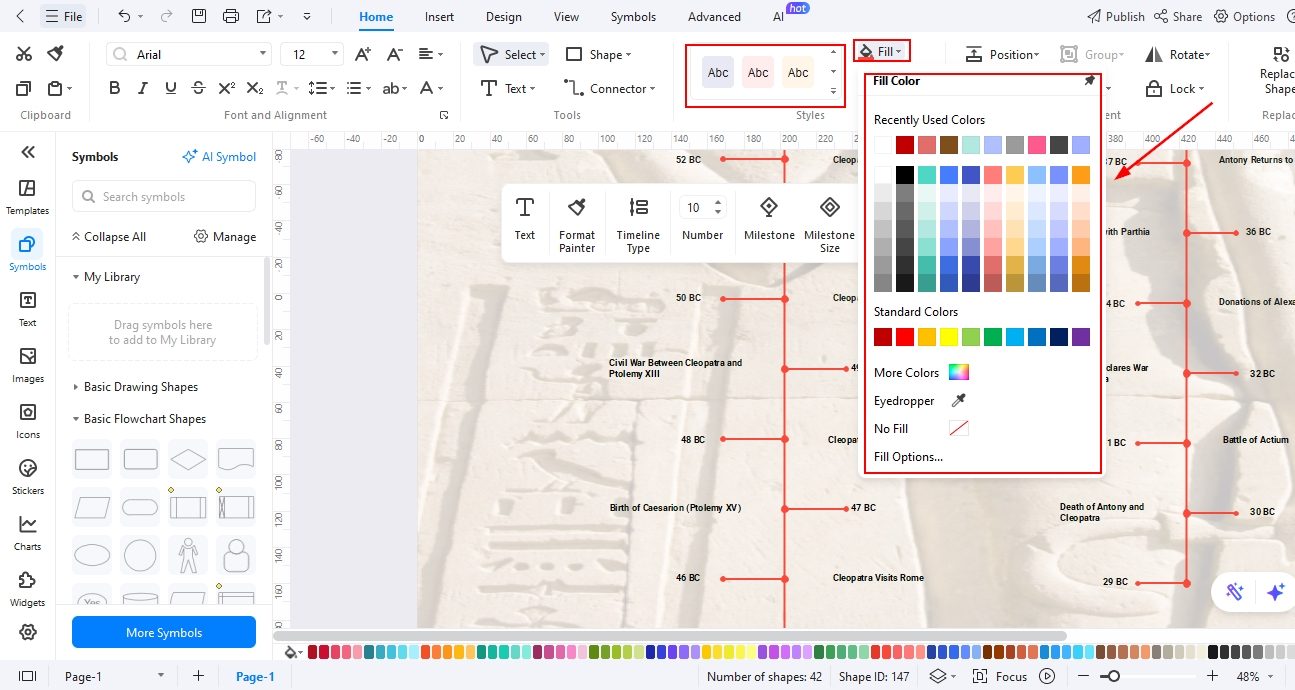
Step4 Adjust the Themes and Set Backgrounds
- Use different colors to make your timeline even better.
- Add layers or grouped elements for categories (political events, military actions, personal milestones) and use color-coding or icons to differentiate them.
Step5 Export the File After Edits
- Apply consistent styles: fonts, colors, and icons; add citations or a small References box with sources in a corner for academic use.
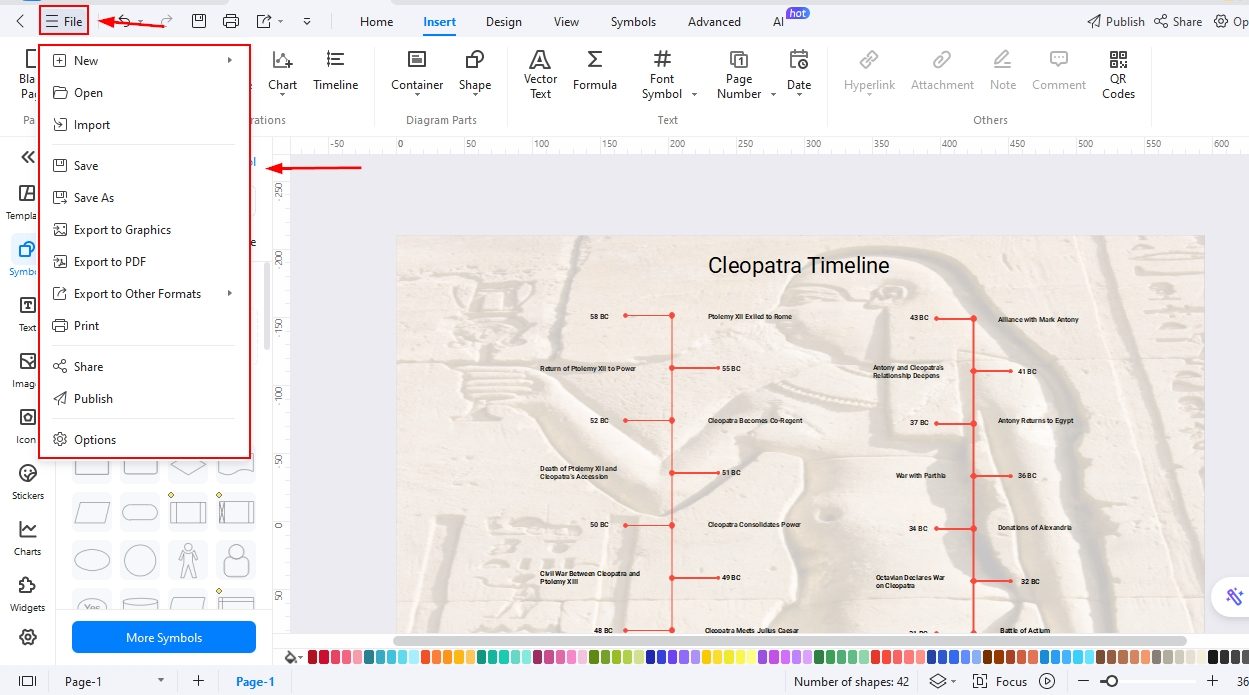
- Export your timeline via File → Export (PDF, PNG, SVG, PowerPoint) or save/share to EdrawMax Cloud for collaboration and presentation.
Final Words
The Cleopatra timeline reflects a life of ambition, intellect, and unyielding power. From her birth into royalty to her alliances with Rome’s most influential men, every moment shaped the ancient world.
By recreating her journey in EdrawMax, learners and historians can visualize how her strategic decisions changed history. This advanced tool not only simplifies complex timelines but also preserves Cleopatra’s story in a modern, visual form — ensuring her legacy continues to inspire future generations.
AI Diagram Generator
Enter your prompt. Upload files if needed. Generate diagrams, charts, or slides instantly.





 (AI & Web)