




Julius Caesar stands as one of the most remarkable figures in ancient Roman history. A general, statesman, and reformer whose legacy reshaped the world. To truly understand his influence, one must explore the Julius Caesar family tree. It connects noble ancestry, political ambition, and imperial succession. This article takes a closer look at his lineage, relationships, and descendants who carried his name and power into Rome’s future. In this article, we will learn about:
- The noble Julii family and Caesar’s early ancestry.
- Key family members, including parents, siblings, and adopted heirs.
- How Caesar’s legacy continued through Augustus and the Roman Empire.
In this article, you will be able to understand the legacy of Caesar and his role in shaping the world. Let's get into it!
In this article
Julius Caesar Family Tree
Julius Caesar’s family belonged to one of the oldest patrician lineages in Rome — the gens Julia. The Julii family claimed divine descent from Iulus (Ascanius), the son of Aeneas, who was said to be the son of Venus, the Roman goddess of love.
This noble ancestry gave Caesar not only political prestige but also a sense of destiny. His family members, both ancestors and descendants, played important roles in shaping the course of Roman history, politics, and culture.
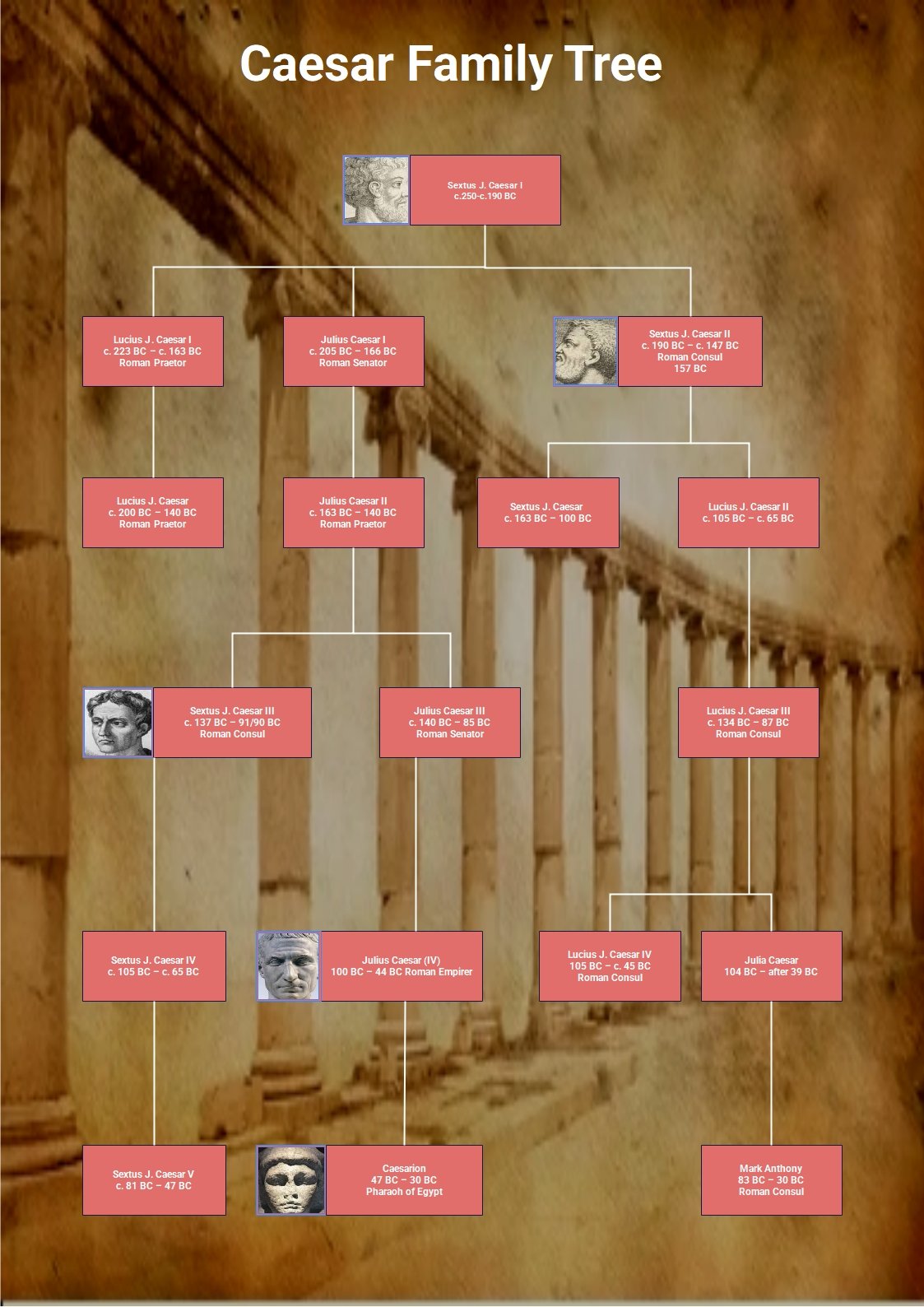


The Julius Family Background
The gens Julia was one of the most ancient patrician families of Rome, tracing its heritage back to the early Republic. Although by Caesar’s time the family had lost much of its earlier political prominence, it still carried immense respect.
The Julii were known for their service to Rome as senators, magistrates, and priests. This legacy of civic duty and leadership became a foundation for Julius Caesar’s own ambitions.
The family’s claim of divine ancestry — from Aeneas and the goddess Venus — gave Caesar an aura of divine favor. This mythic connection would later serve as a key part of his propaganda, strengthening his image as a leader destined to rule.
Julius Caesar’s Parents
Father: Gaius Julius Caesar the Elder (d. 85 BC)
Caesar’s father held the position of praetor, a significant judicial office in Rome, and governed the province of Asia. Although not a major political figure by the standards of his time, he laid the groundwork for his son’s career through his connections and social standing.
His early death, when Julius was just sixteen, left Caesar the head of the family and responsible for its continuation.
Mother: Aurelia Cotta (120–54 BC)
Aurelia was from a distinguished and politically active family, the gens Aurelia. She was known for her intelligence, discipline, and moral strength — traits that deeply influenced her son.
Ancient historians, including Suetonius and Plutarch, praise her as one of the most respected women in Rome. Aurelia supervised her son’s education and political training, ensuring he developed into a skilled orator and strategist.
Julius Caesar’s Siblings
Julia Major
Caesar’s elder sister, Julia Major, was married into other patrician families, strengthening political alliances. Though little is recorded about her personal achievements, her family connections played a role in linking the Julii to influential Roman circles.
Julia Minor
Julia Minor, Caesar’s younger sister, was more directly significant to history. She married Marcus Atius Balbus, and their daughter, Atia Balba Caesonia, became the mother of Gaius Octavius — better known as Augustus, the first emperor of Rome. This connection made Julia Minor the grandmother of the man who would transform Caesar’s political legacy into an empire.
Julius Caesar Himself (100–44 BC)
As the most famous member of his family, Gaius Julius Caesar was a statesman, general, and reformer who fundamentally altered Rome’s political landscape.
His military campaigns, particularly the conquest of Gaul (58–50 BC), expanded Rome’s territories and cemented his reputation as a brilliant strategist.
Politically, Caesar formed the First Triumvirate with Pompey and Crassus to dominate Roman politics. His rise, however, led to civil war and ultimately to his dictatorship.
As a reformer, Caesar reorganized the calendar (introducing the Julian calendar), enacted laws to aid people experiencing poverty, and restructured the government to centralize power.
His assassination on March 15, 44 BC (the Ides of March) marked the end of the Roman Republic but paved the way for the Roman Empire.
Cornelia, Pompeia, and Calpurnia – Caesar’s Wives
Caesar married three times, each marriage contributing to his political and social advancement:
Cornelia (c. 100–69 BC):
His first wife, Cornelia, was the daughter of Lucius Cornelius Cinna, a powerful leader of the populares faction. Their marriage strengthened Caesar’s ties to this political group. They had one daughter, Julia.
Pompeia (69–63 BC):
His second wife, Pompeia, was the granddaughter of Sulla, Rome’s former dictator. The marriage was politically strategic, but ended in scandal after the “Bona Dea” festival incident, where Pompeia was accused (though not proven) of impropriety. Caesar divorced her, famously declaring, “Caesar’s wife must be above suspicion.”
Calpurnia (59–44 BC):
His third and final wife, Calpurnia, was known for her devotion and loyalty. On the morning of Caesar’s assassination, she reportedly begged him not to attend the Senate after dreaming of his death — an omen that proved true.
Julia the Younger – Caesar’s Daughter
Caesar’s only legitimate child, Julia Caesaris, married Pompey the Great, another key figure in Roman politics and Caesar’s ally in the First Triumvirate.
Their marriage was a symbol of unity between two powerful men. However, Julia’s death during childbirth in 54 BC broke this alliance, leading to tensions that later sparked civil war between Caesar and Pompey.
Gaius Octavius (Augustus) – Caesar’s Adopted Heir
Julius Caesar had no male heirs, so he adopted his grandnephew Gaius Octavius (later Augustus) as his son and successor. This adoption was one of Caesar’s most lasting decisions. Augustus would go on to avenge Caesar’s death, defeat his assassins, and establish the Roman Empire.
Under Augustus, Rome entered a golden age of stability and cultural development known as the Pax Romana. He retained the outward appearance of republican rule while holding absolute power — a system that continued for centuries.
Augustus also reinforced the divine lineage of the Julian family, promoting Caesar’s deification as Divus Julius.
Other Notable Relatives
- Atia Balba Caesonia: Julius Caesar’s niece and mother of Augustus, she was praised for her piety and discipline. Her moral character was said to have influenced her son’s leadership style.
- Lucius Julius Caesar: A distant cousin of Julius Caesar, he served as consul and supported reforms that aligned with Caesar’s vision for Rome.
Legacy of the Julian Line
The descendants and relatives of Julius Caesar continued to shape Roman politics for generations. The Julio-Claudian dynasty, which included emperors Augustus, Tiberius, Caligula, Claudius, and Nero, traced its lineage back to Caesar through blood or adoption.
The family’s influence marked the beginning of imperial Rome — a shift that defined the ancient world for centuries.
How to Create a Julius Caesar Family Tree with EdrawMax
Understanding the intricate lineage of Julius Caesar becomes much simpler with EdrawMax, a powerful all-in-one diagramming tool designed for clarity and precision. Julius Caesar, one of Rome’s most celebrated figures, hailed from the noble Julii clan, a family whose influence shaped the political and social fabric of ancient Rome.
Visualizing his ancestry with EdrawMax allows you to trace connections from his mythological descent from Venus to his adopted heir, Augustus, the first emperor of Rome.
- Professional Diagram Layouts: EdrawMax supports organizational charts and hierarchical structures, making it easy to map Julius Caesar’s family lineage with clear generational divisions and relationships.
- Extensive Template Library: Access a wide range of pre-designed family tree and genealogy templates to save time and ensure historical accuracy while customizing the design to match Roman-era aesthetics.
- Drag-and-Drop Editing: Add, connect, and reposition family members using EdrawMax’s intuitive drag-and-drop interface, ensuring a seamless workflow for building complex historical family trees.
- Customization Options: Personalize your Julius Caesar family tree with colors, images, and icons to represent different generations, alliances, and marital ties in a visually appealing way.
- Data Import & Export Flexibility: Import data or images from external files and export your final diagram in multiple formats, such as PDF, Word, or PowerPoint, ideal for academic or research presentations.
Step-by-Step Guide to Create a Family Tree
 Get 500 free AI tokens
Step1 Open the Empty Canvas
- Launch EdrawMax and click on the New tab from the main dashboard.
- Select Blank Drawing under the Organizational Chart or Mind Map category to open an empty workspace for mapping the Julius Caesar family tree.

Step2 Add Elements Needed in the Family Tree
- Navigate to the Insert elements in the canvas and start arranging all the elements.
- Arrange the elements vertically or hierarchically to reflect the generational structure of the Julii family.

Step3 Add Details for Each Family Member
- Add names for each family member and add all the relevant information that you can in the diagram.
- Resize and align the images for uniformity and a clean, scholarly presentation.

Step4 Add Relationships Among the Family Members
- Use Connector Lines from the toolbar to represent relationships such as parentage, marriage, or adoption between family members.
- Label connections with names or relationship roles (e.g., “Father,” “Adopted Son,” or “Ancestor”) for clarity.

Step5 Export Your File
- Once your Julius Caesar family tree is complete, go to the File tab and select Export & Send to save it in formats like PDF, PNG, or Word.
- Store your file locally or in EdrawMax Cloud, and share it with classmates, historians, or colleagues for research and presentation purposes.

Final Words
The Julius Caesar family tree reveals how one lineage profoundly influenced the rise of the Roman Empire. From his noble ancestors and political alliances to his adopted heir Augustus, every connection shaped history. By visualizing these relationships with EdrawMind, the complex web of Roman power becomes easier to grasp and explore.
This powerful tool not only simplifies historical understanding but also brings Caesar’s enduring legacy to life through clear, interactive, and engaging visual storytelling.
AI Diagram Generator
Enter your prompt. Upload files if needed. Generate diagrams, charts, or slides instantly.





 (AI & Web)