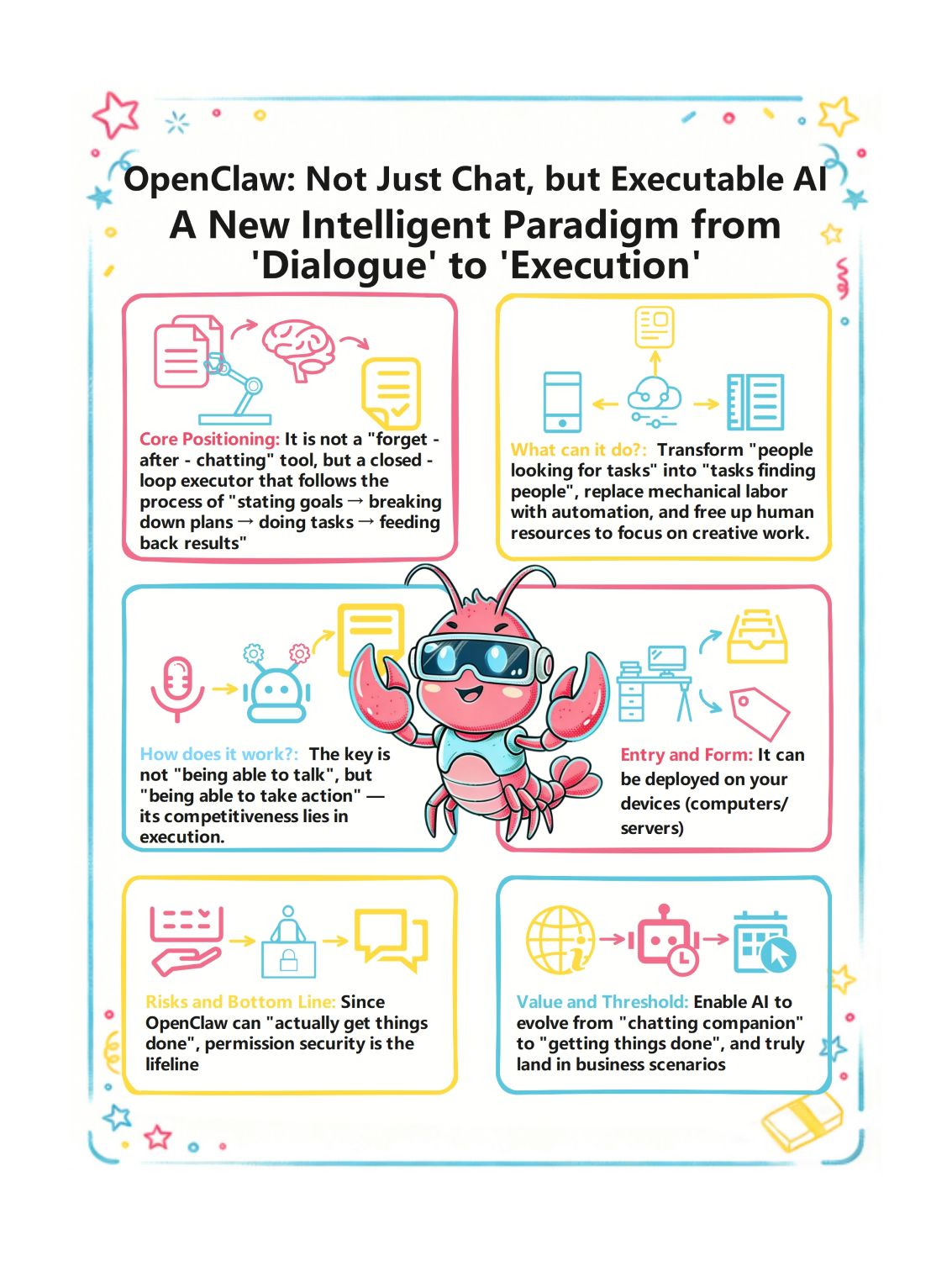
About this OpenClaw AI Agent Explanation Diagram template
This diagram clarifies the difference between basic chatbots and executable AI agents like OpenClaw. It outlines the core positioning, operational logic, and security measures necessary for landing AI in business scenarios. Use this template to visualize automation workflows and the evolution of intelligent task management.
Core Positioning
OpenClaw is defined as a closed-loop executor rather than a simple chat tool. It manages the entire lifecycle of a task from initial goal setting to the final delivery of results for users.
- Stating clear goals
- Breaking down complex plans
- Executing specific tasks
- Feeding back results
What can it do?
This AI agent transforms the workflow by making tasks find the right people. It automates mechanical labor to increase speed. This shift allows human employees to focus their energy on high-value creative projects.
- Automates mechanical labor
- Shifts tasks to people
- Reduces manual workload
- Enhances creative focus
How does it work?
The primary strength of OpenClaw is its ability to take direct action. While other AI models focus on talking, this system prioritizes execution. Its competitive edge lies in getting work done efficiently within software environments.
- Focus on execution
- Action-oriented logic
- High competitiveness
- Task completion focus
Entry and Form
Users can deploy OpenClaw directly onto their own hardware systems. It is versatile enough to run on personal computers or large-scale servers. This flexibility ensures it fits into various professional and technical setups easily.
- Computer deployment
- Server integration
- Local installation
- Flexible entry points
Risks and Bottom Line
Because OpenClaw has the power to perform actions, security is the top priority. Permission management serves as the lifeline for the system. It ensures that the AI only performs authorized tasks within safe boundaries.
- Permission security
- System lifeline
- Risk mitigation
- Authorized access
Value and Threshold
OpenClaw moves beyond being a simple chatting companion. It provides real business value by landing in professional scenarios where results matter. It represents a significant evolution in how artificial intelligence supports modern enterprise goals.
- Business scenario landing
- Result-oriented value
- AI evolution
- Task completion
FAQs about this Template
-
What is the main difference between OpenClaw and a standard AI chatbot?
Standard AI chatbots focus on conversation and providing information based on text prompts. In contrast, OpenClaw is built for execution. It follows a closed-loop process that includes planning and performing tasks. This means it does not just talk about a problem; it actually completes the work and provides the final results to the user.
-
Why is permission security considered the lifeline of OpenClaw?
Since OpenClaw is an executable agent, it has the ability to interact with files and systems. This power requires strict control to prevent unauthorized actions or data breaches. Permission security ensures that the AI only operates within its designated scope. Without these safeguards, the risks of automation could outweigh the benefits of efficiency.
-
How does OpenClaw help human workers focus on creative tasks?
OpenClaw handles the mechanical and repetitive labor that often slows down human employees. By automating these routine tasks, the AI frees up time for people to focus on strategy and creativity. Instead of searching for tasks, the system manages the workflow. This allows teams to contribute more value while the AI handles routine.


 (AI & Web)