Free chemical diagram maker
Create a chemistry diagram without the usual struggle. Turn your rough chemistry notes into a professional diagram in just a few clicks using an online chemical diagram maker.

Why Use EdrawMax Chemical Diagram Maker?
Struggling with your assignments and don't know how to make a chemical diagram? Don't worry anymore. EdrawMax offers a huge collection of ready-made templates for everything from simple molecules to complex reaction paths. Just pick a layout that fits your project, click it, and start editing right away to save your valuable time.

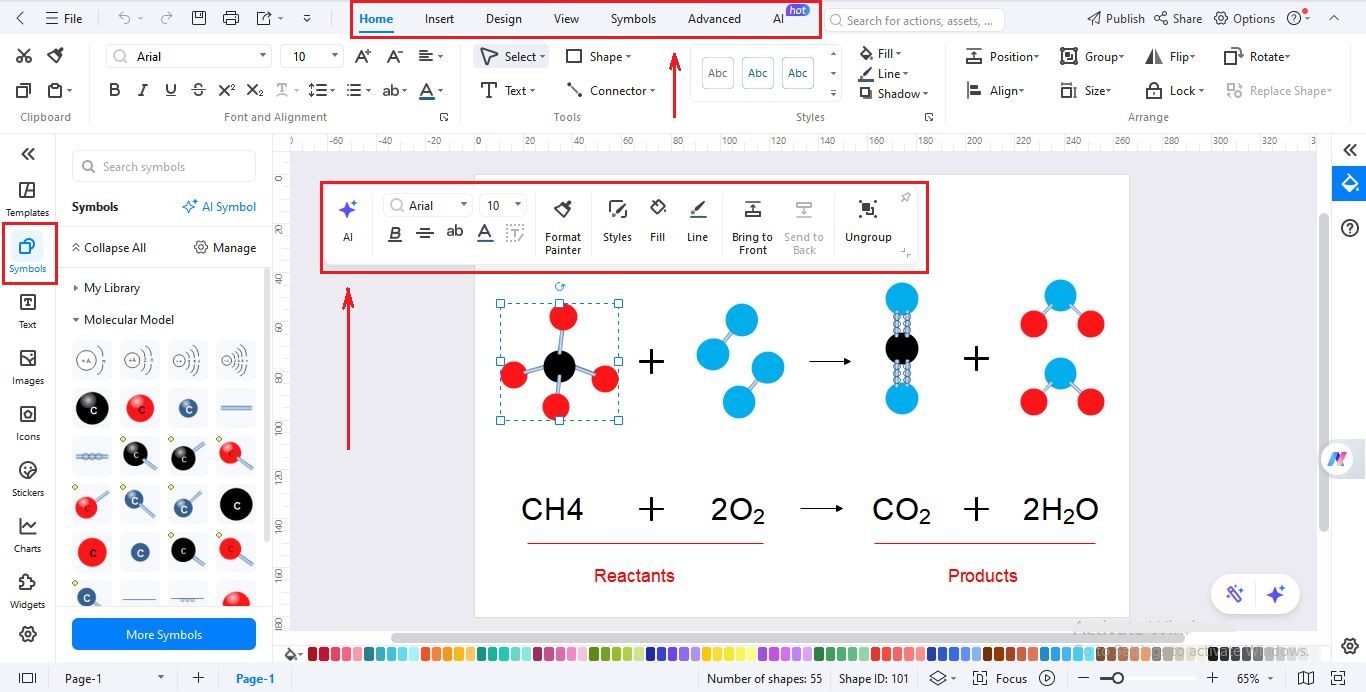
Stop struggling to draw every single bond and beaker from scratch. Our library is packed with thousands of specialized symbols, including atoms, functional groups, lab glassware and more. Just drag and drop these pieces onto your canvas to build an accurate chemical reaction diagram in just a few minutes.

Get high-quality visuals without being a professional artist. Our scientific illustration (powered by Nano Banana Pro) uses smart tools to help you generate accurate diagrams in seconds. Just type what you need, and watch your chemical visuals come to life with incredible precision.

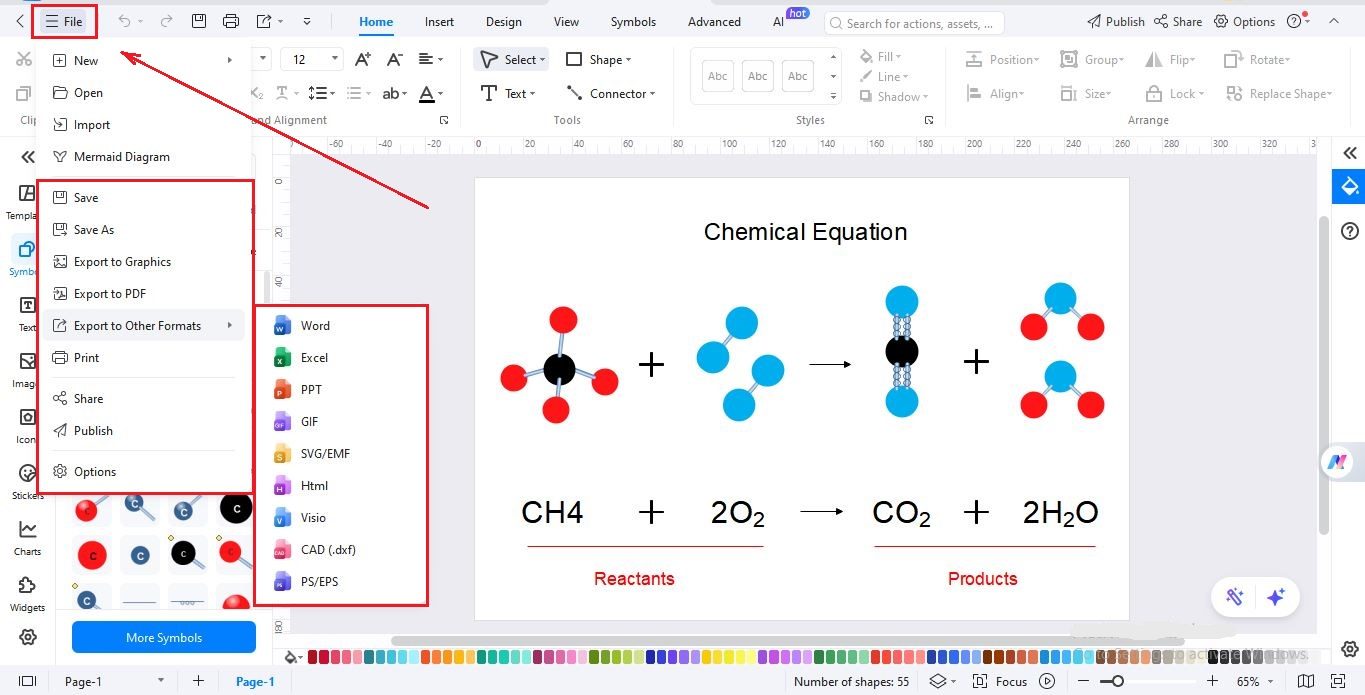
Sharing your hard work shouldn't be a hassle for you or your team. You can save your chemistry diagram in many different formats, including PDF, PNG, Word, and more. This flexibility ensures your visuals look sharp and professional whether they are in a research paper or a slide deck.

How to Make a Chemical Diagram in 3 Simple Steps

What our users say

More Chemical Diagram Tools
Discover more AI-powered diagram makers to boost your productivity.
FAQs About EdrawMax Chemical Diagram Tools
-
What is a chemical diagram?A chemical diagram is a visual representation of the structure and composition of a molecule or compound. It uses symbols for elements and lines to represent chemical bonds. These diagrams help scientists communicate complex information quickly, showing how atoms are arranged and connected within a specific chemical substance.
-
What are the main types of chemical diagrams?Common types include Lewis structures, skeletal formulas, and ball-and-stick models. Lewis structures show valence electrons and bonds, while skeletal formulas simplify organic molecules by omitting most hydrogen atoms. Ball-and-stick models provide a three-dimensional perspective, helping researchers understand the physical spatial arrangement and geometry of different molecular structures.
-
How to read a skeletal formula?In a skeletal formula, carbon atoms are represented by the vertices and ends of lines. Hydrogen atoms attached to carbons are usually implied rather than drawn. Other elements, like oxygen or nitrogen, are explicitly labeled. This streamlined approach makes it easier to visualize large, complex organic molecules quickly.
-
What do single and double lines represent?In chemical diagrams, a single line represents a single covalent bond, where two atoms share one pair of electrons. A double line signifies a double bond, involving two shared electron pairs. These lines indicate the strength and type of connection between atoms, which is crucial for predicting chemical behavior.
-
Why are Lewis structures useful in chemistry?Lewis structures are essential because they show how valence electrons are distributed around atoms in a molecule. By displaying lone pairs and bonding pairs, these diagrams help predict molecular shape, reactivity, and how atoms will interact with others. They serve as a fundamental tool for understanding chemical bonding principles.
Stop drawing. Start describing.
AI diagramming isn't just text-to-diagram.
AI now understands any input, fetches live data, adapts through dialogue, and works everywhere.
 (AI & Web)
Free Chemical diagram templates from EdrawMax