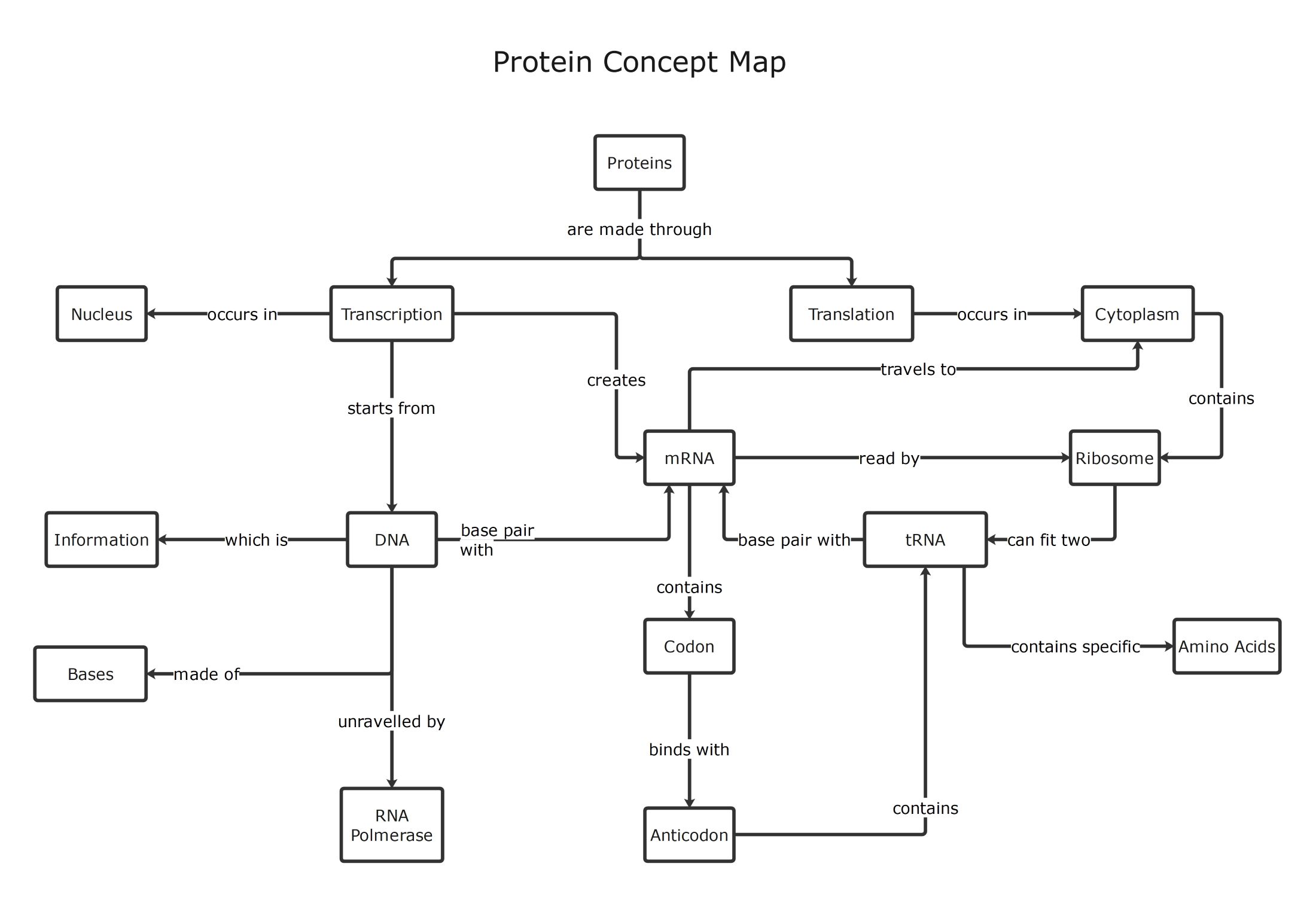
About this Protein Concept Map template
This template offers a clear visual breakdown of protein synthesis. It tracks genetic information from the nucleus into the cytoplasm for final production. Use this guide to simplify the study of transcription and translation for any biology class.
Transcription Process
Transcription is the first major step in creating proteins within a cell. This process happens inside the nucleus where DNA is stored safely. It involves copying genetic code to create a messenger molecule for later use.
- Occurs in the Nucleus
- Starts from DNA information
- DNA is unraveled by RNA Polymerase
- Creates mRNA strands
DNA and Information
DNA serves as the master blueprint for all biological life. It consists of nitrogenous bases that hold essential genetic instructions. During protein synthesis, enzymes must access these bases to start the process of building new protein chains.
- Contains genetic information
- Composed of chemical bases
- Base pairs with mRNA during transcription
- Requires RNA Polymerase for unraveling
mRNA and Codons
Messenger RNA acts as a bridge between DNA and final protein production. It carries the genetic code from the nucleus into the cytoplasm. This molecule contains codons which are essential for the next stage of protein building.
- Travels to the Cytoplasm
- Contains specific Codons
- Binds with tRNA Anticodons
- Read by Ribosomes for translation
Translation and Ribosomes
Translation is the stage where the cell actually builds the protein chain. This occurs in the cytoplasm where ribosomes read the mRNA code. The process brings together amino acids in the correct order based on genetic instructions.
- Occurs in the Cytoplasm
- Involves Ribosomes reading mRNA
- Ribosomes accommodate tRNA molecules
- Results in specific Amino Acid chains
FAQs about this Template
-
What is the main difference between transcription and translation?
Transcription and translation are the two primary steps of protein synthesis. Transcription occurs in the nucleus and turns DNA into mRNA. Translation happens later in the cytoplasm. During translation, ribosomes read the mRNA to build a specific protein chain. These processes work together to ensure that genetic information is used correctly to support the life and function of a cell.
-
Why are codons and anticodons important in this concept map?
Codons and anticodons are vital for accuracy during protein synthesis. A codon is a three-base sequence on the mRNA. An anticodon is a matching sequence found on tRNA. When these two bind together, they ensure the correct amino acid is added to the growing protein chain. This precise pairing prevents genetic errors and ensures the final protein works as intended by the DNA.
-
What role does RNA polymerase play in the transcription process?
RNA polymerase is a crucial enzyme that starts the transcription process. It binds to the DNA strand and helps unravel the double helix structure. Once the DNA is open, the enzyme uses the template to create a new mRNA strand. Without RNA polymerase, the cell cannot read the genetic instructions stored in the DNA. This makes it an essential component for all protein production.


 (AI & Web)