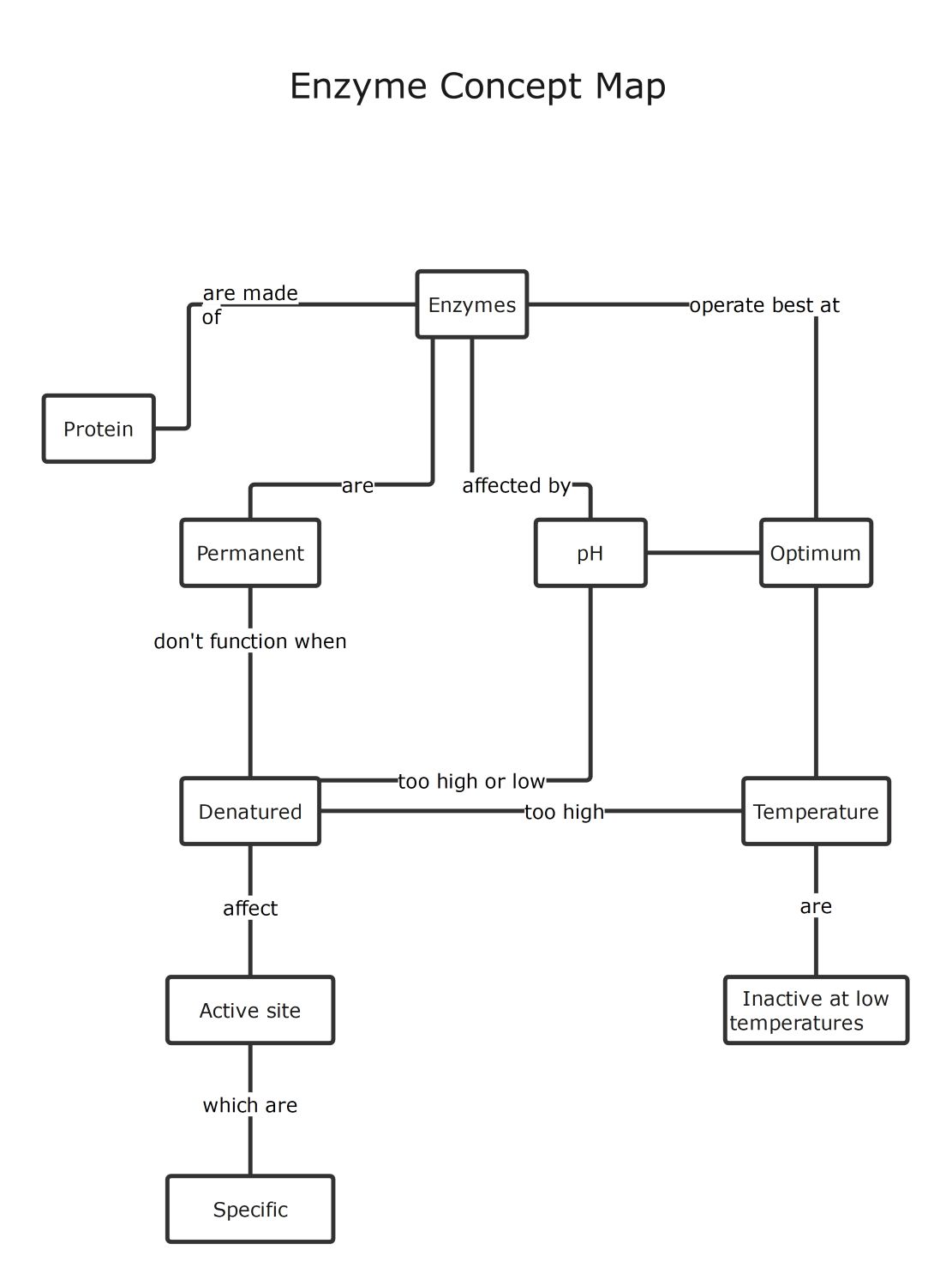
About this Enzyme Concept Map template
This template provides a clear visual guide to understanding enzyme functions and properties. It helps learners connect biological concepts like protein structure, temperature, and pH levels to enzymatic activity and denaturation processes effectively.
Enzyme Composition and Nature
Enzymes are specialized biological molecules primarily composed of proteins. Their unique structure allows them to perform specific tasks within a cell. This section highlights the fundamental makeup and the permanent nature of these catalysts.
- Made of Protein
- Permanent nature
Environmental Factors and pH
Environmental conditions like pH levels significantly influence how well an enzyme works. When pH levels are too high or too low, the enzyme's efficiency drops. Proper balance is required for maintaining the enzyme's structural integrity.
- Affected by pH
- Optimum pH levels
- Denatured by high or low pH
Temperature and Performance
Enzymes operate most efficiently at a specific optimum temperature. While low temperatures may cause inactivity, excessively high temperatures lead to permanent changes. Managing heat is vital for ensuring that biological processes continue at the correct rate.
- Operate best at Optimum Temperature
- Inactive at low temperatures
- Denatured at high temperatures
Active Sites and Specificity
The active site is the crucial region where substrates bind to the enzyme. Because active sites have specific shapes, enzymes only interact with certain molecules. Denaturation alters this shape, preventing the enzyme from functioning correctly anymore.
- Active site region
- Specific interactions
- Affected by denaturation
FAQs about this Template
-
How does temperature affect enzyme activity?
Enzymes have an optimum temperature where they work most efficiently. At low temperatures, kinetic energy is low, making enzymes inactive. However, high temperatures are dangerous. They cause the enzyme's protein structure to unfold, a process called denaturation. Once denatured, the active site changes shape, and the enzyme can no longer bind to its substrate or function.
-
Why is the active site of an enzyme so important?
The active site is the specific region where chemical reactions occur. Its unique shape allows it to bind only with a specific substrate, similar to a lock and key. If this shape is altered by heat or pH changes, the substrate can no longer fit. This specificity ensures that metabolic pathways in the body remain organized and highly controlled.
-
What happens when an enzyme becomes denatured?
Denaturation occurs when extreme heat or improper pH levels break the bonds holding the enzyme's protein structure together. This leads to a permanent loss of the enzyme's three-dimensional shape. Because the active site is destroyed, the enzyme loses its ability to catalyze reactions. Most denaturation is irreversible, meaning the enzyme becomes completely non-functional for the cell.






 (AI & Web)