




As they say, Rome wasn't built in a day, and neither was its empire. From the first emperor, Augustus, in 27 BCE, to the fall of the Western Empire in 476 CE, Rome was shaped by a long line of fascinating rulers. Some leaders brought glory, wealth, and expansion, like Trajan, while others brought chaos and fear, like Nero. The empire experienced golden ages of peace and culture, but also times of political turmoil and civil war.
This timeline guides you through the lives and reigns of Rome’s emperors, showing their success, failures, and lasting impact. It highlights how ambition, power, and circumstance combined to create one of history’s most remarkable civilizations.
In this article
Roman Emperors Timeline
When the Roman Empire was at its peak, it spanned three continents and lasted for more than five hundred years. Its remarkable journey began when Augustus took power in 27 BCE, following the collapse of the Roman Republic.
These leaders shaped historical events through their rule, which sometimes brought stability and success but also led to instability and destruction. Each leader created their own historical legacy through their actions.
This Roman Emperors Timeline presents the most significant emperors who ruled Rome throughout history. You'll find out how each emperor shaped the empire's growth while dealing with obstacles that ultimately led to its downfall.
So, let's get started.
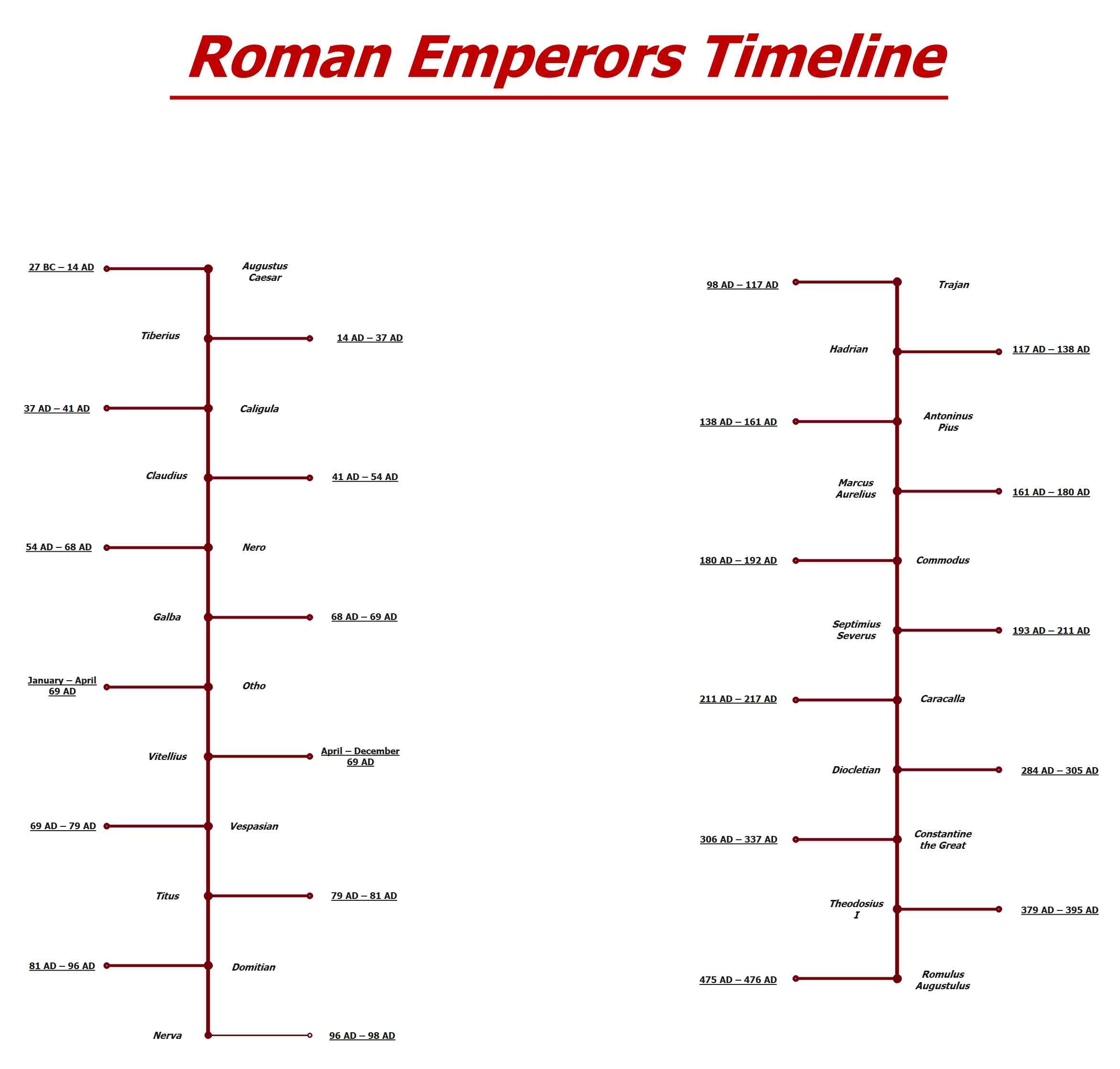


Augustus Caesar (27 BC - 14 AD)
Augustus was also known as Octavian. He was the first emperor of ancient Rome and the founder of the Roman Empire. He brought peace back after years of war and the Pax Romana. His reign was the start of Rome's golden age and the end of the Republic.
Tiberius (14 AD - 37 AD)
Tiberius was the adopted son of Augustus. A capable general, during his reign, he became unpopular. Being very stern by nature, he gave stability to Rome but ruled suspiciously and fearfully. Later, he withdrew to Capri, leaving Rome under harsh officials.
Caligula (Julius Caesar) (37 AD - 41 AD)
Worst of all was Caligula, originally named Gaius Julius Caesar Germanicus, who began as a popular ruler before turning cruel and unstable. He spent extravagantly on the most outlandish of shows and punished those he didn't like. His wild behavior ultimately got him assassinated by the Praetorian Guard.
Claudius (41 AD - 54 AD)
After Caligula died, Claudius became emperor. People thought he was dumb and lazy at first because of how he looked, but he turned out to be smart and hard-working. He made the government better and added Britain to the empire. Later, people thought that his wife, Agrippina, had poisoned him.
Nero (54 AD - 68 AD)
Nero became emperor after the death of his adoptive father, Claudius. He was known for his love of music and art, but his rule turned violent. The Great Fire of Rome happened during his reign, and he blamed the Christians. He committed suicide in 68 AD.
Galba (68 AD - 69 AD)
Galba became emperor after Nero's death. He was a strict and unpopular ruler who tried to restore discipline in the army. His harsh actions angered the soldiers, and they turned against him. Galba was killed in the Forum during a revolt led by Otho.
Otho (January - April 69 AD)
When Galba died, Otho became emperor. He ruled for only three months during the Year of the Four Emperors. Otho took his own life after losing a battle to Vitellius to avoid more bloodshed. He was respected for his brave end.
Vitellius (April - December 69 AD)
Vitellius was the third emperor of the chaotic Year of the Four Emperors. He gained power after defeating Otho but ruled for only a few months. He is remembered for his cruelty and feasting. When Vespasian's forces entered Rome, Vitellius was captured and killed.
Vespasian (69 AD - 79 AD)
Vespasian started the Flavian dynasty and restored peace after the civil war. His era was full of peace and prosperity. He started many great projects, and one of the most famous of them is the Colosseum. His rule returned stability and hope to the Roman world.
Titus (79 AD - 81 AD)
Titus was the son of Vespasian, who ruled with kindness and fairness. He completed the Colosseum and helped the people after disasters like the eruption of Mount Vesuvius. His short reign was peaceful, and the Roman people loved him.
Domitian (81 AD - 96 AD)
Domitian was the younger brother of Titus. He strengthened the empire's borders and improved its finances. However, he became harsh and ruled as a dictator. His fear and suspicion led to many deaths. He was killed in a palace plot.
Nerva (96 AD - 98 AD)
Nerva became emperor after Domitian's assassination. He restored freedom and peace in Rome. To secure stability, he adopted the general Trajan as his heir. Nerva's short reign ended with the start of the great Nerva-Antonine dynasty.
Trajan (98 AD - 117 AD)
Trajan was a successful general and one of Rome's greatest emperors. He expanded the empire to its largest size and built many public works. Under his rule, Rome reached its greatest power and prosperity. He was loved for his fairness and generosity.
Hadrian (117 AD - 138 AD)
Hadrian focused on protecting Rome's borders instead of expanding them. He built Hadrian's Wall in Britain and reformed the government. A lover of art and culture, he promoted Greek learning and peace throughout the empire. His reign was long and stable.
Antoninus Pius (138 AD - 161 AD)
Antoninus Pius ruled during one of the calmest times in Roman history. He was fair, gentle, and wise. He avoided wars and governed peacefully. His care for the people and sense of justice made him one of the most respected emperors.
Marcus Aurelius (161 AD - 180 AD)
Marcus Aurelius was called the Philosopher King. He ruled with wisdom and duty, following Stoic ideas. His reign faced wars and plagues, but he remained calm and just. His writings, known as Meditations, showed his deep thoughts about life and virtue.
Commodus (180 AD - 192 AD)
Commodus was the son of Marcus Aurelius. Unlike his father, he loved luxury and gladiator games. His strange and cruel behavior weakened the empire. He was killed in a plot by his own guards, ending the line of the good emperors.
Septimius Severus (193 AD - 211 AD)
After years of war, Septimius Severus became emperor. The Severan dynasty and reinforcement of the army became his foundation. He had extended the empire and governed decisively. His reign saw the rise of Rome, turning towards military power, and it did not remain under the control of the Senate.
Caracalla (211 AD - 217 AD)
Septimius Severus had a son called Caracalla. Through his well-known decree, he transferred all of the free men in the empire to the position of Roman citizens. He was a tyrannical leader who was violent and levied high taxes. In the East, one of his soldiers killed him.
Diocletian (284 AD - 305 AD)
Diocletian put an end to years of anarchy by breaking up the empire into four divisions or the Tetrarchy. He reorganized the army and economy, restoring peace in Rome. He was the first emperor ever to retire voluntarily and live in peace.
Constantine the Great (306 AD - 337 AD)
Through the Edict of Milan, Constantine brought back the Roman Empire and legalized Christianity. He established a new capital of Constantinople, which became the centre of power. His reign transformed Rome permanently, and it became a Christian empire.
Theodosius I (379 AD - 395 AD)
Theodosius I was the only emperor to rule the East and the West. He turned Christianity into the official religion of the empire. Following his demise, his two sons inherited the empire, and they came to be known as the Eastern and the Western Empires.
Romulus Augustulus (475 AD - 476 AD)
Romulus Augustulus was the last emperor of the Western Roman Empire. He was a ruler who was put on the throne by his father, and he was soon overthrown by the Germanic general Odoacer. His fall marked the official end of ancient Rome.
How to Make a Similar Timeline?
Timelines are a fun way to see events in order and make history or projects easier to understand. It’s like telling a story step by step. Check out these easy tips to get started.
- Define your purpose and scope: Before starting, clarify what you want the timeline to show (e.g., the reigns of rulers, or project milestones) and how broad it will be.
- Choose the right time scale and medium: Decide how detailed the timeline will be (years, decades, centuries) and pick the medium (paper, digital, SmartArt, spreadsheet).
- Gather and organise your events: Make a list of the key events with dates and short descriptions. Then place them in chronological order.
- Visual clarity and design: Use a clear horizontal or vertical line, mark dates evenly, and use colours, shapes, or images to differentiate items and draw attention to key points.
- Highlight milestones and major changes: Make sure your timeline emphasises the big turning points (e.g., in your case: start of an emperor’s reign, major expansions, decline phases) so the reader can see the narrative flow.
- Use appropriate tools and templates: If creating digital, take advantage of tools like EdrawMax or Lucidchart for interactive timelines.
- Review, refine, and update: As you build the timeline, check for readability, accuracy, and whether the sequence makes sense. Adjust spacing, wording, or visuals as needed.
Steps to Make a Roman Emperors Timeline
Step1 Start with a Blank Canvas
- Open Wondershare EdrawMax on your device.
- Sign in or create an account.
- Click New > Blank Drawing to open a fresh canvas.

 Get 500 free AI tokens
Step2 Add a Timeline Title
- Type or insert a title like “Roman Emperors Timeline,” using text or an image. We'll use text here.
- Click Text and then Click to Add Title to add your title.
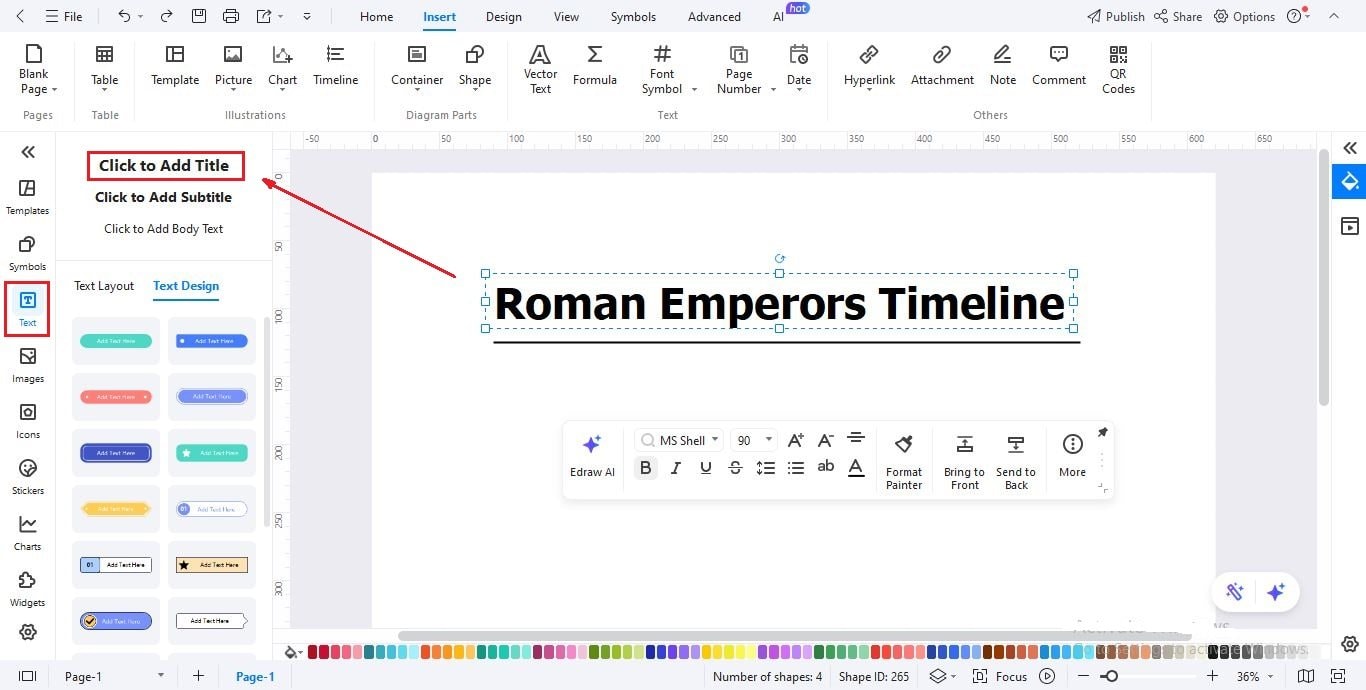
Step3 Insert the Timeline Layout
- Click Insert on the top menu.
- Click "Timeline," then choose "Vertical Timeline" or "Horizontal Timeline" based on your preference.
- Click OK to add it to your canvas.
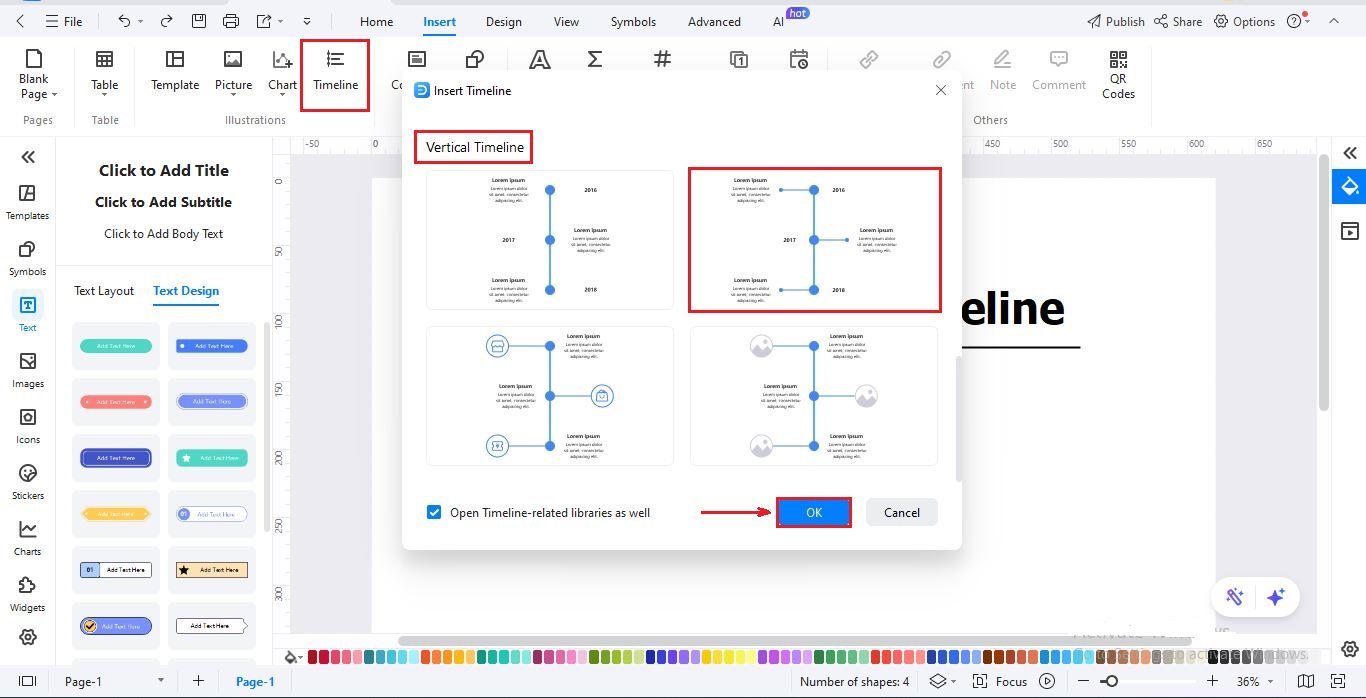
Step4 Add Emperors’ Details
- Click Text from the left panel.
- Enter the year (e.g., [27 BCE]) and the emperor’s name (e.g., Augustus) for each ruler.
- Keep descriptions short, like one sentence about their reign or major achievements.
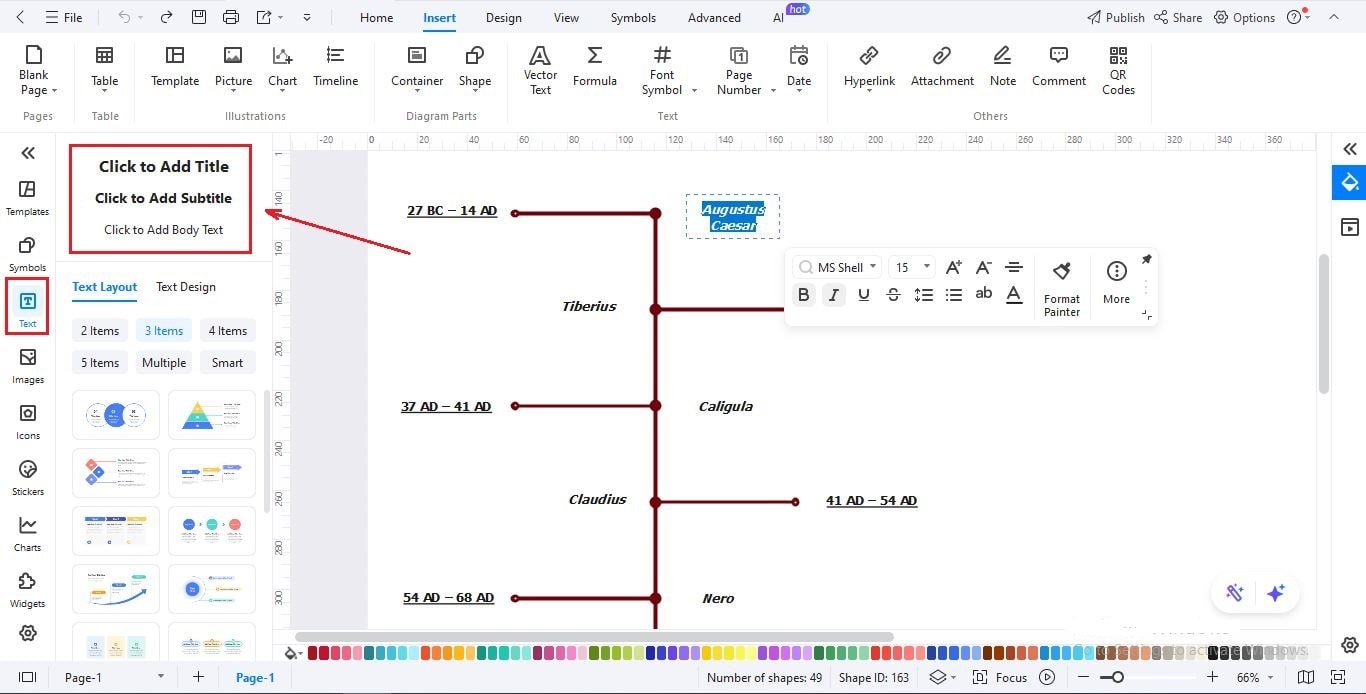
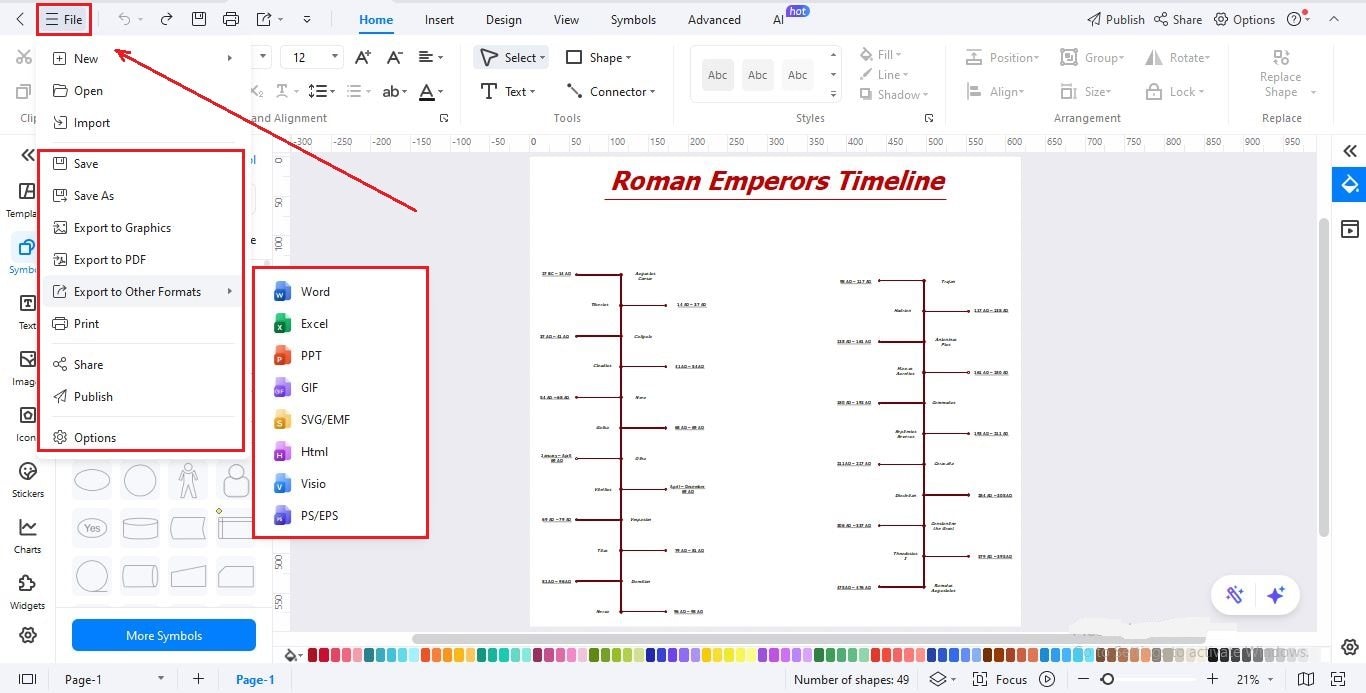
Step5 Save and Export
- Click File > Save to keep your work editable.
- To share, go to File > Export and select PNG, PDF, SVG, or HTML.
- Click Publish to share it with the EdrawMax community.
Wrapping Up
The story of the Roman Empire is full of amazing leaders and big events. From Augustus, the first emperor, to Romulus Augustulus, the last, each ruler changed Rome in their own way. Some brought peace and growth, while others caused trouble and fear. Together, they made one of the most famous civilizations in history.
Looking at this timeline helps us understand history step by step. And if you want to turn stories from the past into a visual journey, EdrawMax lets you build colorful and clear timelines in minutes.
AI Diagram Generator
Enter your prompt. Upload files if needed. Generate diagrams, charts, or slides instantly.





 (AI & Web)