About this ERP Business Process template
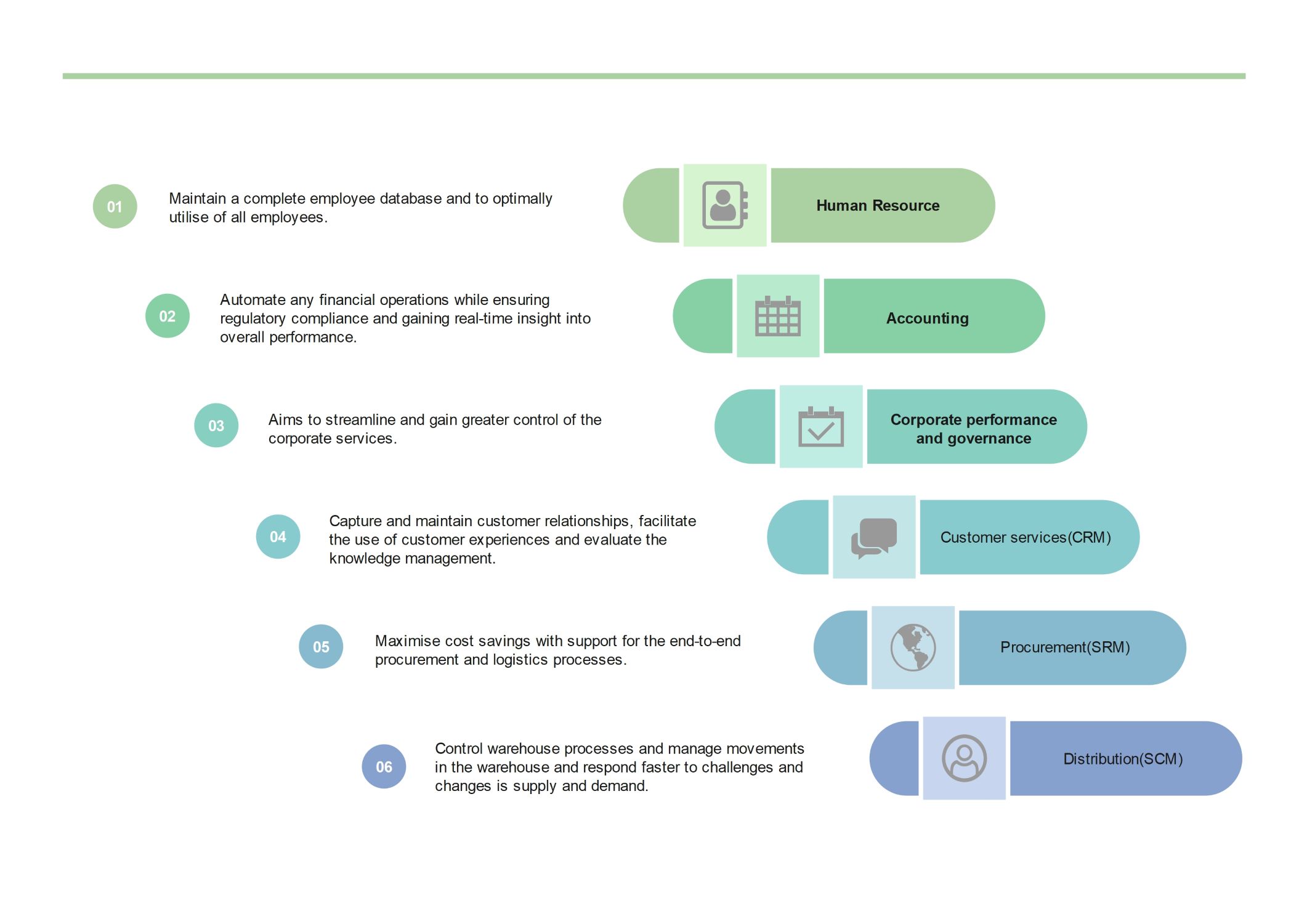
This template highlights the six foundational modules of an Enterprise Resource Planning system. It serves as a visual guide to connecting human resources, finance, and logistics. Use this layout to map your internal workflows and ensure every department works from a single source of truth.
Human Resource
Human Resource modules focus on managing your company's most valuable asset: its people. This section explains how to maintain employee records and optimize staff utilization. It ensures that every worker is assigned to the right tasks for maximum productivity.
- Maintain complete employee database
- Optimally utilize all employees
- Track workforce performance
- Streamline recruitment and onboarding
Accounting
Financial management is the backbone of any ERP system. This module automates daily financial operations while ensuring strict regulatory compliance. It provides managers with real-time insights into the company's fiscal health, allowing for faster and more accurate decision-making processes.
- Automate financial operations
- Ensure regulatory compliance
- Gain real-time insight into performance
- Manage budgets and forecasting
Corporate performance and governance
This section focuses on high-level oversight and administrative control. It aims to streamline corporate services to ensure the business meets its strategic goals. By centralizing governance, organizations gain better control over internal policies and maintain consistent operational standards.
- Streamline corporate services
- Gain greater control of operations
- Monitor strategic goal progress
- Manage internal policy compliance
Customer services (CRM)
The CRM module manages all interactions with your clients and prospects. It captures detailed customer relationships and evaluates knowledge management strategies. By using customer experiences, businesses can improve service quality and build long-term loyalty through personalized and efficient communication.
- Capture and maintain customer relationships
- Facilitate use of customer experiences
- Evaluate knowledge management
- Track sales pipelines and history
Procurement (SRM)
Procurement modules are designed to maximize cost savings throughout the supply chain. This section supports end-to-end logistics and supplier relationship management. Efficient procurement processes ensure that the business acquires materials at the best prices while maintaining strong relationships with reliable vendors.
- Maximize cost savings
- Support end-to-end procurement
- Manage logistics processes
- Optimize supplier relationships
Distribution (SCM)
Supply Chain Management is critical for controlling warehouse processes and product movement. This module helps managers respond quickly to sudden changes in supply and demand. By managing stock levels effectively, companies can prevent shortages and ensure that customers receive orders on time.
- Control warehouse processes
- Manage movements in the warehouse
- Respond to supply and demand changes
- Track inventory in real time
FAQs about this Template
-
How does an ERP system improve business efficiency?
An ERP system improves efficiency by centralizing all company data into one single source of truth. This eliminates the need for manual data entry across different departments, which reduces human errors significantly. With automated workflows and real-time updates, employees can focus on high-value tasks instead of administrative work. Consequently, businesses experience faster communication and more streamlined operational cycles across every department.
-
What are the benefits of integrating CRM with an ERP?
Integrating CRM with an ERP provides a 360-degree view of every customer. This allows sales and support teams to see order history, payment status, and interaction logs in one place. It leads to more personalized service and faster response times. Additionally, sales data flows directly into the accounting and inventory modules. This helps businesses predict demand and manage their cash flow much better.
-
Why is the distribution module critical for supply chains?
The distribution module is vital because it offers real-time visibility into warehouse stock and logistics. It allows managers to track movements and monitor inventory levels accurately. This visibility helps the business react quickly to market fluctuations or supply chain disruptions. By optimizing warehouse processes, companies can reduce carrying costs, prevent stockouts, and ensure that products reach customers efficiently and without unnecessary delays.

 (AI & Web)