About this Research Project Task Decomposition template
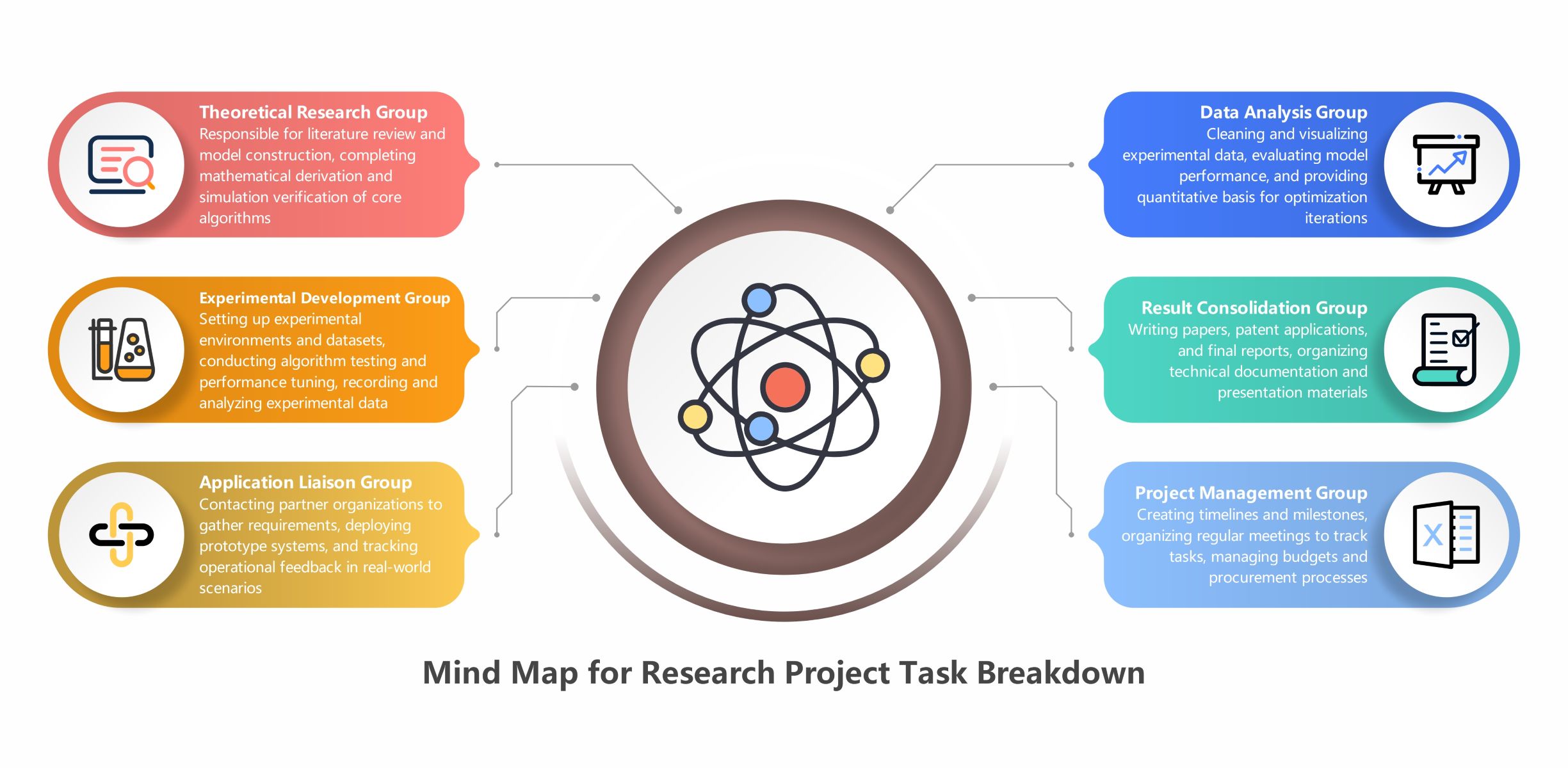
This template provides a clear visual structure for organizing a research team. It breaks down complex research goals into manageable tasks across six specialized groups. It is perfect for academic labs and corporate R&D teams.
Theoretical Research Group
This group handles the foundational elements of the research study. They focus on academic literature and building mathematical models. Their work ensures the core logic and algorithms are sound before any testing begins in the lab.
- Literature review and analysis
- Model construction and refinement
- Mathematical derivation of theories
- Simulation verification for core algorithms
Experimental Development Group
Members of this group turn theoretical ideas into practical reality. They manage the technical environment and run rigorous tests on algorithms. This team is responsible for collecting the raw data needed for the final project analysis.
- Setting up experimental environments
- Creating and managing datasets
- Conducting algorithm testing
- Performance tuning and recording data
Application Liaison Group
This group acts as the bridge between the research team and the outside world. They work with partners to gather requirements and test systems in real-life settings. They ensure the research meets actual user needs.
- Contacting partner organizations
- Gathering user and system requirements
- Deploying prototype systems
- Tracking operational feedback in real-world scenarios
Data Analysis Group
This group processes all information collected during the experimental phase. They use statistical tools to clean data and visualize findings. Their evaluations help the team understand if the research models are performing correctly or need optimization.
- Cleaning and visualizing experimental data
- Evaluating model performance metrics
- Providing quantitative basis for iterations
- Optimizing research outcomes based on data
Result Consolidation Group
This group focuses on the final output of the research project. They transform technical findings into readable papers, patents, and reports. This stage is vital for sharing knowledge with the scientific community or important company stakeholders.
- Writing academic papers and journals
- Filing patent applications
- Drafting final research reports
- Organizing presentation materials for stakeholders
Project Management Group
This group oversees the entire project to ensure everything stays on track. They manage the timeline, budget, and internal communications. Their goal is to remove obstacles so other groups can focus entirely on their important research tasks.
- Creating project timelines and milestones
- Organizing regular meetings and tracking tasks
- Managing research budgets and funding
- Handling procurement of necessary equipment
FAQs about this Template
-
How does task decomposition improve research efficiency?
Breaking down a research project into smaller tasks allows teams to focus on specific expertise. It prevents overlaps in work and ensures that critical path items, like data cleaning or literature reviews, are handled by the right people. This structure reduces confusion, speeds up the development cycle, and makes it much easier to track progress against milestones.
-
What roles are essential for a research task decomposition mind map?
A robust mind map should include roles for theoretical foundation, experimental development, data analysis, and project management. Additionally, liaison roles are vital for gathering external requirements, and consolidation roles ensure the findings are published or patented. Including these distinct groups ensures that both the creative research and the administrative logistics are managed effectively.
-
Can this template be used for both academic and corporate research?
Yes, this template is highly versatile and fits both academic and corporate environments. In academia, the focus might lean toward theoretical research and paper writing. In a corporate setting, more emphasis might be placed on the application liaison and patent application stages. The underlying structure of task delegation and milestone management remains beneficial for any complex project.

 (AI & Web)