About this Annual Work Planning Panoramic Blueprint template
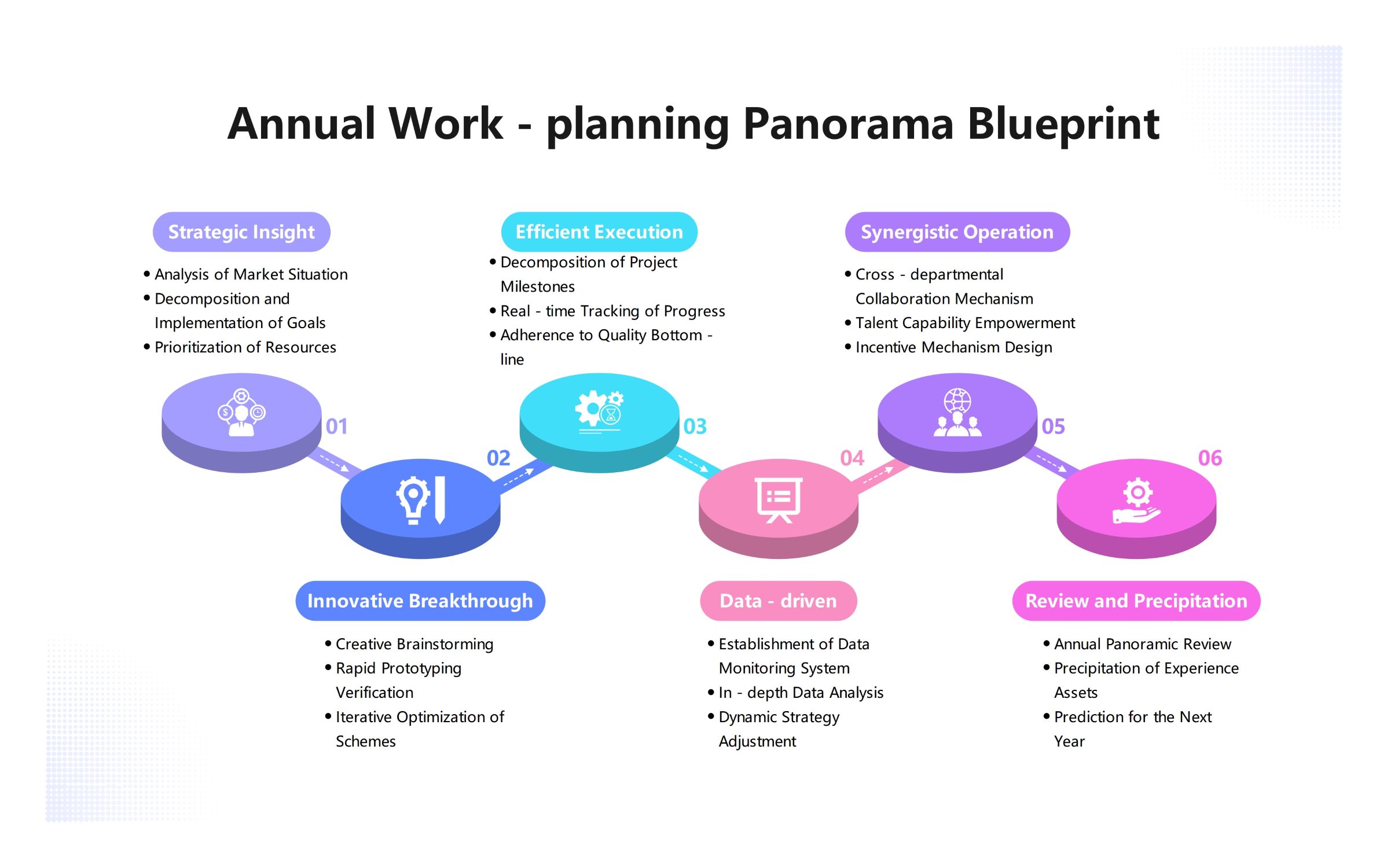
This template provides a structured six-step workflow to guide your organization from initial market analysis to final yearly reviews. It is designed to foster innovation, execution efficiency, and data-backed decision-making across all departments.
Strategic Insight
This foundational phase focuses on understanding the external market and internal capabilities. Leaders analyze current situations to decompose high-level goals into actionable tasks while ensuring that limited resources are prioritized for the highest impact.
- Analysis of Market Situation
- Decomposition and Implementation of Goals
- Prioritization of Resources
Innovative Breakthrough
Innovation keeps a company competitive by encouraging fresh ideas and rapid testing. This section guides teams through creative brainstorming and prototyping to verify concepts quickly before moving into iterative optimization for the most effective schemes.
- Creative Brainstorming
- Rapid Prototyping Verification
- Iterative Optimization of Schemes
Efficient Execution
Execution turns plans into reality through disciplined tracking and milestone management. It emphasizes breaking down projects into manageable parts and maintaining a strict quality bottom-line to ensure every deliverable meets the required professional standards.
- Decomposition of Project Milestones
- Real-time Tracking of Progress
- Adherence to Quality Bottom-line
Data-driven
A data-driven approach ensures that decisions are based on evidence rather than intuition. By establishing robust monitoring systems and performing in-depth analysis, organizations can implement dynamic strategy adjustments to stay aligned with changing market trends.
- Establishment of Data Monitoring System
- In-depth Data Analysis
- Dynamic Strategy Adjustment
Synergistic Operation
Success requires unity across different business units and empowered employees. This node highlights the importance of cross-departmental collaboration, enhancing talent capabilities, and designing incentive mechanisms that motivate teams to achieve shared organizational objectives together.
- Cross-departmental Collaboration Mechanism
- Talent Capability Empowerment
- Incentive Mechanism Design
Review and Precipitation
The final stage involves reflecting on the year's performance to capture valuable knowledge. By performing a panoramic review, teams can convert experiences into lasting assets and use these insights to make accurate predictions for next year.
- Annual Panoramic Review
- Precipitation of Experience Assets
- Prediction for the Next Year
FAQs about this Template
-
What is the primary purpose of an annual work planning panoramic blueprint?
The primary purpose is to provide a holistic, 360-degree view of an organization's strategy and operations for the upcoming year. It acts as a bridge between long-term vision and tactical execution. By visualizing every stage from strategic insight to final review, it ensures all departments remain aligned, resources are used efficiently, and progress is measurable against key milestones.
-
How does this template help in cross-departmental collaboration?
This template includes a specific 'Synergistic Operation' phase designed to break down organizational silos. It outlines formal mechanisms for cross-departmental collaboration and emphasizes talent empowerment. By defining how different teams interact and creating shared incentive designs, the blueprint ensures that everyone is working toward the same unified annual goals, which significantly reduces friction and improves overall productivity.
-
Why is 'Precipitation of Experience Assets' a critical step in the planning process?
Precipitation involves capturing and documenting the lessons learned, successes, and failures from the previous year. This step is critical because it prevents the organization from repeating past mistakes and helps standardize best practices. By turning raw experiences into formal 'knowledge assets,' the company builds a stronger foundation for future planning, leading to more accurate predictions and smarter resource allocation.

 (AI & Web)