



Patient flow describes how people move through a healthcare service from arrival or referral to assessment, treatment, transfer, discharge, or follow-up. Mapping that journey can reveal delays and handoff problems.

In this article
Part I: Insights into Patient Flow Charts
A patient flow chart visualizes the administrative and clinical steps a patient moves through, such as registration, assessment, testing, treatment, payment, transfer, and discharge. It helps teams see where handoffs or waits occur.
The AHRQ workflow toolkit recommends defining the process, identifying its participants, arranging steps and handoffs, and reviewing the chart with people who perform the work.
A patient-flow chart should show the process boundary, responsible roles, handoffs, waiting points, and decisions. Map the workflow that staff actually perform before proposing changes. Clinical protocols require separate local validation.
A diagram can help staff discuss where delays and unclear ownership occur. It does not by itself establish that care has become faster, safer, or more effective.
Patient Flow Chart Examples and Editable Templates
For other starting points, see the complex flowchart examples and the browser flowchart tutorial.
EdrawMax lets teams edit shapes, connectors, labels, and layouts for a patient-flow diagram. Start with an appropriate template, then replace its roles and decision rules with the workflow used in your facility.
Best Examples of Patient Flow Chart Templates
We have gathered some great examples below that show complex concepts in an easy-to-understand way. These examples will help you understand the concepts better and choose the best one for what you need.

 below.
  below.

Cross-functional hospital flow charts are like maps that help us understand how different departments in a hospital work together. They show the steps and responsibilities of each department in a clear and organized way.
This sample assigns different activities to named departments. Treat those labels as placeholders, not standard healthcare roles. Replace them with the reception, scheduling, registration, nursing, or other teams actually involved in your process.
These flow charts are important tools that help hospitals run smoothly and provide the best care for patients.
Sequential Hospital Process Flow Chart Template

Healthcare institutions use hospital patient flow charts to understand and improve daily operations and enhance the patient experience. The diagram above shows the steps like making an appointment, getting a prescription, showing test reports, and completing checkout.
This example includes age, eligibility, location, and consultation-format branches. They are specific sample rules, not universal requirements for patient registration. Replace them with your organization’s approved criteria before using the template.
Moreover, patients can go directly to the pharmacy or see a consultant doctor first. Depending on their condition, they may also need to visit the lab or get a prescription from another doctor. When the check-up is done, the patient receives a report.
Healthcare Patient Flow Chart Template

When hospitals have too many unnecessary tasks or processes, it wastes resources, delays medical care, and slows down how many patients can be helped. But now, with electronic records instead of paper, it's easier for doctors to have all the information they need when treating patients.
The diagram illustrates an emergency-related workflow. Its paths must not be treated as general instructions for assessing or treating a patient. Use it only as a visual template and have the responsible clinical team confirm the local protocol.
When adapting this example, label responsibility, transfer points, and communication steps. Clinical assessment, treatment, and transport decisions belong to the approved local protocol rather than an AI-generated rule.
Procedural Patient Flow Chart in Clinic Template

Patient flow charts in clinics can help make the patient flow smoother, improve how the clinic is managed, and organize the order in which patients are seen. It's also a way to save time for patients and their families.
In the patient flowchart above, the process starts when the patient arrives at the reception desk. They check if the patient has already registered, and if so, they can go ahead with treatment. Then, the receptionist checks if a nurse is available. If there is, the nurse examines the patient's medical condition and sends the report to the doctor.
If the doctor is available, they look at the medical report and make a decision. For example, if the patient's condition is serious, they might recommend a follow-up appointment. They might also write a prescription and ask the patient to leave.
Flow Chart of Patient in Hospital Template

To make sure everything runs smoothly in a healthcare facility, all departments need to understand how patients move through the process and what improvements can be made. By using a patient flow chart in the hospital, everyone can see and understand how patients are taken care of and what to do in emergencies.
The patient flow diagram above shows the whole process of how a patient is looked after, treated, and released from the healthcare center. First, the patient provides their personal, medical, and financial information for the treatment. The reception staff checks their medical history, and then they go to the consultation room where the doctor examines them.
The template then branches to further services or the end of the visit. Treat its clinical decisions as example content; the responsible clinical team must replace them with the facility’s approved pathway.
How to Create a Patient Flow Chart in EdrawMax
The manual method below uses an existing EdrawMax template. Use the AI method when you have a written operational workflow, then review the draft against the actual process.
Draft an outpatient check-in workflow with AI
Use EdrawMax V16 to turn a documented workflow into a first-pass diagram, then refine it through the Agent conversation. Start with a clearly bounded operational process. The example below covers appointment verification and registration; it does not prescribe diagnosis, treatment, or clinical triage decisions.
Step 1 Describe the local check-in process
Confirm the start, end, responsible roles, handoffs, and exception routes with the staff who perform the work. Use fictional examples or an approved workflow description without patient-identifying information.
Step 2 Generate a diagram from the description
Open the desktop AI/Agent flowchart workflow and enter:
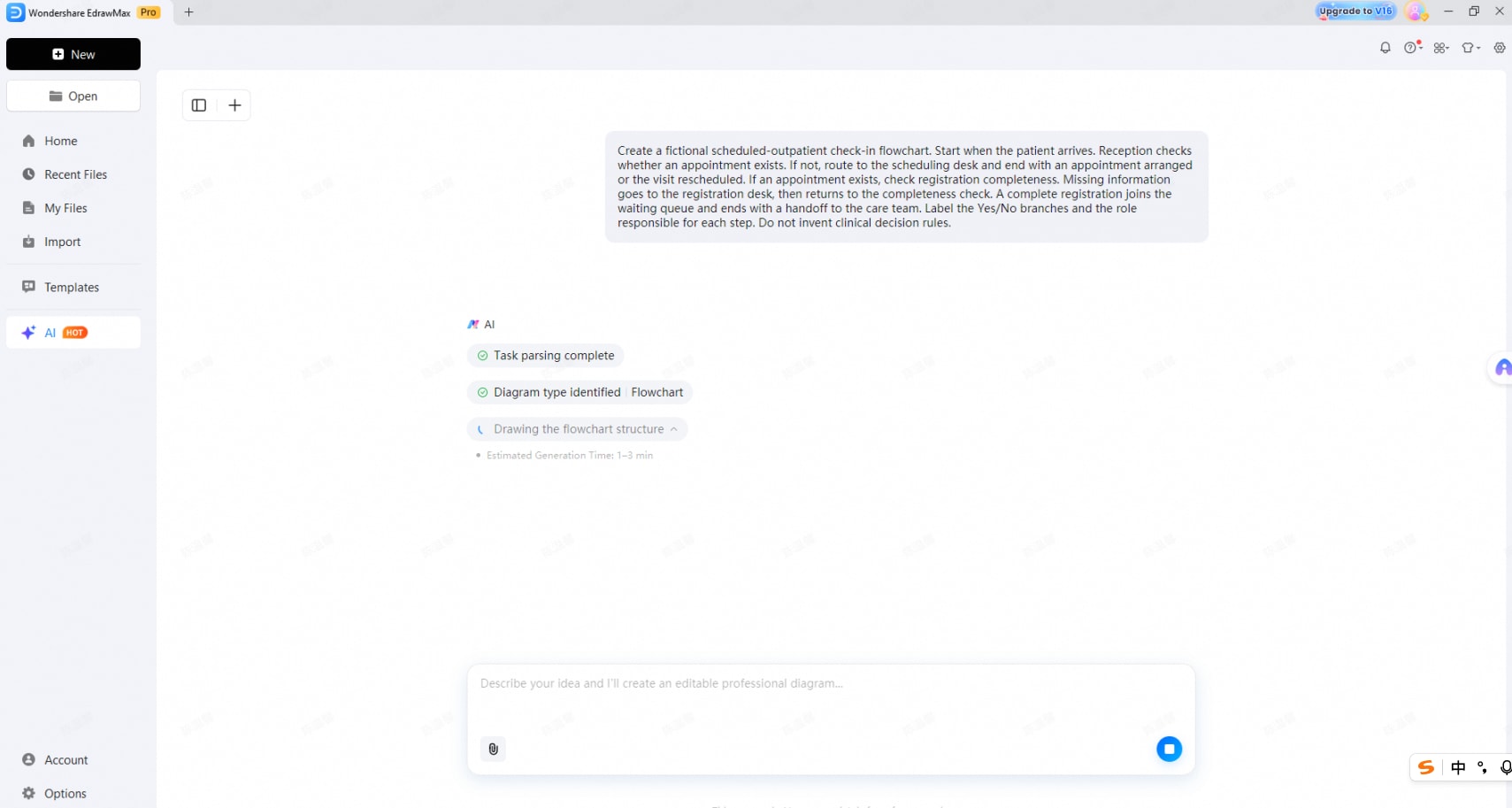
Example prompt: Create a fictional scheduled-outpatient check-in flowchart. Start when the patient arrives. Reception checks whether an appointment exists. If not, route to the scheduling desk and end with an appointment arranged or the visit rescheduled. If an appointment exists, check registration completeness. Missing information goes to the registration desk, then returns to the completeness check. A complete registration joins the waiting queue and ends with a handoff to the care team. Label the Yes/No branches and the role responsible for each step. Do not invent clinical decision rules.
Step 3 Add an exception through a follow-up prompt
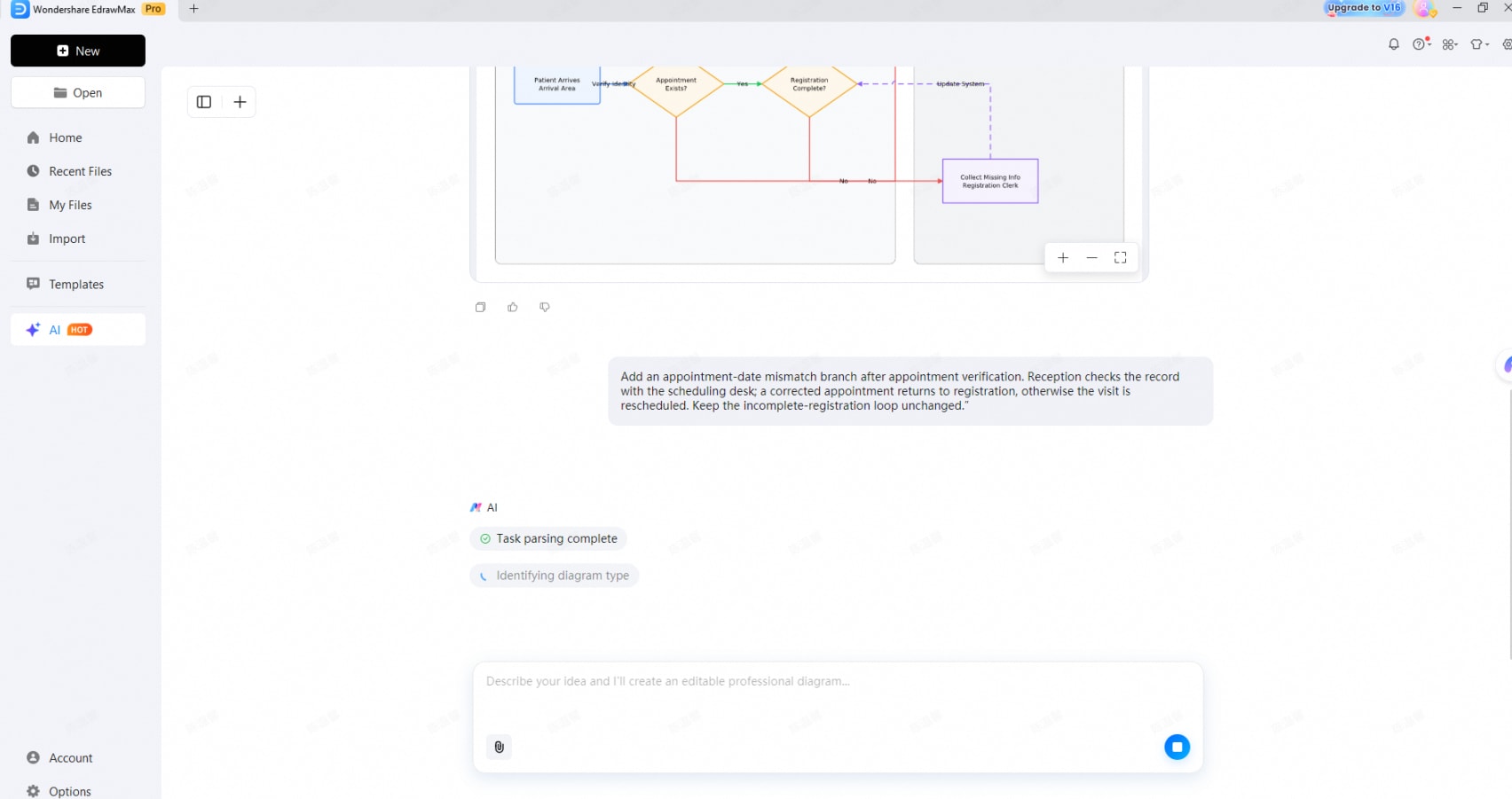
Ask “Add an appointment-date mismatch branch after appointment verification. Reception checks the record with the scheduling desk; a corrected appointment returns to registration, otherwise the visit is rescheduled. Keep the incomplete-registration loop unchanged.” Check that the correction route returns to the correct step instead of bypassing registration.
Step 4 Review the operational logic with the team
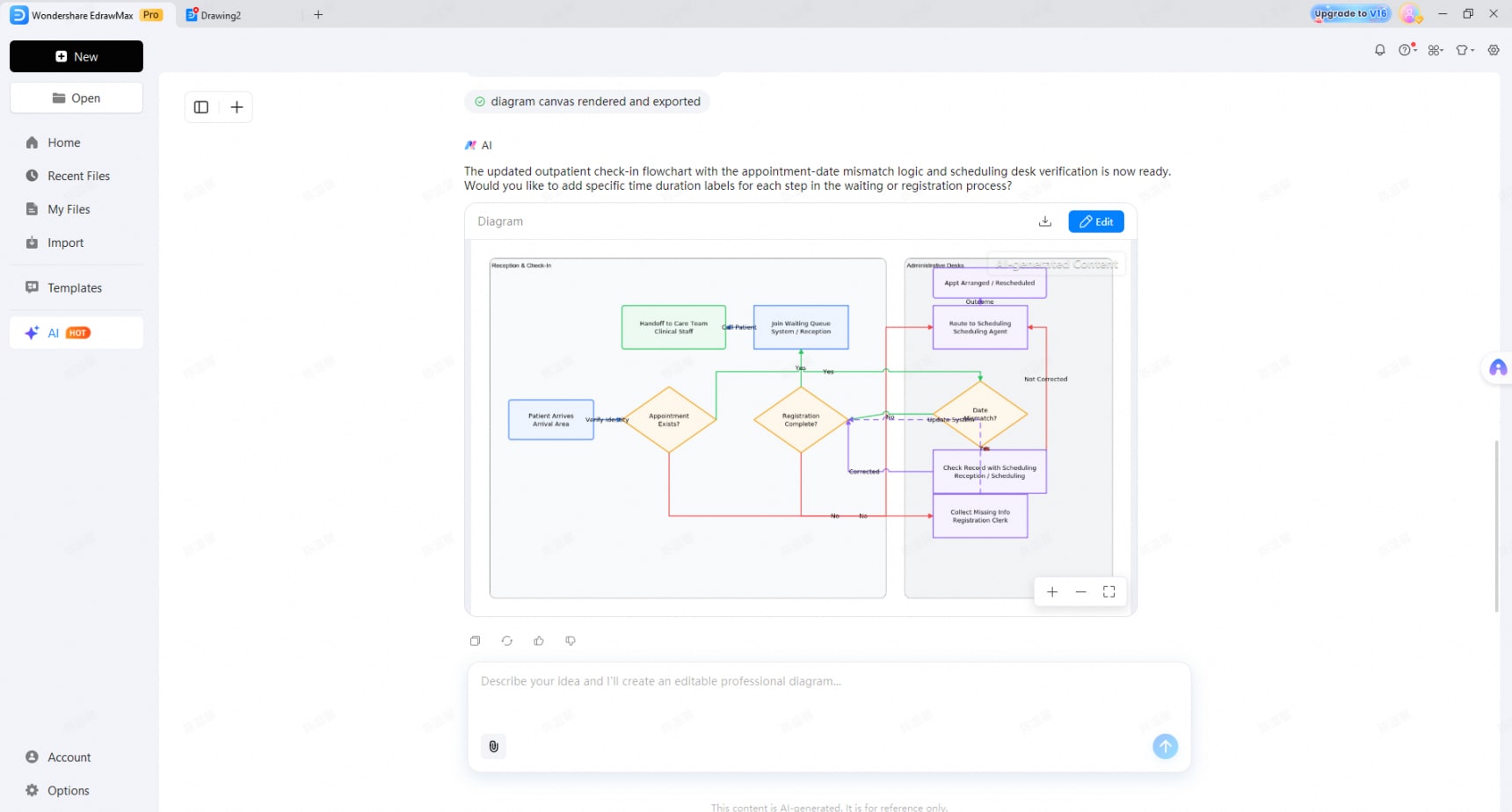
The expected draft has distinct scheduling and registration exceptions, one waiting-queue entry, and a clear care-team handoff. This is illustrative logic, not a tested AI output or a clinical protocol. Walk through the chart with reception, scheduling, and care-team representatives, correct the paths, then edit and export it in EdrawMax.
Consult the AI Flowchart guide for interface details. If you need a general introduction to AI generation, use the AI method in the flowchart tutorial.

Manual method: adapt an existing patient-flow template
Step1
Initiate your hospital flow chart creation by launching the "EdrawMax" application.
Step2
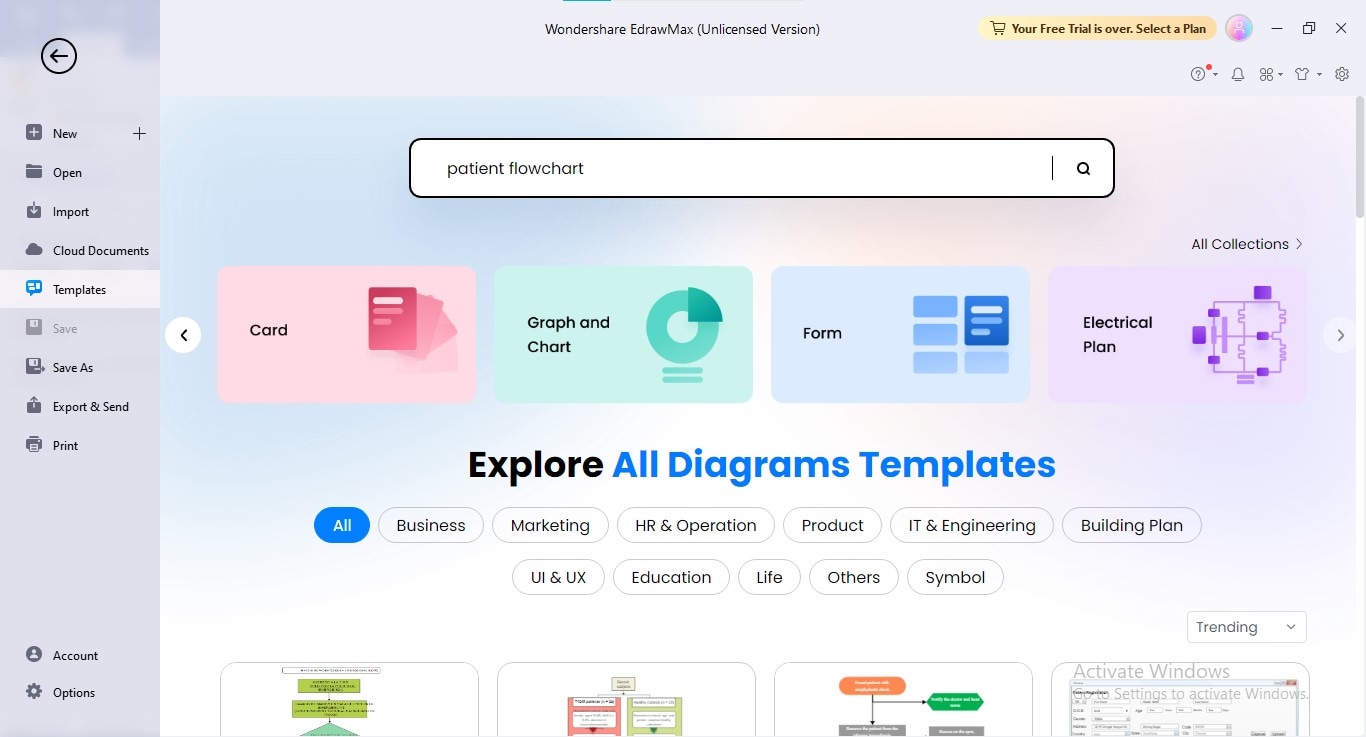
Navigate to the "Templates" option, type "Patient Flowchart" in the search bar, and advance with your desired template.
Step3
After opening an appropriate template, modify it according to your requirements by adding or removing shapes.
Step4
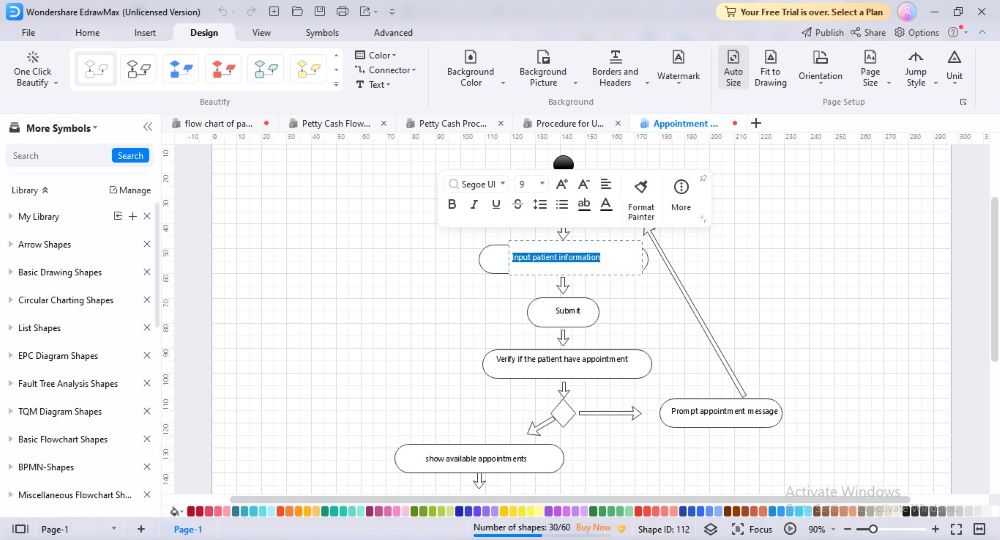
To customize the patient flow chart template, edit its information; to add a custom text, double-click a shape and enter your text.
Step5
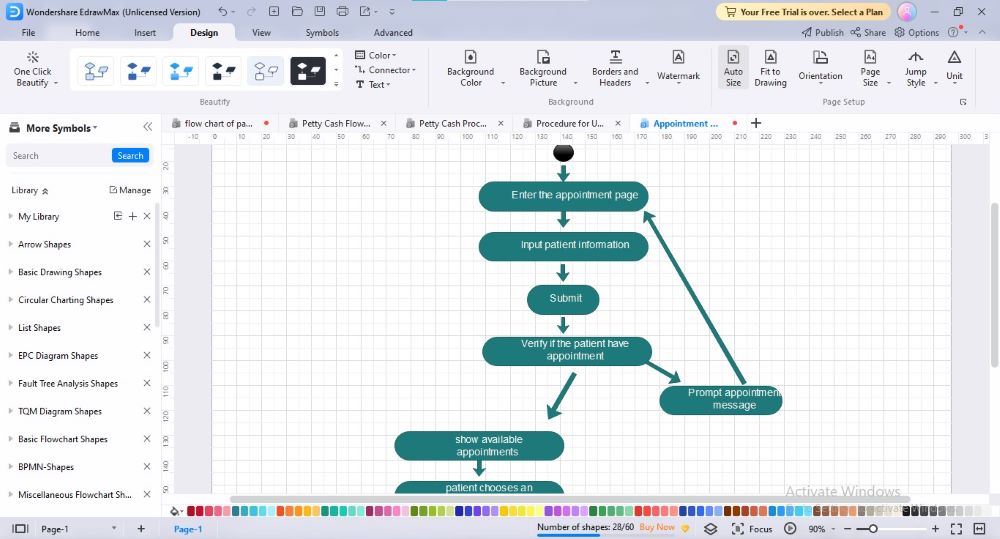
If you want to modify the appearance of your hospital flowchart, navigate to the "Design" tab in the main menu, and choose your favorite theme, color combo, font, connector style, & background.
Step6
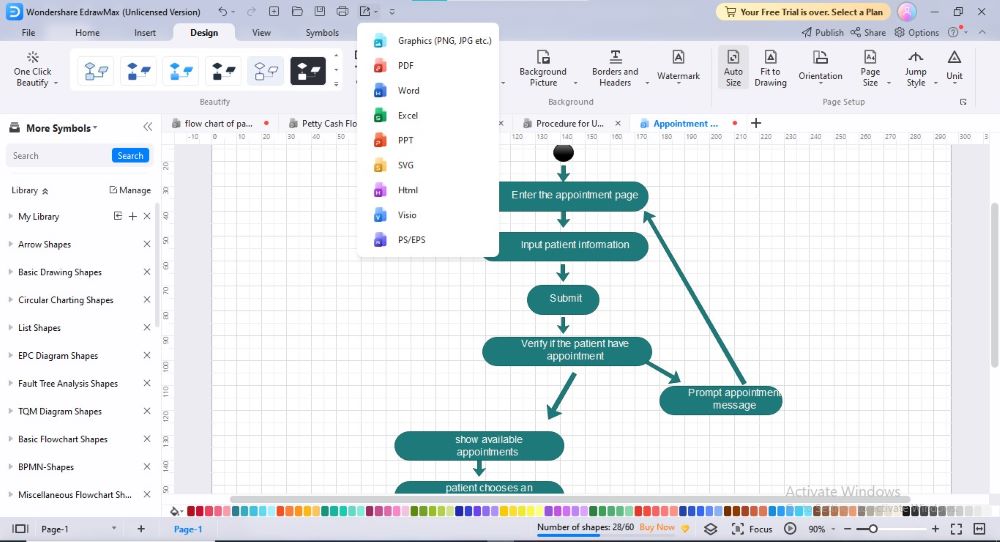
Navigate to "Export" at the top of the page to save the patient flow diagram in your preferred format.
Frequently Asked Questions
-
Which measures can I use alongside a patient-flow chart?
Choose measures that fit the process boundary. Examples include waiting or transfer delays, available capacity, occupancy, and inpatient length of stay. Annotate where each measure is collected rather than assuming the diagram itself supplies the data. IHI’s hospital-wide patient-flow guidance discusses system-level measures.
-
Is an operational patient-flow chart a clinical pathway?
No. An operational chart mainly documents movement, responsibility, queues, and handoffs. A clinical pathway addresses care for a defined condition or patient group and needs appropriate clinical governance. Do not treat template branches or generated diagram text as approved care instructions.
Conclusion
A patient-flow chart is most useful when it makes ownership, queues, handoffs, and major decisions visible. Use the examples as a starting point, then validate the actual local workflow before implementation.
AI Diagram Generator
Enter your prompt. Upload files if needed. Generate diagrams, charts, or slides instantly.





 (AI & Web)