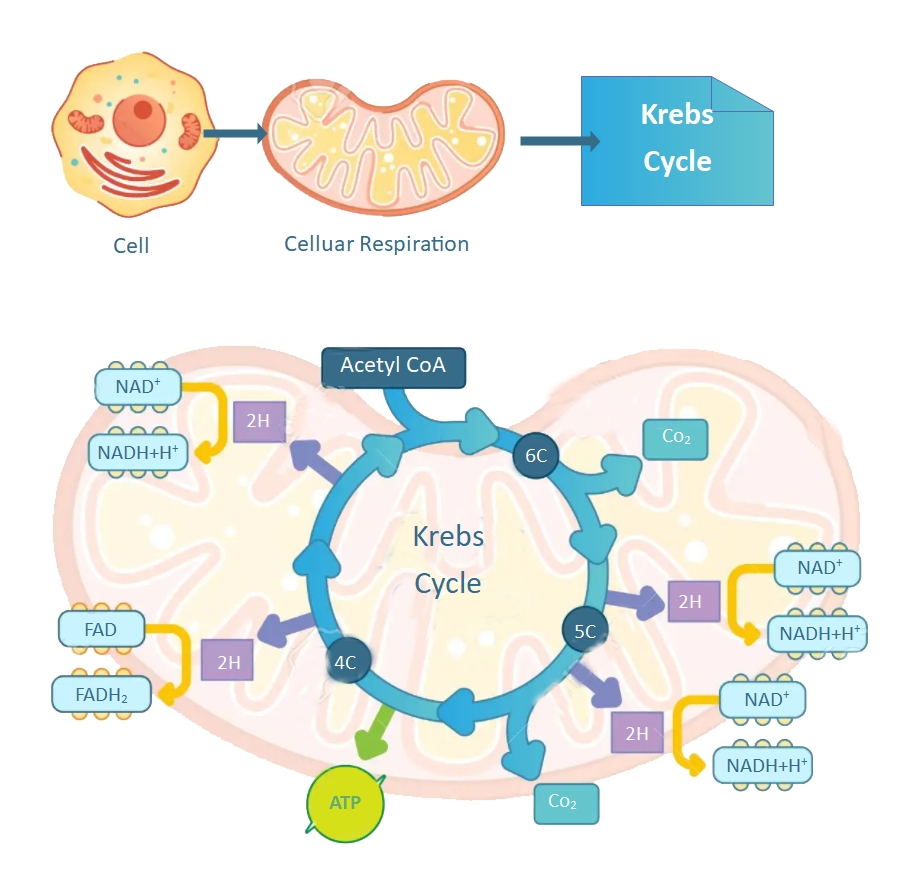
About this Krebs cycle diagram template
This template offers a detailed visual representation of the Citric Acid Cycle. It helps learners identify key chemical reactions and energy outputs. Educators can use this diagram to simplify the complex steps of cellular metabolism for their students effectively.
Acetyl CoA Entry
The cycle starts when Acetyl CoA enters the mitochondrial matrix. It joins with a four-carbon molecule to create a six-carbon compound called citrate. This initial step is vital for triggering the series of energy-releasing chemical reactions.
- Acetyl CoA input
- Mitochondrial matrix location
- Formation of 6C Citrate
Carbon Loss and NADH Production
In this phase, the molecules lose carbon atoms which are released as carbon dioxide. This process generates high-energy electrons that are captured by NAD+ to form NADH. These carriers are crucial for the final energy production stage.
- Carbon Dioxide release
- Reduction of NAD+ to NADH
- Transition from 6C to 5C and 4C
Energy Harvest and Regeneration
During the final stages, the cycle produces ATP for immediate cellular use. It also creates FADH2 and more NADH by transferring hydrogen atoms. Finally, the starting four-carbon molecule is regenerated to allow the entire cycle to repeat.
- Direct ATP production
- FAD reduction to FADH2
- Regeneration of oxaloacetate
FAQs about this Template
-
What is the main purpose of the Krebs cycle?
The primary goal of the Krebs cycle is to harvest high-energy electrons from carbon-based fuels. These electrons are then carried by molecules like NADH and FADH2 to the electron transport chain. Although it produces a small amount of ATP directly, its most important role is powering the system that creates most of the cell's energy.
-
Where does the Krebs cycle occur in the cell?
The Krebs cycle takes place within the mitochondrial matrix of eukaryotic cells. The mitochondria are often called the powerhouses of the cell because they host these critical energy-producing reactions. By keeping the cycle inside this specific compartment, the cell can efficiently manage the chemical reactions and transport the resulting electron carriers.
-
Why is the Krebs cycle called a cycle?
It is called a cycle because the starting material is regenerated at the end of the process. The four-carbon molecule, oxaloacetate, combines with Acetyl CoA to begin the sequence. After several chemical transformations and energy releases, the molecule returns to its original four-carbon form, allowing the entire process to repeat continuously.

 (AI & Web)