Multimeter symbols
Get a clear picture of common multimeter symbols to make accurate measurements.
- Templates
- Circuit diagram templates
- Multimeter symbols
About these multimeter symbols
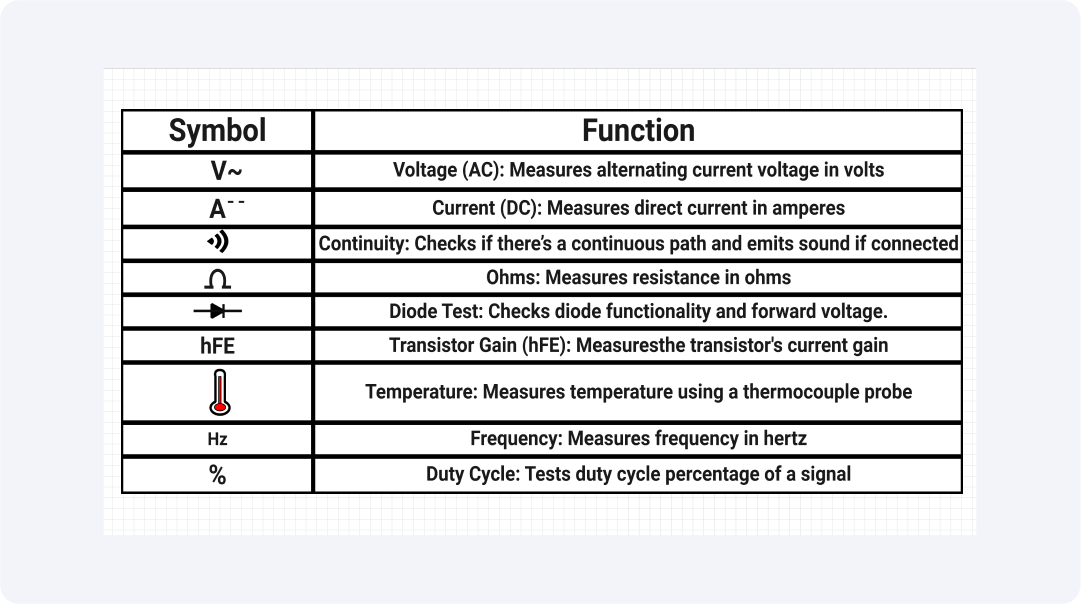
Multimeter is one of the tools every practitioner who deals with electrical circuits should have as it helps measure voltage, current, and resistance. One could call it a voltmeter, ammeter, and ohmmeter all in one. It is very versatile. It is vital to know the multimeter's symbols. This helps to measure correctly and avoid risks.
Some of the symbols found on a multimeter include 'V', for voltage; accompanied by a straight line for the DC voltage and a wave line for the AC voltage. Another is the current symbol which is a straight line (A) for direct current or a wavy line(A) for an alternating current. These symbols let users quickly learn the settings for their measurements.
The resistance measurement symbol is the omega symbol (Ω). When this symbol is selected, the multimeter measures resistance within the circuit. This is crucial for checking component values. The continuity symbol, displaying arcs, allows users to verify if a certain circuit is complete and operational.
Other useful symbols include the diode test symbol in the form of a triangle pointing at a line. These symbols allow the users to check the service and functioning of diodes and capacitors in order to determine whether or not they are fine. Learning these symbols allows users to use the multimeter for other electrical purposes most efficiently.
Voltage (AC)
This is a symbol for ac voltage. It is used to measure the voltage across an electrical circuit in volts with respect to the potential difference across the outlets, wiring or the devices.
Current (DC)
This symbol is used to measure DC current flow. It is labeled in amperes (A), representing the intensity of the current passing in a circuit.
Continuity
The continuity symbols check if a circuit path has been made. It produces an audible signal which is a beep if the circuit is connected with no interruptions.
Ohms
The ohms symbol measures the resistance across the circuit. It is expressed in ohms, which demonstrate how much a specific component opposes electric current.
Diode test
This tests diode directionality. It measures the drop off in voltage connection that tells whether current runs in one direction only.
Transistor gain
The hFE symbol defines how much signal strength the transistor amplifies.
Temperature
This symbol is used to measure temperature in Celsius scale or Fahrenheit by using an external probe thermometer.
Frequency
It measures the rate of oscillation in hertz (Hz). This reading helps quantify how frequently an AC signal oscillates per second.
Duty cycle
This symbol calculates time that a signal is high in relation to time that is low in a cycle.
Related templates
Get started with EdrawMax today
Create 210 types of diagrams online for free.
Free Download Free Download Draw a diagram free Draw a diagram free Draw a diagram free (AI & Web)