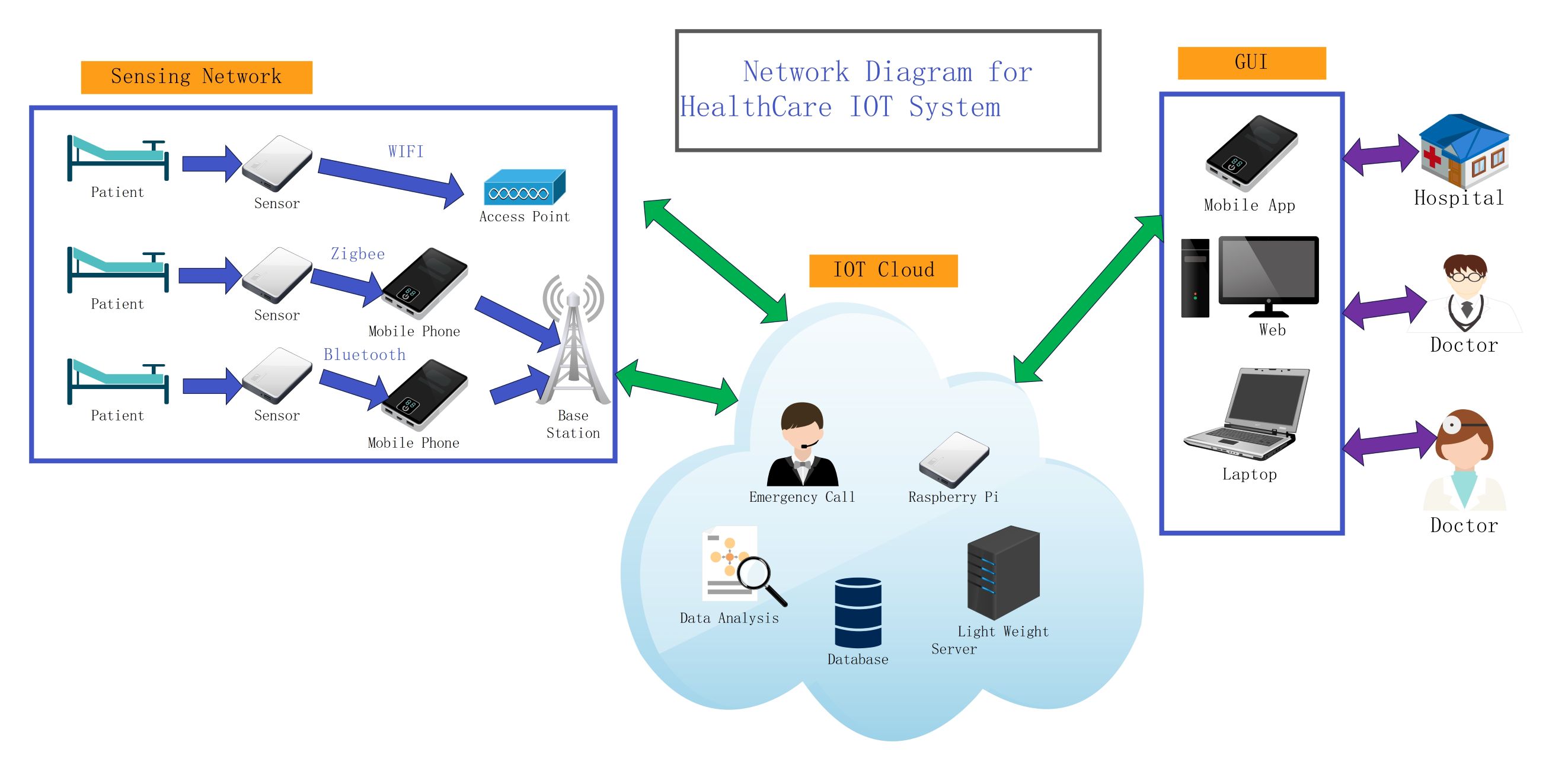
About this Network Diagram for Healthcare IOT System template
This template outlines a comprehensive IoT architecture tailored for medical environments. It visualizes the flow of patient data through sensors, cloud processing, and user interfaces. Use it to design or analyze complex smart healthcare networks efficiently.
Sensing Network
The sensing network captures vital health data directly from patients using various sensors. These devices use wireless protocols to send information to gateways. This stage is critical for ensuring accurate data collection at the source.
- Patient Sensors
- WIFI Connectivity
- Zigbee Protocol
- Bluetooth Connection
- Access Point
- Mobile Phone Gateways
- Base Station
IOT Cloud
The IOT cloud acts as the central processing hub for the entire system. It stores patient records, performs data analysis, and manages emergency calls. This layer ensures that raw data becomes useful information for medical professionals.
- Emergency Call Services
- Raspberry Pi Processing
- Data Analysis Tools
- Patient Database
- Light Weight Server
GUI and Stakeholders
The GUI section provides the visual interface for different users to access the health data. Hospitals and doctors use these applications to monitor patients remotely. This interface bridges the gap between digital data and clinical action.
- Mobile Application
- Web Portal
- Laptop Interface
- Hospital Management
- Medical Doctors
FAQs about this Template
-
What are the main benefits of using IoT in a healthcare network?
Implementing IoT in healthcare networks significantly improves patient outcomes by enabling continuous, real-time monitoring of vital signs. This technology allows for early detection of potential health issues, leading to faster medical interventions. Furthermore, it reduces the overall cost of care by minimizing hospital readmissions and streamlining administrative tasks for medical staff through automated data collection.
-
Which wireless protocols are best for healthcare IoT sensors?
The choice of protocol depends on the specific needs of the medical device. Bluetooth is ideal for low-power, short-range connections like wearable heart monitors. Zigbee offers a reliable mesh network for multiple sensors in a hospital room. WIFI is best for high-bandwidth data transmission where power consumption is less of a concern, such as video monitoring systems.
-
How does the cloud layer protect sensitive patient data?
The cloud layer protects patient information through advanced encryption and strict access controls. It uses lightweight servers and databases designed to handle encrypted medical records securely. Additionally, the system can trigger automated emergency calls if the data analysis detects an anomaly. This ensures that privacy is maintained while providing critical health alerts to the necessary hospital staff and doctors.

 (AI & Web)