Basic electric symbols
Learn the common basic electric symbols to make accurate measurements.
- Templates
- Circuit diagram templates
- Basic electric symbols
About these basic electric symbols
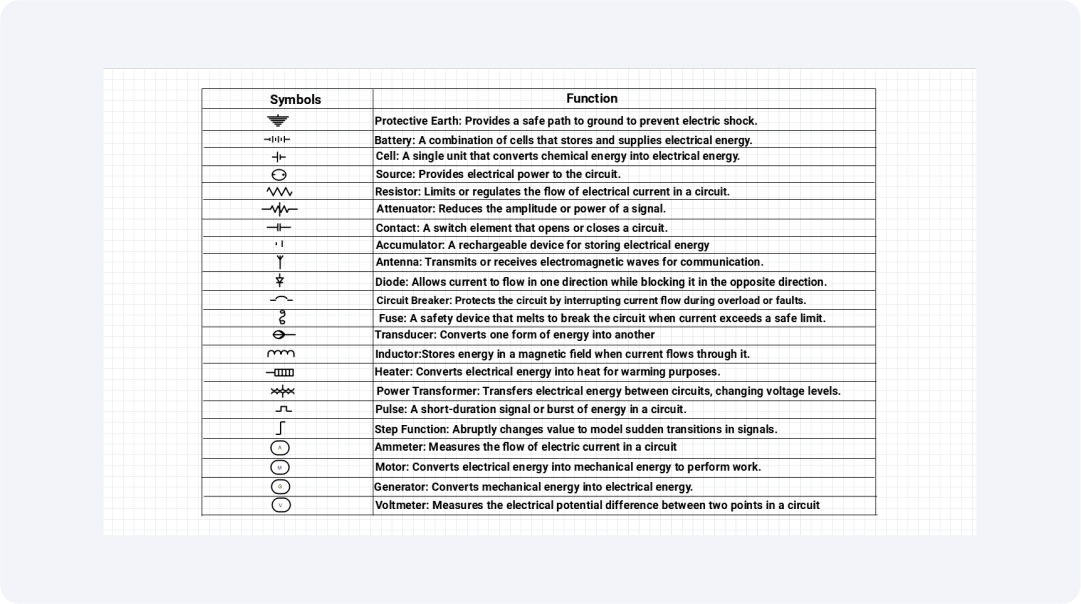
All of these symbols symbolize different parts that have got critical uses in electrical circuits whereby engineers and technicians apply their efforts to design, analyze, and fix circuits.
This starts with symbols that include the protective earth which is a safety aspect of a circuit that directs the flow of electrical current to the ground in the case of abnormality. It also has symbols related to batteries and cells, these are the elements that deliver electrical energy in circuits, and supply power to most devices.
These include resistors and attenuators in the form of shading components to synchronize and manage the current in the devices to foster safety as well as efficiency. Accumulators that act as electrical energy storage are also distinguished since they are used in backup power as well as in energy storage.
Coils are incorporated with the ability to transmit and receive electromagnetic waves hence useful in any communication technology. This gives more detail about the diodes used in devices that allow current flow in only one direction and are usually used in rectification processes and control of signals in circuits.
These circuit breakers and fuses are safety devices presented in the table; which act to control and break the circuit if there is a likelihood of its damage due to excessive current, or other faults. Transformers are still another, converting energy from one form to another, as in the microphone, which transforms sound into electricity.
Other components include heaters, which use electrical energy to produce heat for uses such as heater devices as well as in industrial processes. Power transformers are also shown because they utilize electrical energy to step up or down between transformer circuits used for the transmission and distribution of electricity.
The symbols for measuring instruments like ammeters and voltmeters, which measure current and voltage, respectively, are essential for monitoring and troubleshooting circuits. It also includes symbols for motors and generators, which convert energy between electrical and mechanical forms, powering devices or generating electricity in various applications. Understanding these symbols helps in designing and analyzing electrical systems more effectively.
Let's take a look at a few important basic electric symbols:
Protective Earth
This symbol offers a controlled render for current to pass to the ground hence no electric shocks and equipment is protected from faults.
Battery
This type of symbol is made up of a combination of cells and shifts electrical energy to light up circuits and devices, being able to act as a temporary or standby source of power.
Cell
Type of symbol which is a single unit and used to convert the chemical energy into electrical energy.
Source
This symbol supplies electrical power to the circuit either constantly or variably.
Resistor
This symbol either reduces or controls the amount of current passing through a circuit and affords voltage protection to elements in the circuit.
Attenuator
This symbol is used for lowering the amplitude or power of a signal; it is often used in many communication systems and audio devices.
Contact
This type works as a switching component to give a path or deny an electrical circuit, thus controlling current circulation.
Accumulator
This symbol conserves electrical energy for future use, more commonly in the form of storage cells which are rechargeable.
Antenna
This symbol uses or disseminates electromagnetic waves, thus allowing wireless transmission and signal-integrated circuits.
Diode
This symbol permits flow in one direction only, does not permit reverse current, and is used in rectification and signal control.
Fuse
This symbol safeguards circuits from extreme currents to prevent damage to the circuitry in the occurrence of an overload or fault.
Transducer
An electronic symbol that actively changes one form of energy to another such as sound to electrical or the other way round.
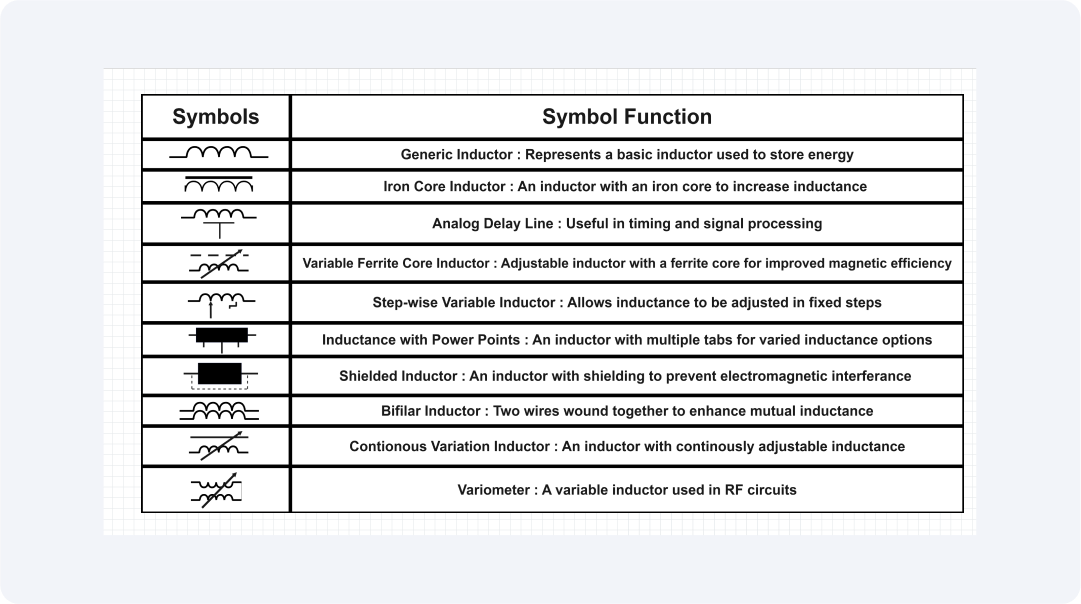
Inductor
This symbol possesses the ability to store energy in its magnetic field which is used in filters, transformers, and energy storage circuits.
Heater
An electronic symbol that heats from electrical energy such as toasters, ovens, heating machines, and so on.
Power transformer
This symbol transforms electrical energy from one circuit voltage level to another more suitable voltage level for distribution.
Pulse
This symbol is an elementary pulse or short energy package that is applied in timing, communication, and control systems.
Step function
This symbol of the step function either makes the output active or inactive. It produces 0 for inputs less than the threshold and 1 for inputs which are equal to or higher than the threshold.
Ammeter
This symbol measures the amount of electric charges that are flowing through a circuit at any one time, measured in amperes.
Motor
This symbol converts electricity into rotary motion and movements into interacting with machines and devices.
Generator
This symbol converts mechanical energy into electric energy to provide energy to different services.
Voltmeter
This symbol measures the current occurring between two points in a circuit involving electrical charge shifting between two points known as voltage, shown in volts.
Related templates
Get started with EdrawMax today
Create 210 types of diagrams online for free.
Free Download Free Download Draw a diagram free Draw a diagram free Draw a diagram free (AI & Web)