




You’ve probably heard of Genghis Khan. He’s one of the world’s greatest leaders or emperors.
He is the first Emperor of the Mongol Empire, which basically united the scattered tribes of Mongolia into a powerful force in Asia.
Genghis Khan is one of those leaders who changed the course of history. The Mongol Empire under his leadership influenced culture and was a major trading powerhouse during the 12th to 14th centuries.
While his accolades and achievements are easy to appreciate, a closer look at the history that followed him is where he truly shines. Through his descendants, the Mongol Empire remained strong for hundreds of years.
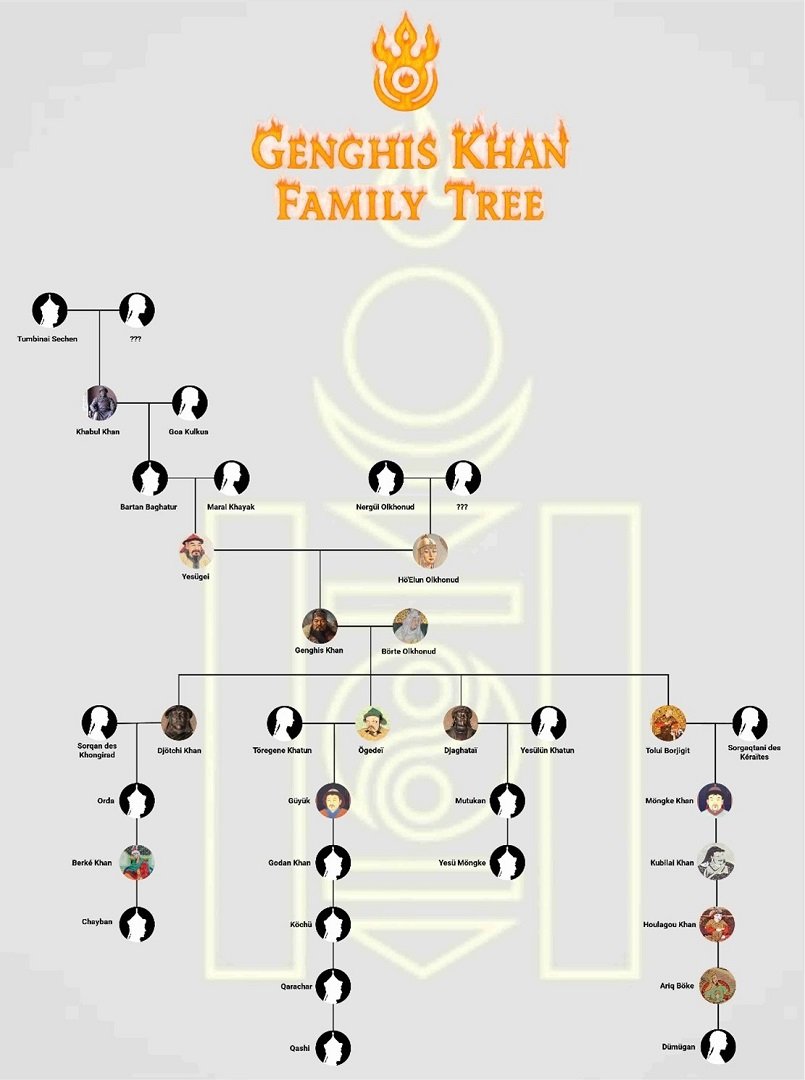


If you’re curious about Genghis Khan’s family tree and the major achievements of notable descendants, read through this article. You’ll take a crash course in a major part of Mongolia’s history.
In this article
The Origins of Genghis Khan
Genghis Khan was born around 1162 in a clan located near the Onon River of present-day Mongolia. His name was actually Temüjin. Historians claim that the name originated from a captured Tatar warrior.
Early Life
His parents are nobles of sorts. His father, Yesügei, led a small Mongol clan, while his mother, Hoelun, came from the Olkhunut tribe. However, his father faced a tragic end when his enemies poisoned him.
After his father’s death, they were abandoned by their own clan. Due to this, her mother struggled to feed him and her children. The family primarily survived through hunting and gathering to survive the brutal winters of the steppes.
It is said that the difficult years Genghis Khan faced in his youth shaped much of his character and strength. He learned the value of unity and loyalty, from which he formed alliances with other tribes, slowly and surely.
Rebuilding His Family’s Position
The 20-30-year-old Temüjin focused on rebuilding his family’s position. He sought alliances with neighboring tribes and relied on his charisma rather than on his bloodline alone.
His first ally was Toghrul, a Kereit leader who had been a friend of his father, followed by Jamukha, a childhood companion who would later become his rival.
Through these strategic alliances, Genghis Khan gradually united the fragmented Mongol tribes under his rule.
The Rise of the Mongol Empire
Genghis Khan stood out because of his fairness and merit-based system. Even individuals coming from poor families were able to rise above their stations and prove themselves worthy of service to Genghis Khan.
Such a rise was likewise marked by bloodshed and violence against clans that refused to submit to Genghis Khan’s power.
By 1206, after years of battle and shifting alliances, he was able to proclaim himself Genghis Khan, meaning “universal ruler,” during a kurultai, or a grand assembly of all the tribe leaders.
Genghis Khan’s Wives and Children
Genghis Khan wouldn’t have been able to rise without the help of marriage. During his time, marriage was a political tool that Genghis Khan utilized to strengthen his ties with major tribes.
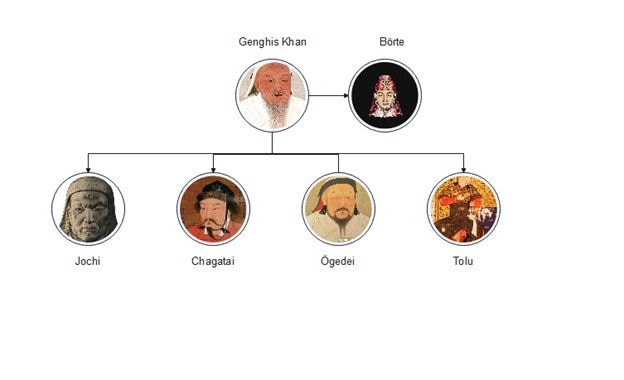
His first and chief wife was Börte, whom he married when she was around sixteen years old. She came from the Khongirad tribe. This union basically placed the tribe under the Mongol’s reign.
Beyond Börte, Genghis Khan had several other wives and concubines, many of whom were from tribes that had joined the Mongols through either alliance or conquest. These marriages often ensured peace and loyalty between groups.
The Children
Most notable are the children of Genghis Khan with Börte, from whom he had four sons, Jochi, Chagatai, Ögedei, and Tolu, and several daughters. All of them were able to govern large tracts of the Mongol Empire’s territory.
Ögedei, Genghis Khan’s third son, was chosen as his successor. After his father’s death, Ögedei became the Great Khan and expanded the empire further into Eastern Europe and China, while Tolu, the youngest, served as regent after his passing.
Historians and genealogists claim that a significant portion of Mongolia’s present-day population is somehow related to Genghis Khan, who was known for his prolific breeding and his sons’ similar reproductive habits.
Genghis Khan’s Dynasty and Expansion
When Genghis Khan died in 1227, the Mongol Empire was already one of the largest in history. But what’s even more remarkable is that it didn’t fall apart after his death. Instead, it continued to grow.
Before his passing, Genghis Khan divided his empire among his four sons, while naming Ögedei, his third son, as his official successor.
This way, every son had their share of land but still owed loyalty to the Great Khan—the supreme ruler of all Mongols.
Ögedei Khan and the Expansion West
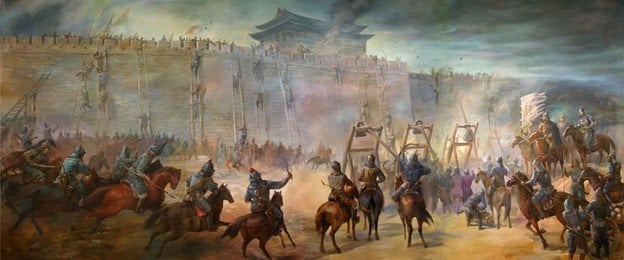
After Genghis Khan’s death, Ögedei Khan became the Great Khan and continued his father’s vision of conquest. Under his rule, the Mongols pushed westward, invading parts of Eastern Europe.
His armies captured vast territories, extending the empire deep into Eastern Europe. Ögedei also strengthened Mongol rule in China by finishing the conquest of the Jin Dynasty.
To manage this growing power, he built Karakorum, the first capital of the Mongol Empire. It became a symbol of Mongol unity and a center of trade, politics, and culture.
Jochi and the Golden Horde
Jochi, Genghis Khan’s eldest son, was granted control over the westernmost parts of the empire. However, he died before his father, leaving his lands to his descendants.
His son, Batu Khan, founded what would later be known as the Golden Horde. This branch ruled over Russia, Ukraine, and parts of Eastern Europe.
The Golden Horde became one of the most powerful Mongol states, influencing politics and trade in the region for centuries. Russian princes paid tribute to them, and their rule shaped the future of Eastern Europe.
Chagatai and Central Asia
The second son, Chagatai, inherited Central Asia. His territories included modern-day Uzbekistan, Kazakhstan, and western China. The Chagatai Khanate became known for preserving Genghis Khan’s laws, known as the Yassa.
Chagatai’s descendants ruled for several generations, balancing nomadic Mongol practices with the more settled lifestyle of Central Asia’s cities.
This mix of cultures made the region a key trade route between East and West.
Tolui and His Powerful Descendants
Tolui, Genghis Khan’s youngest son, acted as regent after his father’s death and played a big role. Though he didn’t form his own khanate during his lifetime, his descendants became some of the most influential Mongol rulers in history.
Tolui’s son Möngke became the Great Khan, continuing to oversee the vast Mongol territories. Another son, Kublai Khan, established the Yuan Dynasty in China, the first foreign dynasty to rule the entire country.
Meanwhile, Hulagu Khan, another of Tolui’s sons, led campaigns in the Middle East and founded the Ilkhanate in Persia, which ruled over Iran, Iraq, and parts of Turkey.
How To Make a Similar Timeline With EdrawMax
By using a family tree, you now have a different approach to studying the Mongol Empire’s history. Since Genghis Khan was such a pivotal character in Asian history, it’s great to trace his family and their respective achievements.
You’ll need a tool to create timelines. For this, you need a reliable diagramming app with a ton of features to help you focus on what matters: research and learning.
Wondershare EdrawMax and Key Features
With EdrawMax, creating a Genghis Khan family tree becomes incredibly simple and flexible. For starters, it’s an all-in-one diagramming tool that helps users design not only timelines but also flowcharts, trees, and other visual representations.
To get you better acquainted with the tool, here are some of its key features:
- Expansive diagram support. Aside from family trees, you can also check out around 280+ diagram types supported by EdrawMax and see what fits your study of history best.
- Templates gallery. EdrawMax also has 1,500+ built-in templates that you can enjoy, with around 30,000+ more in its user-powered Templates Gallery, where you can likewise upload your works.
- AI features. EdrawMind offers several AI features, ranging from diagram generation to copywriting and OCR, as well as other helpful tools, including a built-in AI chatbot.
- Cross-platform access. Lastly, the best part about EdrawMax is that it has cross-platform compatibility and cloud access that lets you create your family tree on iOS, Mac, Linux, Windows, or the web.
How To Make a Genghis Khan Family Tree in EdrawMax
Now, follow the steps below to begin using Wondershare EdrawMax for your family tree creation:
Step1
Download, install, and launch EdrawMax—login with your Wondershare, Google, Facebook, Apple, or X (formerly Twitter) account.
 Get 500 free AI tokens
Step2
Go to Home > Organization and Chart > Family Tree, then create a Blank Drawing or select any of the templates.

Step3
Drag any of the shapes from the Symbols panel to the canvas. Arrange it according to the general structure of your family tree.

Step4
Then, connect each of the shapes you’ve dragged to each other. You can use the Connector tool or drag the blue/red buttons around each shape to the desired node.

Step5
Next, label the nodes with the names of each person in the tree. You can do this by using the Text tool.
- Some nodes allow you to type directly. In that case, double-click them and type away.

Step6
Customize the family tree. Here, it would be best to add relevant images, change the appearance of shapes, edit the text fonts, or add backgrounds to design it accordingly.

Step7
Lastly, export your family tree.

Conclusion
Genghis Khan is one of the most important figures in history. Thus, learning his family tree is an interesting approach to the history of the Mongol Empire and of his legacy.
Mapping out his family tree helps make sense of how his influence spread across Eurasia. You can do this by annotating as much information as you can into the family tree.
So, if you want to create your own version of Genghis Khan’s family tree, try out EdrawMax. As you’ve seen above, it’s simple to use and offers just the right features for informative study sessions.
AI Diagram Generator
Enter your prompt. Upload files if needed. Generate diagrams, charts, or slides instantly.