



Isaac Newton wasn’t your average kid. He was born in 1643 and grew up asking “why” about almost everything! That curiosity led him to discover the law of gravity, study light and color, and invent calculus. His discoveries changed science forever.
He even made a special telescope and wrote Principia Mathematica, a book that explained how the universe moves. Let's take a closer look at the major moments in his life and see how it all happened in order.
In this article
Sir Isaac Newton Timeline
Isaac Newton’s story is full of curiosity and amazing discoveries. Most people know him as the man who discovered gravity, but there’s so much more to him! He was born in 1643 and loved learning about how the world works. His ideas changed science forever.
The apple story is just one part of his life. Newton also invented calculus, studied light and colors, and built the first reflecting telescope. He showed that great things come from asking questions, working hard, and never giving up. Let’s explore his exciting life and what made him so special.
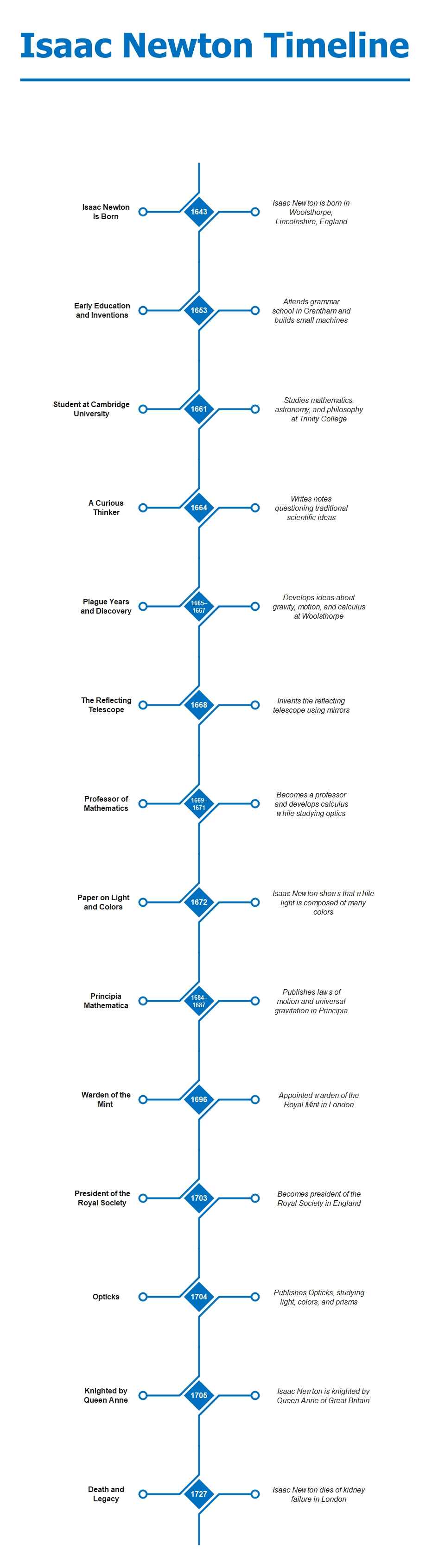


Isaac Newton was Born (1643)
Isaac Newton was born on January 4, 1643, in Woolsthorpe, Lincolnshire, England. His father, also called Isaac, had died before he was born. His mother, Hannah Ayacough, remarried and sent him to live with his grandmother. He was a quiet child who enjoyed thinking alone. These early years helped form his curious and independent mind.
Early Education and Inventions (1653)
Newton returned to live with his mother after his stepfather's death. She wanted him to run the family farm, but he disliked it. He went to grammar school in Grantham. There, he showed talent for building small machines, such as clocks and windmills. His teachers noticed his sharp mind and love for learning.
Student at Cambridge University (1661)
Newton joined Trinity College, Cambridge, at the age of 18. Europe was all through the Scientific Revolution. Newton read Aristotle, but was soon interested in emerging scientific concepts of Copernicus, Kepler, and Galileo. He studied astronomy, philosophy, and mathematics. These years were the basis of his future findings in motion and gravity.
A Curious Thinker (1664)
During his studies, Newton created some notes which he named Quaestiones Quaedam Philosophicae (Certain Philosophical Questions). He put it in writing that Plato is my friend, Aristotle is my friend, but truth is my best friend. He adored such thinkers as René Descartes and Robert Boyle. His ideas showed he was ready to challenge old beliefs about nature and science.
Plague Years and Discovery (1665-1667)
In 1665, Newton graduated with a bachelor’s degree. A few months later, the Great Plague had to close Cambridge. He went back to Woolsthorpe. It was during this silent period that he worked on mathematics, light, and motion. He came up with ideas about gravity and calculus. These two years were the most creative of his life.
The Reflecting Telescope (1668)
In 1668, Newton made the reflecting telescope. It used mirrors rather than lenses and depicted sharper images. The design of the telescope was small, but it was powerful. This invention not only brought him fame in the scientific circles, but also proved his talent in theory and practical invention.
Professor of Mathematics (1669-1671)
Newton joined the faculty at Trinity College. He composed De Analysi per Aequationes Numero Terminorum Infinitas: (On Analysis by Equations with an Infinite Number of Terms), the foundations of calculus. His techniques were referred to as fluxions. He also delivered lectures on optics (the behavior of light and color) during these years.
Paper on Light and Colors (1672)
Newton sent a paper on light and colors to the Royal Society. He demonstrated that a white light consists of numerous colors. His work was applauded by some scientists, but some of them, such as Robert Hooke, criticized it. Offended by the reaction, Newton became more private and did not want to argue with people for many years.
Principia Mathematica (1684-1687)
In 1684, astronomer Edmond Halley asked Newton about the motion of the planets. Newton sent him a short paper called De Motu. He has extended it to his master book Philosophiae Naturalis Principia Mathematica (1687). It described his laws of motion and universal gravitation. The Principia Mathematica was considered one of the most significant works in modern science.
Warden of the Mint (1696)
In 1696, Newton moved to London to work as a warden of the mint. He later became master of the mint. He controlled the minting of the English money, and he punished the counterfeiters. Well, he was a scientist, but he did not take this government position lightly and contributed to the improvement of the currency system in the country.
Royal Society President (1703)
In 1703, Newton was given the presidency of the Royal Society, the most prominent scientific organization in the UK. He led it for more than 20 years. He directed the society to become more powerful and helped in spreading new scientific information in Europe.
Opticks (1704)
Newton published Opticks in 1704. The book described his works on light, colors, and prisms. It also talked about reflection, refraction, and diffraction. Opticks was a significant contribution to the future scientific community. It proved the brilliance of Newton in terms of his approach to experiments.
Knighted by Queen Anne (1705)
Queen Anne made Newton a knight in 1705. He became Sir Isaac Newton, the first scientist ever to receive this honor. His knighthood showed how highly England valued his discoveries and service.
Death and Legacy (1727)
Isaac Newton passed away on 31st March 1727 in London. He was buried in Westminster Abbey, among England's greatest figures. His concepts about gravity, motion, and light transformed the field of science. Newton can be remembered as one of the most genius minds in the history of mankind.
How to Make a Similar Timeline?
Creating a timeline about a person, country, or event helps you understand how things happened over time. Here’s how to make one step by step:
- Collect background information: Start by finding important facts like names, dates, and major events. Write them down in order.
- Choose a clear structure: Decide how you want your timeline to look: horizontal, vertical, or circular. Pick what fits your topic best.
- Add events and dates: Write each event on your timeline in the order it happened. Use arrows or lines to connect them clearly.
- Include images or icons: Add small pictures or symbols to make your timeline colorful and easy to understand.
- Review, update, and share: Check your dates and details for accuracy, make quick fixes, then save or print your timeline to share.
Steps to Make an Isaac Newton Timeline
 Get 500 free AI tokens
Step1 Start with a Blank Canvas
- Open Wondershare EdrawMax on your computer.
- Sign in or create an account if you don’t have one.
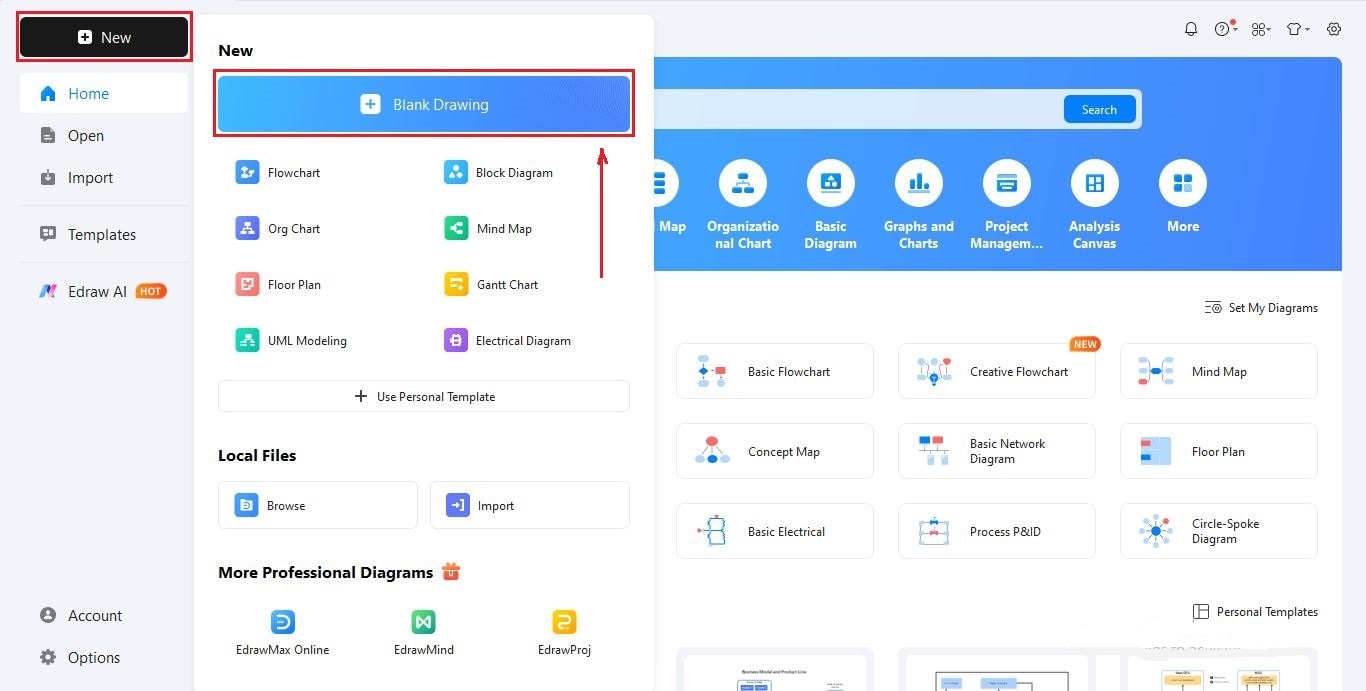
- Go to New > Blank Drawing to start with a fresh canvas for your timeline.
Step2 Add a Title
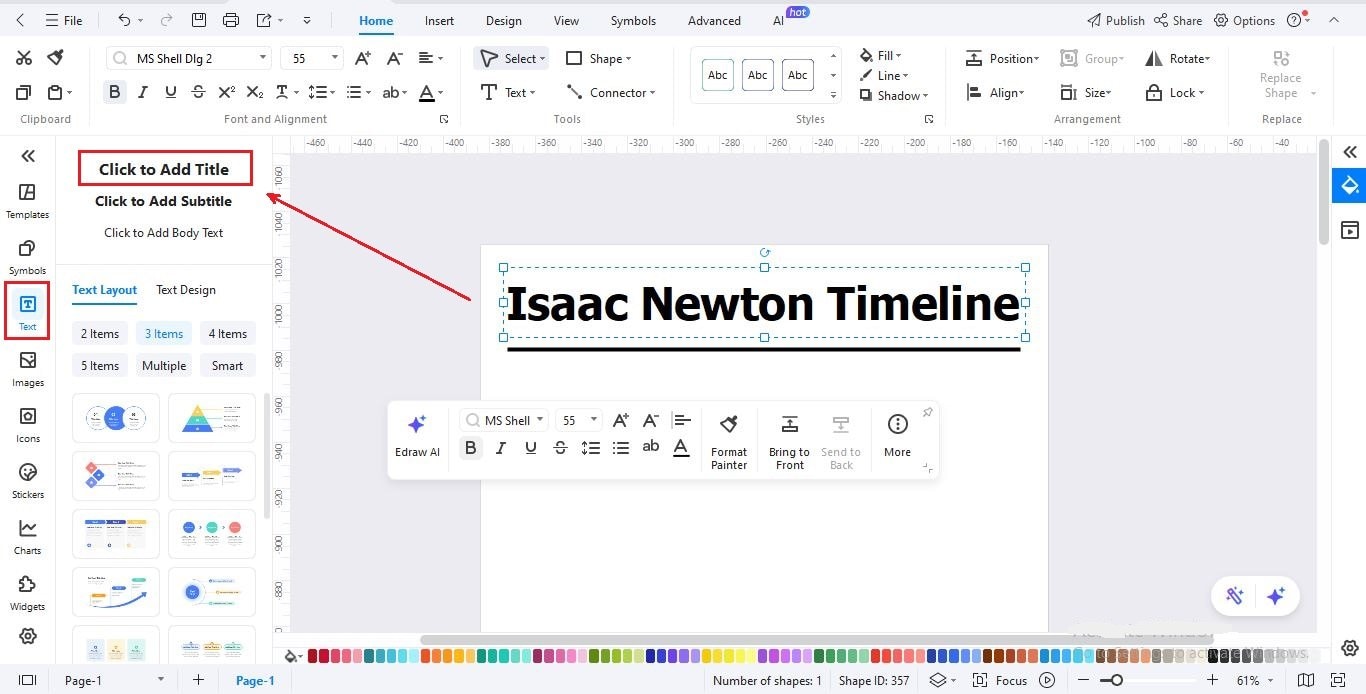
- Add a clear title like “Isaac Newton Timeline” using text.
- Click Text, then Click to Add Title and type your heading.
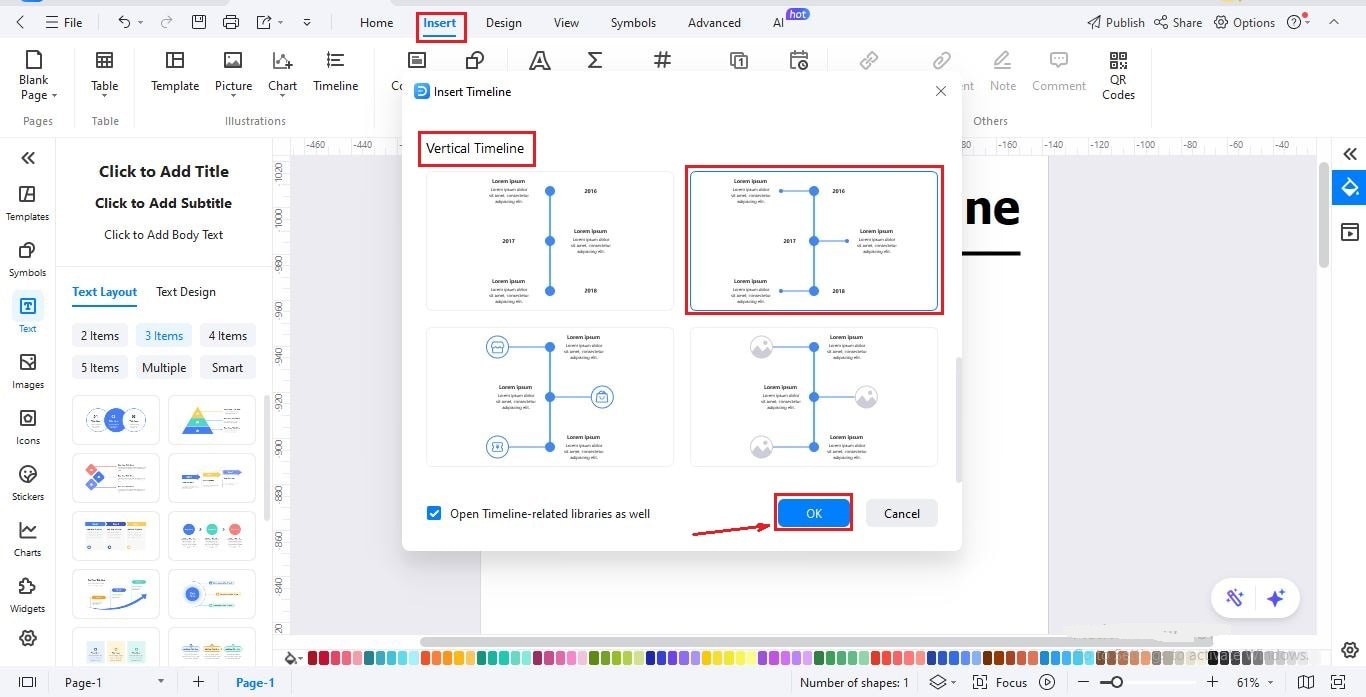
Step3 Insert the Timeline Layout
- Click Insert on the top menu bar.
- Select Timeline > Vertical Timeline, then click OK to add it.
- Resize or adjust it to fit your workspace neatly.
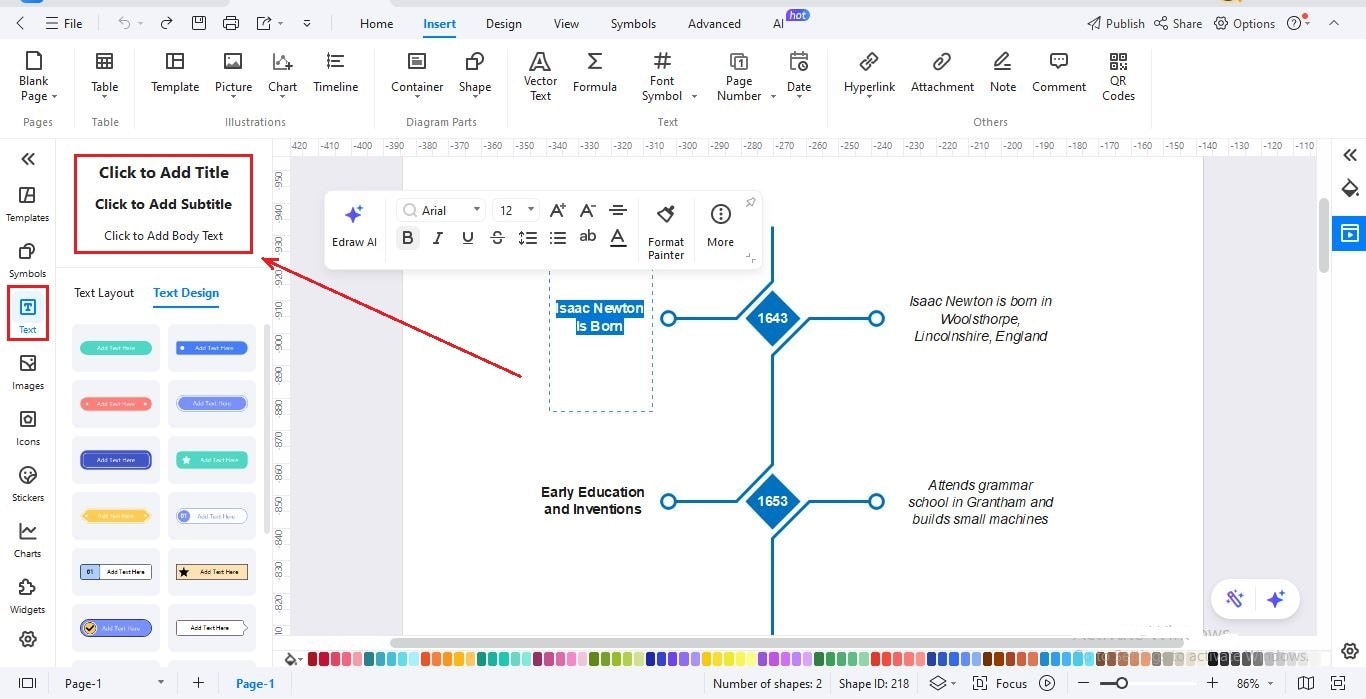
Step4 Add Newton’s Major Life Events
- Click Text on the left editing panel.
- Use Click to Add Subtitle for each era.
- Then use Click to Add Body to add short descriptions of each major event.
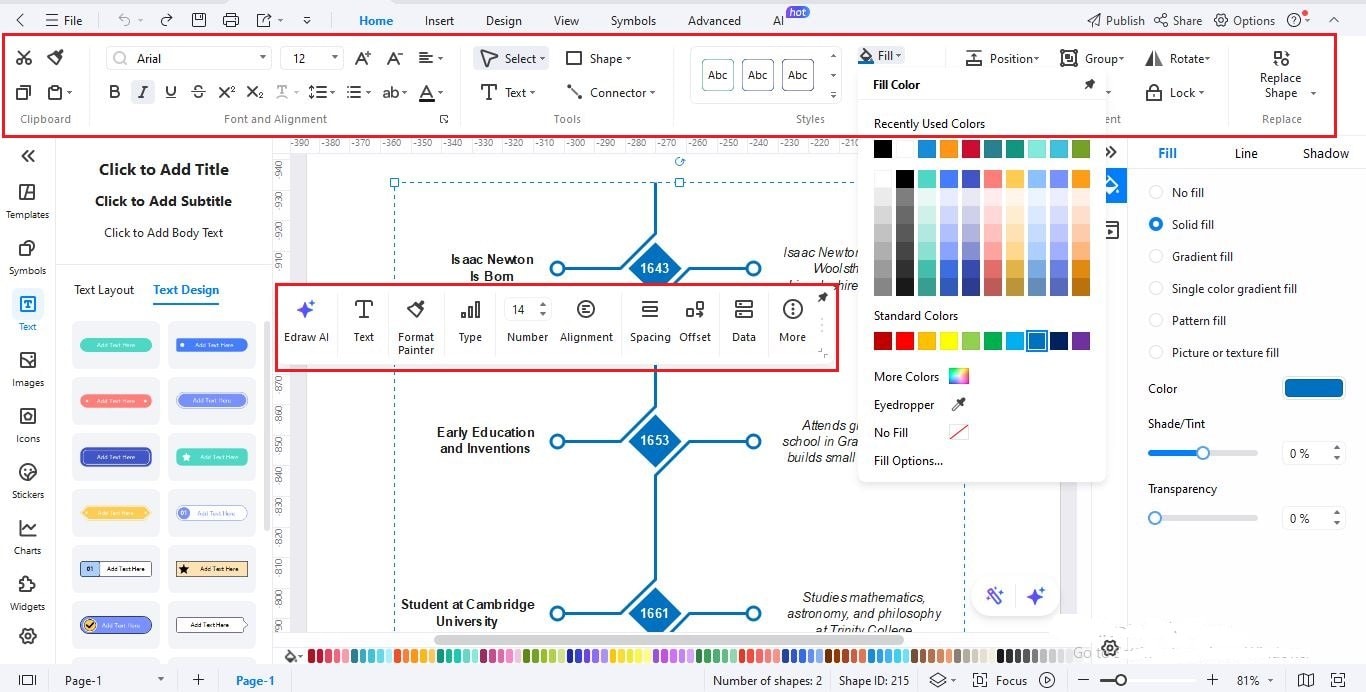
Step5 Customize the Design
- Use the Format panel or top toolbar to change colors, fonts, and shapes.
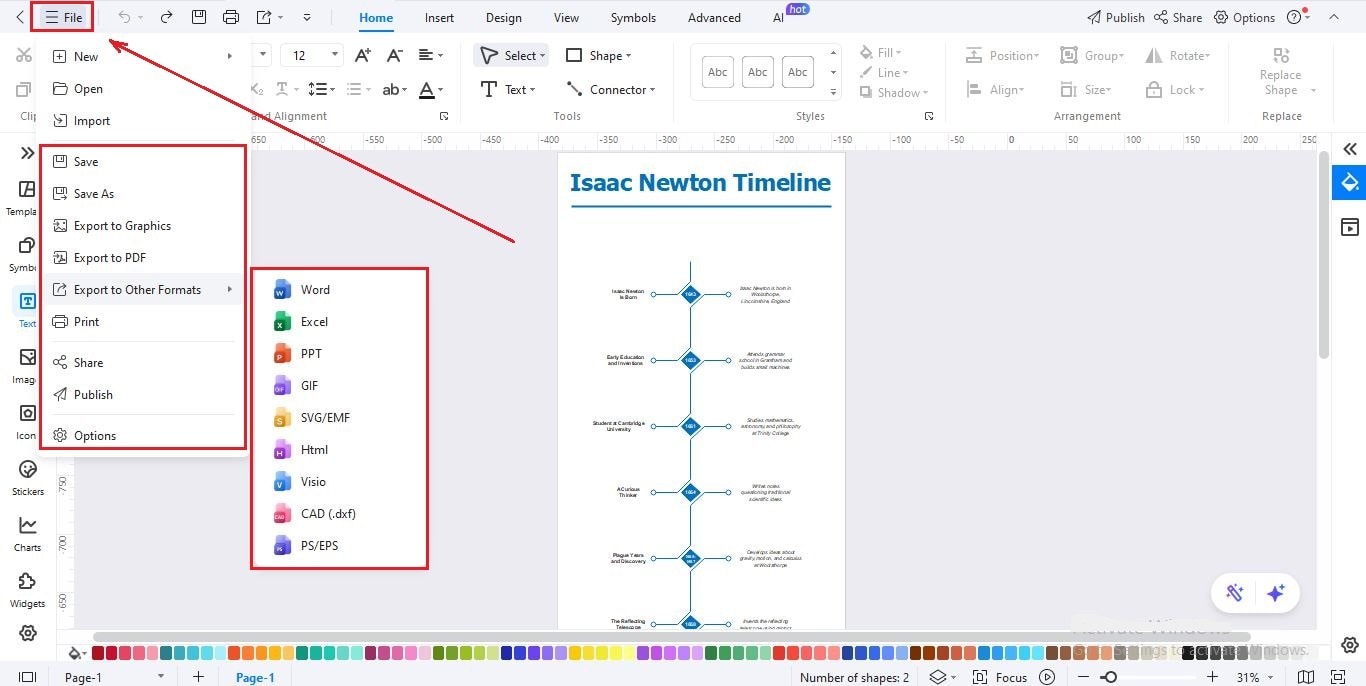
Step6 Save and Export
- Click File > Save to keep your project in EdrawMax format.
- To share, go to File > Export and choose PNG, PDF, SVG, or HTML.
- You can also click Publish to share your finished timeline in the EdrawMax community.
Closure
Isaac Newton’s discoveries shaped how we understand the universe. His work on gravity, motion, and light helped build the foundation of modern science. He proved that with curiosity and determination, one person can truly change the world. Newton’s legacy still inspires people to explore and learn more every day.
If you want to design your own Isaac Newton timeline or any historical timeline, try EdrawMax. It's an online diagramming tool that helps you make professional, creative visuals in just a few clicks!
AI Diagram Generator
Enter your prompt. Upload files if needed. Generate diagrams, charts, or slides instantly.